Question
What is not true of equipotential surface?

Answer

  1. Equipotential surfaces are always spherical.
Explanation:
Equipotential surface
→ P.D difference between two points on the surface is zero always since potential is same everywhere in equipotential surface.
→ The EF is always perpendicular to the surface because there is no potential gradient along any direction parallel to the surface P so no EF parallel to the surface
→ Equipotential surface can have any shape not just sphere.
→ No work is done in moving a charge along the surface, because potential difference is zero.

Need a full question paper?

Generate a complete, print-ready paper with questions like this in minutes — across 16+ boards, with answer keys.
Start Generating Free

Similar questions

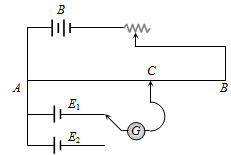
The circuit shown here is used to compare the $\text{e.m.f.}$ of two cells $E _1$ and $E _2\left( E _1> E _2\right)$. The null point is at $C$ when the galvanometer is connected to $E _1$. When the galvanometer is connected to $E _2$, the null point will be
Atomic weight of boron is $10.81$ and it has two isotopeses $5^{8^{10}}$ and $5^{8^{11}}$. Then ratio of $5^{8^{10}}: 5^{8^{11}}$ in nature would be
The motion of planets in the solar system is an example of conservation of (a) Mass (b) Momentum(c) Angular momentum(d) Kinetic energy
       
For nuclei with A > 100:
  1. The binding energy of the nucleus decreases on an average as A increases.
  2. The binding energy per nucleon decreases on an average as A increases.
  3. If the nucleus breaks into two roughly equal parts, energy is released.
  4. If two nuclei fuse to form a bigger nucleus, energy is released.
An oil drop having charge $2 e$ is kept stationary between two parallel horizontal plates $2.0 \ cm$ apart when a potential difference of $12000$ volts is applied between them. If the density of oil is $900 \mathrm{~kg} / \mathrm{m}^3$, the radius of the drop will be
Find the false statement.
The mutual inductance of an induction coil is $5H$. In the primary coil, the current reduces from $5A$ to zero in $10^{-3} s$. What is the induced $emf$ in the secondary coil
The focal length of a concave mirror is 50 cm. Where an object be placed so that its image is two times and inverted(a) 75 cm(b) 72 cm(c) 63 cm(d) 50 cm
       
Consider a simple circuit shown in Fig. stands for a variable resistance $R\ '. R\ '$ can vary from $R_0$ to infinity. $r$ is internal resistance of the battery $(r < < R < < R_0).$
In Fresnel diffraction, if the distance between the disc and the screen is decreased, the intensity of central bright spot will(a) Increase(b) Decrease(c) Remain constant(d) None of these