Question
What is Osmosis? What is Osmotic Pressure? Derive it's formula.

Answer

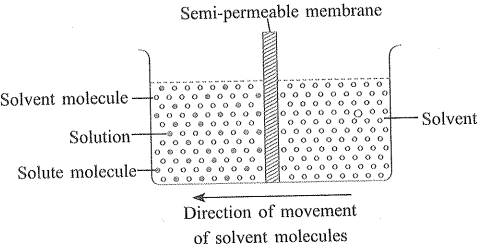
$\rightarrow$ If semi permeable membrane is placed between the solvent and solution as shown fig. the solvent molecules will flow through the membrane from pure solvent to the solution.
This process of flow of the solvent is called osmosis.
Image
$\rightarrow$ The flow will continue till the equilibrium is attained
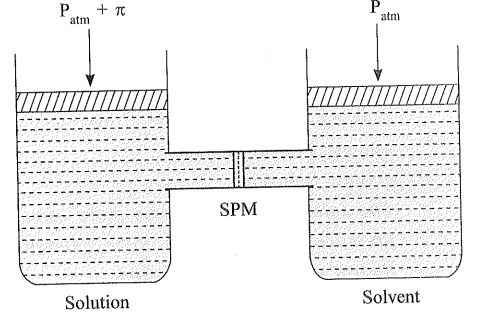
$\rightarrow$ The flow of the solvent from its side to solution side across a semipermeable membrane can be stopped if some extra pressure is applied on the solution.
This pressure that just stops the flow of solvent is called osmotic pressure of the solution.
Image
$\rightarrow$ The osmotic pressure of a solution is the excess pressure that must be applied to a solution to prevent osmosis,
$\rightarrow$ Osmotic pressure is a colligative property as it depends on the number of solute molecules and not on their identity.
$\rightarrow$ osmotic pressure is proportional to the molarity$, C$ of the solution at a given temperature $T$.
$\pi=\text { CRT }$
Where, $\pi=$ Osmotic pressure
$R =$ gas constant
$ \therefore \pi =\frac{n_2 R T}{V} \ \left(\because C=\frac{n_2}{V}\right)$
$\pi =\frac{W_2 R T}{M_2 V}$
$ W _2= Wt . \text { of Solute }$
$M _2=$ Molar mass of Solute 
$V =$ Volume of Solution $(L)$
$T =$ Temperature

Need a full question paper?

Generate a complete, print-ready paper with questions like this in minutes — across 16+ boards, with answer keys.
Start Generating Free

Similar questions

Crystal structure of oxides of transition metals often show defects. Given reason. (2)
Read the following text carefully and answer the questions that follow: Raoult's law states that for a solution of volatile liquids, the partial vapour pressure of each component of the solution is directly proportional to its mole fraction present in solution.
Dalton's law of partial pressure states that the total pressure $(P_{total})$ over the solution phase in the container will be the sum of the partial pressures of the components of the solution and is given as: $P_{total} = P1 + P2$
Image
i. Is the above $-$ mentioned Raoult's law applicable for non $-$ volatile liquids?
ii. What type of deviation from Raoult's law does the above graph represent?
iii. Give an example of such system.
$OR$
iii. A solution of two liquids boils at a temperature more than the boiling point of either of them. What type of deviation will be shown by the solution formed in terms of Raoult's law?
Derive integrated rate equation for first order reaction and also explain how than rate constant can be determine with help of graph.
Write the test by which following are distinguished:
(i) Ethanol and Acetaldehyde
(ii) Phenol and carboxylic acid
(iii) Aldehyde and Ketone
(iv) Formic and Acetic acid
A solution of glucose in water is labelled as 10% w/w, what would be the molality and mole fraction of each component in the solution? If the density of solution is 1.2 g mL-1, then what shall be the molarity of the solution?
Read the following text carefully and answer the questions that follow:
The solutions which boil at a constant temperature like a pure liquid and possess the same composition in liquid, as well as vapour state are called azeotropes. The components of azeotropes cannot be separated by fractional distillation. Only non-ideal solutions form azeotropes. Solutions with negative deviation form maximum boiling azeotrope and the solutions with positive deviation form minimum boiling azeotrope. The boiling point of azeotrope is never equal to the boiling points of any of the components of the azeotrope.
i. The azeotropic solutions of two miscible liquids show what type of deviation from Raoult's law? 
ii. The azeotropic mixture of water & HCI boils at 108.5°C. What type of deviation is shown by the solution?
Does this solution behave as ideal or non-ideal? 
iii. Do ideal solutions form azeotropes?
The rate constant for the first order decomposition of $H_{2}O_{2}$ is given by the following equation: $log~k=14.2-\frac{1.0\times10^{4}K}{T}$. Calculate $E_a$ for this reaction and rate constant k if its half-life period be 200 minute.
( given $R =8.314 J K ^{-1} mol^{-1}$)
Explain giving reasons :
(i) Alcohols are generally soluble in water.
(ii) Phenols boil at higher temperature than arenes of comparable molecular mass.
(iii) The lower homologues of alcohols are soluble in water whereas phenols are slightly soluble in water.
(v) Boiling point of an alcohol is higher than the corresponding alkane.
(vi) The solubility of alcohols in water decreases with increase in molecular mass.
Compare the general characteristics of the first series of the transition metals with those of the second and third series metals in the respective vertical coloumns. Give special emphasis on the following points :
(i) Electronic configurations
(ii) Oxidation states
(iii) Ionisation enthalpies and
(iv) Atomic sizes.
The product formed by the reaction of ethyl alcohol with conc. $H _2 SO _4$ depends on the reaction conditions. Explain this fact using different equations.