Question
Derive integrated rate equation for first order reaction and also explain how than rate constant can be determine with help of graph.
Answer

$\rightarrow$ "First order reaction means that the rate reaction is proportional to the first power the concentration of the reactant$ R$."
$\rightarrow$  For example, consider the following reaction
$R \rightarrow P$
$\rightarrow$ Rate of reaction for this reaction can be expressed as
$ \begin{array}{l} \text { Rate }=-\frac{ d [ R ]}{ dt }= k [ R ] \\ \text { Or } \frac{ d [ R ]}{[ R ]}=- kdt \end{array} $
$\rightarrow$ Integrating this equation, we get
$ \ln [R]=-k t+I .. ..Eq. (1) $
where, $I$ is the constant of integration and its value can be determined easily.
$\rightarrow$ When $t =0, R =[ R ]_0$, where $[ R ]_0$ is the initia concentration of the reactant.
$\rightarrow$ Therefore, equation $(1$) can be written as
$\ln [R]_0=- k \times 0+ I$
$\ln [ R ]_0= I$
$\rightarrow$ Substituting the value of $I$ in equation $(1)$
$\ln [ R ]=- kt +\ln [ R ]_0 \quad \ldots \quad \ldots \text { Eq. (2) }$
$\rightarrow$ Rearranging this equation
$\ln \frac{[ R ]}{[ R ]_0}=- kt$
or $k =\frac{1}{ t } \ln \frac{[ R ]_0}{[ R ]}.... $ Eq. $(3)$
$\rightarrow$ At time $t_1$ from equation $(1)$
$\ln [R]_1=-k t_1+\ln [R]_0 \ldots \ldots$ Eq. $(4)$
At time $t _2$
$\ln [R]_2=- kt _2+\ln [ R ]_0 \ldots \ldots$ Eq. $(5)$
where, $[ R ]_1$ and $[ R ]_2$ are the concentration the reactants at time $t_1$ and $t_2$ respectively.
$\rightarrow \rightarrow \rightarrow$ Subtracting Eq. $(5)$ from $(4)$
$\begin{array}{l} \ln [ R ]_1-\ln [ R ]_2=- kt _1-\left(- kt _2\right) \\ \ln \frac{[ R ]_1}{[ R ]_2}= k \left( t _2- t _1\right) \\ k =\frac{1}{\left( t _2- t _1\right)} \ln \frac{[ R ]_1}{[ R ]_2} \quad \ldots \ldots \text { Eq. (6) }
\end{array}$
$\rightarrow$ So, equation $(2)$ can also be written as
$ \ln \frac{[ R ]}{[ R ]_0}=- kt $
Taking antilog of both the side
$[ R ]=[ R ]_0 e ^{- kt } .. ...$ Eq. $(7)$
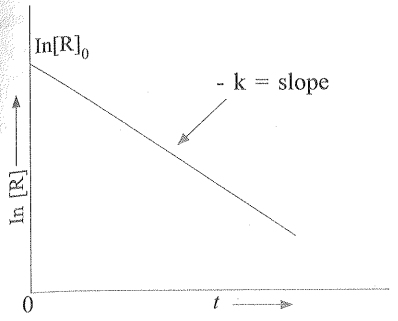
$\rightarrow$ Comparing equation $(2)$ with $y = mx + c$, if we plot $\ln [R]$ against $t,$
we get a straight line with slope $=- k$ and intercept equal to $\ln [ R ]_0$
Image
$\rightarrow$ The first order rate equation $(3)$ can also be written in the form
$k =\frac{2.303}{ t } \log \frac{[ R ]_0}{[ R ]} \quad \ldots \ldots \text { Eq. (8) }$
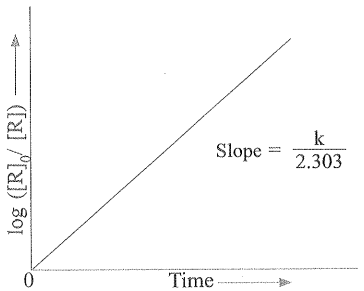
or $\log \frac{[ R ]_0}{[ R ]}=\frac{ kt }{2.303}$
$\rightarrow$ If we plot a graph between $\log \frac{[R]_0}{[R]}$ vs $t$, the slope $=\frac{ k }{2.303}$
Image

Need a full question paper?

Generate a complete, print-ready paper with questions like this in minutes — across 16+ boards, with answer keys.

Start Generating Free

Similar questions

Explain with equations, the nucleophilic addition reaction of aldehydes and ketones with Grignard's reagent (R'-Mg-X).
An organic compound (A) [Molecular formula $\left.C _8 H _{10} O _2\right]$ was hydrolysed with dilute sulphuric acid to give a carboxylic acid (B) and an alcohol (C). Oxidation of (C) with chromic acid produced (B). (C) on dehydration gives but-1-ene.
Write equations for the reactions involved.
(a) Give Reasons -
(i) Monochloro ethanoic acid has a higher P ka value than dichloro ethanoic acid.
(ii) Ketones are less reactive towards nucleophilic addition reaction than aldehydes.
(b) Write short note on aldol condensation
Explain geometrical isomerism in octahedral Complex.
How would you account for the following :
(i) Of the d4 species Cr2+ is strongly reducing while manganese(III) is strongly oxidising.
(ii) Cobalt(III) is stable in aqueous but in the presence of complexing reagents it is easily oxidised.
(iii) The d1 configuration is very unstable in ions.
What is the difference between EMF and Cell potential (potential difference)?
Explain Raoult's Law for volatile solute and Volatile solvent and derive formula for total vapour pressure with graph.
Compare the general characteristics of the first series of the transition metals with those of the second and third series metals in the respective vertical coloumns. Give special emphasis on the following points :
(i) Electronic configurations
(ii) Oxidation states
(iii) Ionisation enthalpies and
(iv) Atomic sizes.
Out of pure liquid and azeotrope showing positive deviation, Which one has a higher boiling point?
Crystal structure of oxides of transition metals often show defects. Given reason. (2)