Question
What is rDNA? Explain the technique of cloning rDNA.

Answer

rDNA is the DNA formed by combining DNAs from two different organisms. In bacterial cell, rDNA can be transferred by using a vector where it multiplies into many copies. These copies are preserved as gene library.
Recombinant DNA technology involves the following steps:
  1. Isolation of DNA.
  2. Fragmentation of DNA by restriction endonucleases.
  3. Isolation of a desired DNA fragment.
  4. Amplification of the gene of interest.
  5. Ligation of the DNA fragment into a vector.
  6. Insertion of recombinant DNA into the host.
  7. Culturing the host cells on a suitable medium at a large scale.
  8. Extraction of the desired gene product.
  9. Downstream processing of the products as finished product, ready for marketing.

Need a full question paper?

Generate a complete, print-ready paper with questions like this in minutes — across 16+ boards, with answer keys.
Start Generating Free

Similar questions

Which methodology is used while sequencing the total DNA from a cell? Explain it in detail.
Define transgenic animals. Explain in detail any four areas where they can be utilised.
Which type of food would have lactic acid bacteria. Discuss their useful application.
Your school’s athletic team along with the athletic teams from different schools reach the venue two days before the inter district school athletic event was to be held. A day before the competition, a team of officials from an agency arrive and ask for blood and urine samples from all the participating athletes.
  1. Would you support or object to this sample collection? Provide explanation to your answer.
  2. Write a note that you would like to read out to your team-mates to explain the purpose of this visit of these officials.
The biology teacher was explaining about restriction enzymes and came to a point explaining that these enzymes are extracted from bacteria and are called as molecular scissors. Varun got curious and asked some questions for more clarity on the concept to his teacher.
  1. From which part of microorganisms are restriction enzymes derived?
  2. Why are restriction enzymes called molecular scissors?
  3. What if some strands are needed to be cut from within. Would that lead to wastage of DNA?
  4. What values are shown by Varun?
Write the sequence of steps involved in the sequencing of genome of an organism.
Read the following and answer any four questions from (i) to (v) given below:

Gene therapy is the technique of genetic engineering to replace a faulty gene by a normal healthy functional gene. It is a way of treating genetic disease by introducing a piece of DNA into the cells of an affected individual. Liposomes can be used for gene therapy as they target the cells affected by a genetic disease.

  1. A patient suffers from adenosine deaminase (ADA) deficiency, an autosomal recessive immune deficiency in which bone marrow lymphoblasts cannot replicate to generate immuno-competent lymphocytes. The treatment option that would cure the patient is:
  1. Germ-line gene therapy to replace one ADA gene copy.
  2. Germ-line gene therapy to replace both ADA gene copies.
  3. Somatic cell gene therapy to replace both ADA gene copies in circulating lymphocytes.
  4. Somatic cell gene therapy to replace one ADA gene copy in bone marrow lymphoblasts.
  1. Which type of gene therapy is least effective in transferring DNA to the nucleus?
  1. Adenoviruses.
  2. DNA attached to a ligand.
  3. Liposomes.
  4. Retroviruses.
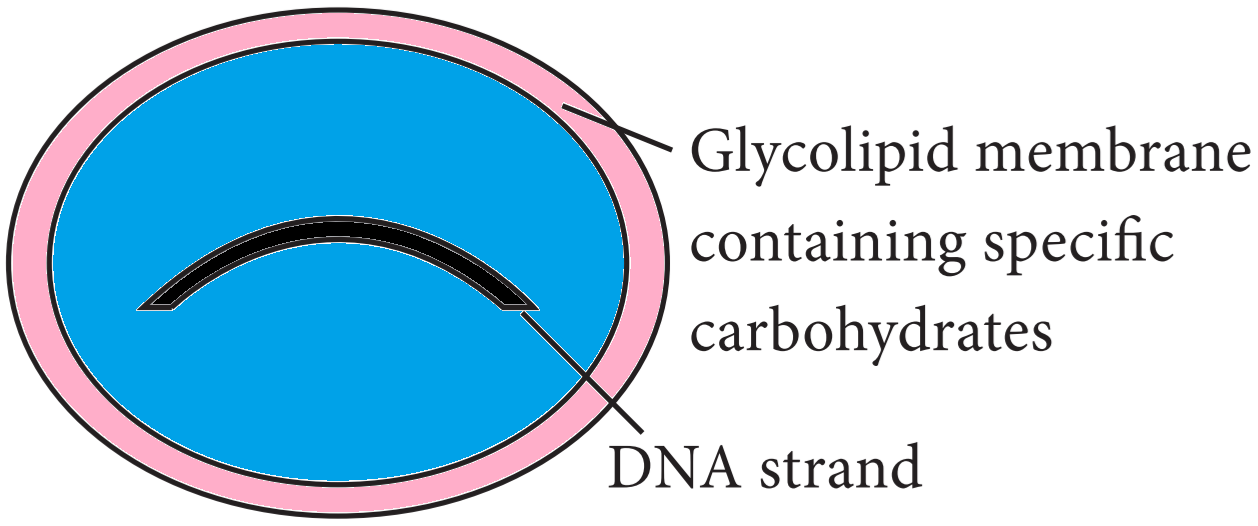
  1. Liposomes can be used for gene therapy as they target the cells affected by a genetic disease. The diagram shows the structure of a liposome.

What feature of a cell surface membrane allows the liposome to target cells affected by a genetic disease? 

  1. Carrier molecules.
  2. Phosphate groups.
  3. Protein channels.
  4. Receptor molecules.
  1. Which of the following disorders would gene therapy be least effective?
  1. Cystic fibrosis.
  2. Huntington's disease.
  3. Sickle cell anaemia.
  4. Type II diabetes.
  1. Following are some reasons explaining why gene therapy is not yet fully an effective treatment for genetic diseases.
  1. Lack of knowledge of DNA sequences.
  2. Lack of efficient and safe gene delivery system.
  3. Cost of the technology.
  4. Some diseases involve multiple genes.
  5. Problems with appropriate gene regulation.

Select the correct option. 

  1. I, III and V only
  2. II, IV and V only
  3. Ill, IV and V only
  4. I, III and IV only
In a court of law, two couples X and Y, claim a child Z of blood group O belongs to them. Couple X has man with blood group O and woman with blood group AB. Couple Y has man with blood group A and woman with blood group B. So, a geneticists helped in solving the problem but the judge ordered the= use of more recent and advance techniques and then the child was handed over ultimately to couple Y.
  1. Is it a correct judgement regarding the true/ biological parents of the child? Justify with your knowledge of genetics.
  2. Name the other technique that the judge has ordered for solving this problem.
  3. Indicate the value(s) exhibited by the judge.
Explain the mechanism of sex determination in human being.
Write a short note on uterus.