What is the difference between excretion and defecation? Explain the process of excretion in humans.
Download our app for free and get startedPlay store
Excretion: Excretion is the process of eliminating waste products of metabolism and other non-useful materials.In humans, the two major excretory processes are the formation of urine in the kidneys and the formation of carbon dioxide (a human's abundant metabolic waste) molecules as a result of respiration, which is then exhaled from the lungs. These waste products are eliminated by urinationand exhalation respectively.
Defecation: Defecation is the final act of digestion by which organisms eliminate solid, semisolid or liquid wastematerial (feces) from the digestive tract via the anus. Humans expel feces with a frequency varyingfrom a few times daily to a few times weekly. Waves of muscular contraction known as peristalsis inthe walls of the colon move fecal matter through the digestive tract towards the rectum. Undigestedfood may also be expelled this way; this process is called egestion.
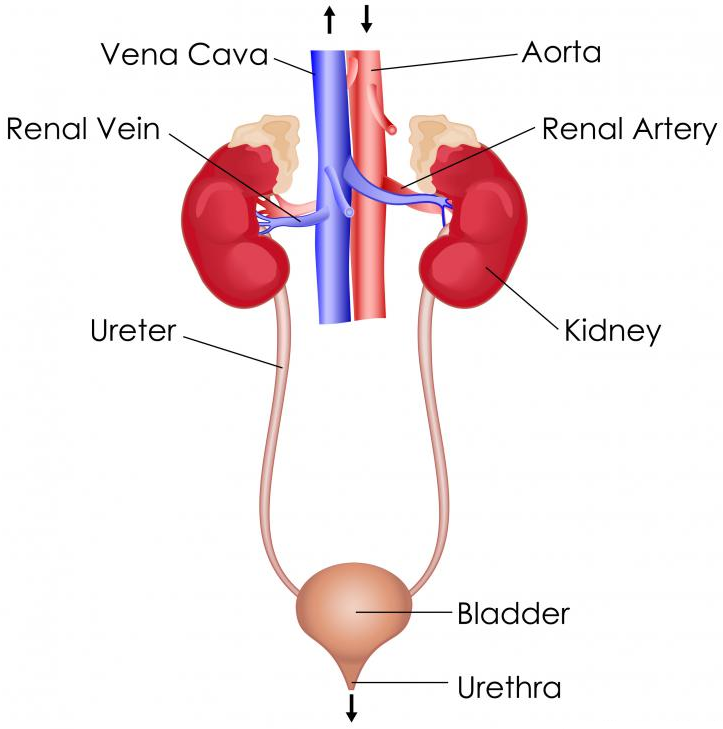
Human excretory system:
  1. Kidneys: Kidneys are the main organ of the human excretory system. They are the primary excretory organ in humans.They are divided into three regions- the renal cortex which is the outer layer, the renal medulla which is the inner layer and the renal pelvis which is responsible for carrying the urine from the kidney to the ureter. The functional unit of a kidney is called the nephron.
  2. Ureters: There is one ureter that comes out of each kidney as an extension of the renal pelvis. The ureter is a thin muscular tube that carries urine from the kidneys to the bladder.
  3. Urinary bladder: It is a sac-like structure that is lined with smooth muscle layer and is responsible for storage of urine till it is expelled from the body by micturition. Micturition is the act of expelling urine from the body. The bladder receives urine from the ureters, one from each kidney. The level of the urinary bladder placement in the body differs in men and women.
  4. Urethra: This is a tube that arises from the urinary bladder and functions to expel urine to the outside by micturition.
art

Download our app
and get started for free

Experience the future of education. Simply download our apps or reach out to us for more information. Let's shape the future of learning together!No signup needed.*

Similar Questions

  • 1
    What are the methods used by plants to get rid of their waste products?
    View Solution
  • 2
    1. Draw a sectional view of the human heart and label on it: Aorta, Pulmonary arteries, Vena cava, Left ventricle.
    2. Why is double circulation of blood necessary in human beings?
    View Solution
  • 3
    Explain the significance of peristalsis.
    View Solution
  • 4
    What is the main difference between aerobic respiration and anaerobic respiration? Give one example of each.
    View Solution
  • 5
    Some sugar solution is taken in a test-tube and a little of substance X in powder form is added to it. The mouth of test - tube is closed with a cork and allowed to stand for sometime. On opening the cork, a characteristic smell of substance Y is obtained and a gas Z is also observed to be formed. The gas Z extinguishes a burning matchstick.
    1. What could be X, Y and Z?
    2. What is the process of converting sugar into substance Y by the action of X known as?
    3. What type of respiration is exhibited by X in the above process?
    View Solution
  • 6
    1. Draw a diagram of human alimentary canal and label - gall bladder, pancreas, liver and small intestine on it.
    2. Give two reasons to explain why absorption of digested food occurs mainly in the small intestine.
    View Solution
  • 7
    Explain how deoxygenated blood travel from body to lung for purification. Draw well-labeled diagram in support of your answer.
    View Solution
  • 8
    The partially digested food coming from the stomach of a person enters a long and narrow organ A in his body. The organ A receives the secretion of two glands: liver and pancreas. Liver secretes a greenish - yellow liquid B which is normally stored in the organ C. Pancreas secretes pancreatic juice which contains three digestive enzymes D, E and F. The intestinal juice completes the process of digestion of food. The inner wall of organ A has millions of tiny finger - like projections G which help in the rapid absorption of digested food into blood stream. The undigested part of food then passes into wider tube H which absorbs most of the water from undigested food. The last part of tube H called I stores this undigested food (or waste) for some time. The undigested food is then passed out though opening J as faeces in the process known as K.
    1. Name the organ A.
    2. Name liquid B and organ C.
    3. What are the digestive enzymes D, E and F?
    4. Name the projections G present on the inner wall of organ A.
    5. Name Tube H, Part I, Opening J and Process K.
    View Solution
  • 9
    Plants absorb water from the soil. How does this water reach to the top of the tree? Explain in detail.
    View Solution
  • 10
    Differentiate between left lung and right lung of humans.
    View Solution