Explain the digestion of chapati in human beings. Draw a diagram depicting human alimentary canal.
Download our app for free and get started
Chapati is written down as food so,
Thus, the digestion of chapati is completed. The diagram is given below: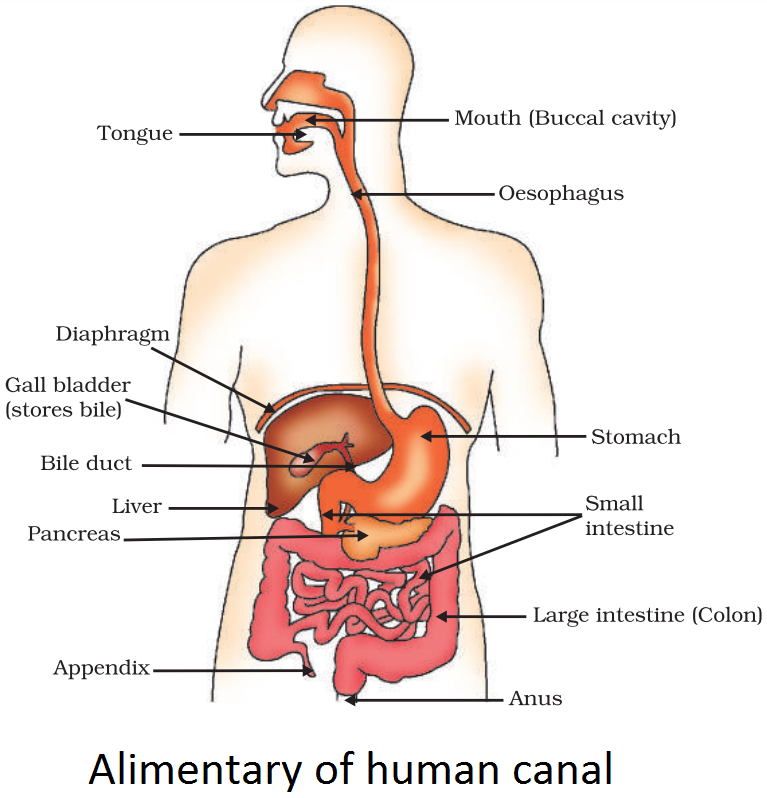
- The first step is done by the teeth to crush it into smaller pieces.
- Then the saliva has salivary amylase enzymes which breaks down the starch in the food to give sugar and it also wets the food to make the passage of food down the alimentary canal easier Peristaltic movement occurs all along the gut till the food reaches the stomach.
- In the stomach the digestive functions are taken care by the gastric glands present in the walls of the stomach, the gastric glands secrete hydrochloric acid an enzyme called pepsin and mucus.
- And then the food reaches the small intestine longest part of thealimentary canal, the small intestine recieves the secretions of the liver and pancreas which help in the digestion of food , the juice secreted by the liver is called bile juice and the juice secreted by the pancreas is called pancreatic juice.
Thus, the digestion of chapati is completed. The diagram is given below:

Download our appand get started for free
Experience the future of education. Simply download our apps or reach out to us for more information. Let's shape the future of learning together!No signup needed.*
Similar Questions
- 1View SolutionExplain with a schematic representation the exchange of gases in tissues.
- 2What happens with $CO _2$ and $O _2$ in plants during daytime?View Solution
- 3View SolutionDraw a labelled diagram of the human respiratory system.
- 4View SolutionDraw a labelled diagram of the human digestive system. With the help of this diagram, describe the process of digestion of food in man (humans).
- 5View SolutionDraw a neat labelled diagram of the human excretory system.
- 6View SolutionWhat is the main difference between aerobic respiration and anaerobic respiration? Give one example of each.
- 7View SolutionOutline the functioning of kidney dialysis machine?
- 8View SolutionThe liquid connective tissue A circulates in our body continuously without stopping. This tissue contains a pigment B which imparts it a colour C. The tissue A consists of four components D, E, F and G. The component D fights infection and protects us from diseases. The component E helps in the clotting of tissue A if a person gets a cut. The component F is a liquid which consists mainly of water with many substances dissolved in it and component G carries oxygen from the lungs to all the parts of the body.
- What is (i) tissue A, (ii) pigment B and (iii) colour C?
- Name (i) D, (ii) E, (iii) F and (iv) G.
- Name one substance (other than oxygen) which is transported by tissue A in the human body.
- Which two components of tissue A are the cells without nucleus?
- Name any two organisms (animals) which do not have liquid like A in their body.
- 9View Solution
- List the three events that accur during the process of photosynthesis. Explain the role of stomata in this process.
- Describe an experiment to show that ''sunlight is essential for photosynthesis.''
- 10View SolutionGive the steps involved in photosynthesis.