Valves are present in between the auricles and ventricles of the heart. Give one reason.
Download our app for free and get started
The heart features four types of valves which regulate the flow of blood through the heart. These valves permit blood flow only in one direction, and prevent back flow of blood. The four types of valves are:
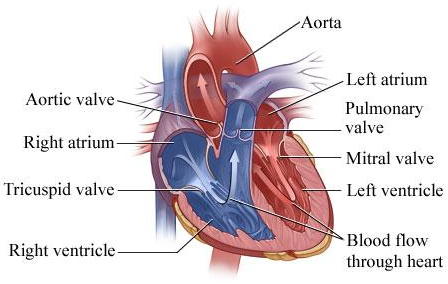
- Tricuspid Valve: This valve separates the right atrium from the right ventricle, and regulates the blood flow between them. Tricuspid valves allow blood to flow from the right atrium into the right ventricle, and prevent back flow of the same.
- Pulmonary Valve: This valve separates the right ventricle from the left pulmonary artery. These valves prevent the control the flow of blood from the right ventricle into the left pulmonary artery.
- Mitral Valve: Bicuspid valve or Mitral valve separates the left ventricle from the left atrium.
- Aortic Valve: This valve separates the left ventricle from the aorta, and controls the blood flow from the ventricle into the rest of the body.

Download our appand get started for free
Experience the future of education. Simply download our apps or reach out to us for more information. Let's shape the future of learning together!No signup needed.*
Similar Questions
- 1View SolutionGiven below is the experimental set-up to establish that one of the atmospheric gases is essential for photosynthesis in plants.

- Name the atmospheric gas which is essential for photosynthesis.
- What is kept in watch-glass in figure 'a' and why?
- Write the balanced chemical equation for the process of photosynthesis.
- When do the desert plants takeup carbon dioxide and perform photosynthesis?
- 2View SolutionList the factors on which diffusion in the plants depends.
- 3View SolutionA, B and C are three living organisms. The organism A is a unicellullar fungus which can live without air. It is used in the commercial production of an organic compound P from molasses. The organism B is a unicellular animal which lives in water and feeds and moves by using pseudopodia. It breathes through an organelle Q. The organism C is a tiny animal which acts as a carrier of malarial parasite. It breathes and respires through a kind of tiny holes R and air - tubes S in its body.
- What are organisms A, B and C?
- Name P, Q, R and S.
- Which organism/ organisms undergo aerobic respiration?
- Which organism/ organisms undergo anaerobic respiration?
- 4View SolutionDescribe the process of urine formation in kidneys.
- 5View SolutionDescribe the flow of blood through the heart of human beings.
- 6View SolutionThe organs A of a person have been damaged completely due to which too much of a poisonous waste material B has started accumulating in his blood, making it dirty. In order to save this person's life, the blood from an artery in the person's arm is made to flow into long tubes made of substance E which are kept in coiled form in a tank containing solution F. This solution contains three materials G, H and I in similar proportions to those in normal blood. As the person's blood passes through long tubes of substance E, most of the wastes present in it go into solution. The clean blood is then put back into a vein in the arm of the person for circulation.
- What are organs A?
- Name the waste substance B.
- What are (i) E and (ii) F? Name G, H and I.
- What is the process described above known as?
- 7View SolutionExplain the term dialysis.
- 8View SolutionExplain the three pathways of breakdown in living organisms.
- 9View SolutionExplain how deoxygenated blood travel from body to lung for purification. Draw well-labeled diagram in support of your answer.
- 10View SolutionDuring the respiration of an organism A, 1 molecule of glucose produces 2 ATP molecules whereas in the respiration of another organism B, 1 molecule of glucose produces 38 ATP molecules.
- Which organism is undergoing aerobic respiration?
- Which organism is undergoing anaerobic respiration?
- Which type of organism, A or B, can convert glucose into alcohol?
- Name one organism which behaves like A.
- Name two organisms which behave like B.