MCQ
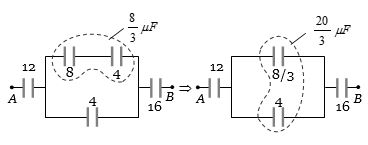
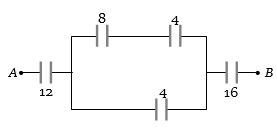
What is the equivalent capacitance between $A$ and $B$ in the given figure (all are in farad)
  • A
    $\frac{{13}}{{18}}\,F$
  • B
    $\frac{{48}}{{13}}\,F$
  • C
    $\frac{1}{{31}}\,F$
  • $\frac{{240}}{{71}}\,F$

Answer

Correct option: D.
$\frac{{240}}{{71}}\,F$
d
(d) The given circuit can be simplified as follows
Hence equivalent capacitance between $A$ and $B$
$\frac{1}{{{C_{AB}}}} = \frac{1}{{12}} + \frac{1}{{20/3}} + \frac{1}{{16}}$ $==>$ ${C_{AB}} = \frac{{240}}{{71}}\,F$

Need a full question paper?

Generate a complete, print-ready paper with questions like this in minutes — across 16+ boards, with answer keys.
Start Generating Free

Similar questions

If a slab of insulating material $4 \times 10^{-3} m$ thick is introduced between the plates of a parallel plate capacitor, the separation between plates has to be increased by $3.5 \times 10^{-3} m$ to restore the capacity to original value. The dielectric constant of the material will be
The dependence of the short wavelength limit $\lambda_{\min }$ on the accelerating potential V is represented by the curve of figure
A point charge $+q,$ is placed at a distance d from an isolated conducting plane. The field at a point $P$ on the other side of the plane is:
Consider the diffraction pattern obtained from the sunlight incident on a pinhole of diameter $0.1\, \mu m$. If the diameter of the pinhole is slightly increased, it will affect the diffraction pattern such that :
The kinetic energy of electron and proton is ${10^{ - 32}}J$. Then the relation between their de-Broglie wavelengths is
A ring of radius $R$ is charged uniformly with a charge $+\,Q$ . The electric field at a point on its axis at a distance $r$ from any point on the ring will be
Coulomb’s law is true for:
Hydrogen atom emits blue light when it changes from n = 4 energy level to the n = 2 level. Which colour of light would the atom emit when it changes from the n = 5 level to the n = 2 level
In a P-N junction diode if P region is heavily doped than n region then the depletion layer is
In the circuit shown, if a conducting wire is connected between points $A$ and $B,$ the current in this wire will