Question
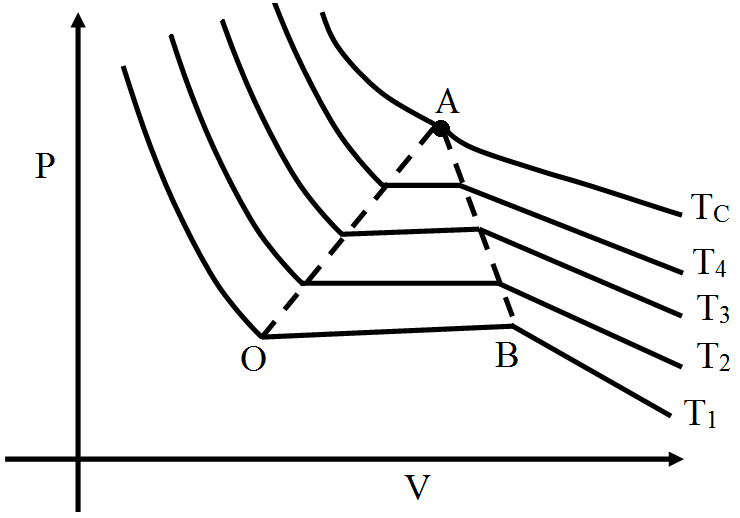
What is the Internal energy in the process of vapourisation?

Answer

During vapourisation, volume increases. So work done $=P\left(V_f-V_i\right)$ and temperature does not change. So, $d Q=m L_v$
$\therefore$ from first law of thermodynamics, $d U=d Q-D W=m L_v-P\left(V_f-V_i\right)$.

Need a full question paper?

Generate a complete, print-ready paper with questions like this in minutes — across 16+ boards, with answer keys.

Start Generating Free

Similar questions

It is a common observation that rain clouds can be at about a kilometre altitude above the ground. If a rain drop falls from such a height freely under gravity, what will be its speed? Also calculate in km/h. ($g = 10m/s^2$)
A body placed on a rough inclined plane just begins to slide, when the slope of the plane equal to 1 in 4. Calculate the coefficient of friction.
One mole of an ideal gas is taken in a Carnot engine working between $27°C$ and $227°C$. The useful work done in one cycle is $600J$. Calculate the ratio of the volume of the gas at the end and beginning of the isothermal expansion. Given $R = 8.31J mole^{-1} K^{-1}$.
A copper block of mass $2.5kg$ is heated in a furnace to a temperature of $500°C$ and then placed on a large ice block. What is the maximum amount of ice that can melt? (Specific heat of copper = $0.39 J g^{–1} K^{–1\}$; heat of fusion of water = $335 J g^{–1}$ ).
Precise measurements of physical quantities are a need of science. For example, to ascertain the speed of an aircraft, one must have an accurate method to find its positions at closely separated instants of time. This was the actual motivation behind the discovery of radar in World War II. Think of different examples in modern science where precise measurements of length, time, mass etc. are needed. Also, wherever you can, give a quantitative idea of the precision needed.
An inclined plane $(\theta)$ has its topmost point at a height 'h'. Prove that the work done to bring a mass to the ground level either vertically or along the inclined surface is equal and is mgh. Also prove that the velocity of the mass at the lowermost point is $\sqrt{2\text{gh}}$.
A 100m sprinter uniformly increases his speed from rest at the rate of $1ms^{-2}$​​​​​​​ up to $\frac{3}{4}\text{th}$ of the total run and then covers the balance $\frac{1}{4}\text{th}$ run with uniform speed. How much time does he take to complete the race?
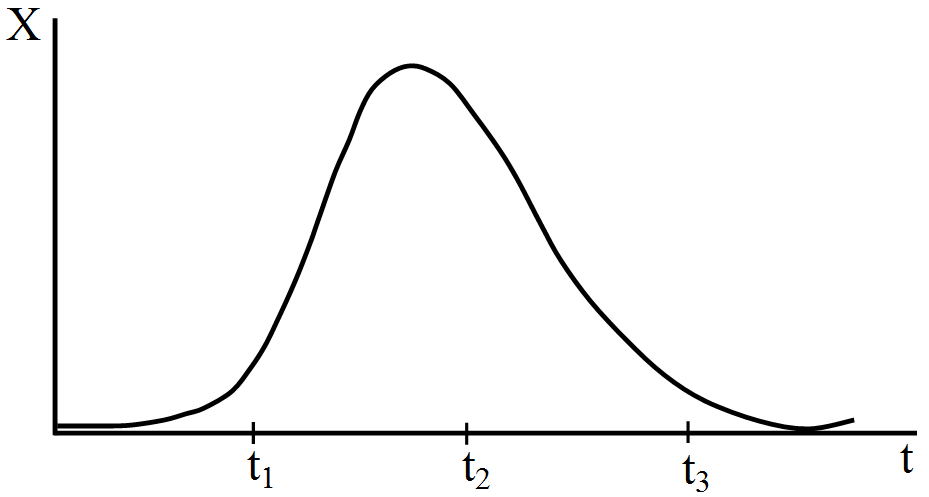
Figure shows the $x$ coordinate of a particle as a function of time. Find the signs of $v_x$ and $a_x$ at $t = t_1, t = t_2$ and $t = t_3$.
The time of flight of an object projected at an angle $\theta$ is T. What will be its time of flight, if the object be projected at an angle $(90-\theta)^\circ?$
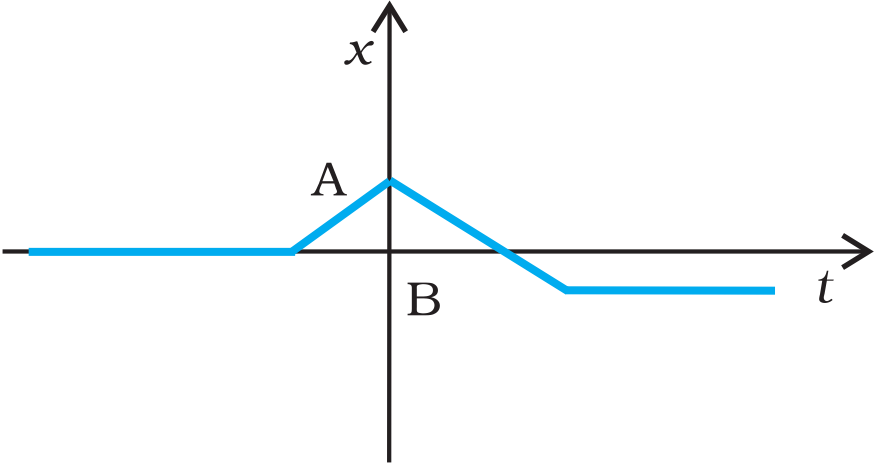
Suggest a suitable physical situation for of the following graphs.