Question
A copper block of mass $2.5kg$ is heated in a furnace to a temperature of $500°C$ and then placed on a large ice block. What is the maximum amount of ice that can melt? (Specific heat of copper = $0.39 J g^{–1} K^{–1\}$; heat of fusion of water = $335 J g^{–1}$ ).
Answer

Mass of the copper block, m = 3kg = 3000g Rise in the temperature of the copper block, $\triangle\theta=500^\circ\text{C}$ Specific heat of copper, $\mathrm{C}=0.39 \mathrm{Jg}^{-1}{ }^{\circ} \mathrm{C}^{-1}$ The maximum heat the copper block can lose, $\text{Q}=\text{mc}\triangle\theta=3000\times0.39\times500=5.85\times10^5\text{J}$ Let, $m_1$ be the total amount of ice melted by the hot block of copper. Heat gained by molten ice, $Q = m_1L \therefore\text{m}_1=\frac{\text{Q}}{\text{L}}=\frac{585000}{335}=1746.26\text{g}$

Need a full question paper?

Generate a complete, print-ready paper with questions like this in minutes — across 16+ boards, with answer keys.

Start Generating Free

Similar questions

Estimate the proportion of boron impurity whieh will increase the conductivity of a pure silicon sample by a factor of 100. Assume that each boron atom creates a hole and the concentration of holes in pure silicon at the same temperature is $7 \times 10^{15}$ holes per cubic metre. Density of silicon is $5 \times 10^{21}$ atoms per cubic metre.
Give three important characteristics of displacement.
A famous relation in physics relates ‘moving mass’ m to the ‘rest mass’ mo of a particle in terms of its speed v and the speed of light, c. (This relation first arose as a consequence of special relativity due to Albert Einstein). A boy recalls the relation almost correctly but forgets where to put the constant c. He writes: $\text{m}=\frac{\text{m}_0}{(1-\text{v}^2)^{1/2}}.$ Guess where to put the missing c.
The magnetic field B inside a long solenoid, carrying a current of $5.00A$, is $3.14 \times 10^{-2}T$. Find the number of turns per unit length of the solenoid.
Two capillaries of same length and radius in the ratio of $1 : 2$ are connected in series and a liquid flows through this system under streamline conditions. If the pressure across the two extreme ends of combination is $1m$ of water, what is the pressure difference across the:
  1. First capillary.
  2. Second capillary?
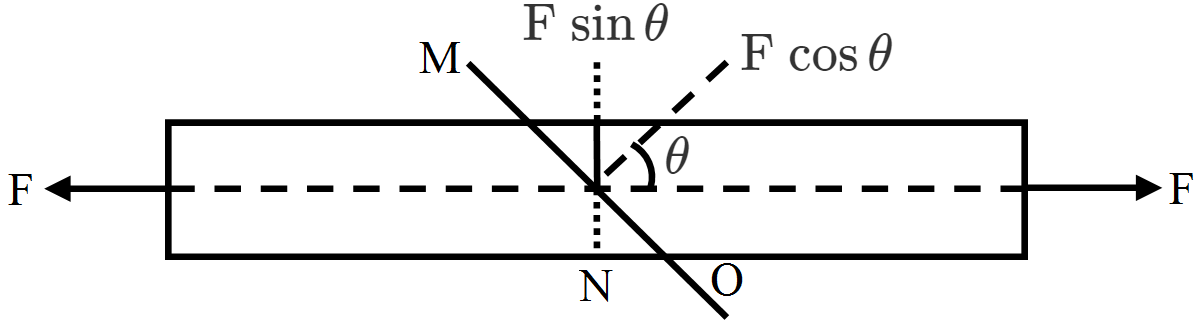
A bar of cross$-$section $A$ is subjected to equal and opposite tensile forces at its ends. Consider a plane section of the bar whose normal makes an angle $q$ with the axis of the bar.
  1. What is the tensile stress on this plane?
  2. What is the shearing stress on this plane?
  3. For what value of $q$ is the tensile stress maximum?
  4. For what value of $q$ is the shearing stress maximum?
If the velocity of light (c), the constant of gravitation (G) and Planck's constant (h) be chosen as the fundamental units, find the dimensions of mass, length and time in the new system.
A uniformly moving cricket ball is turned back by hitting it with a bat for a very short time interval. Show the variation of its acceleration with time. (Take acceleration in the backward direction as positive).
Find the angle of minimum deviation for an equilateral prism made of a material of refractive index 1.732. What is the angle of incidence for this deviation?
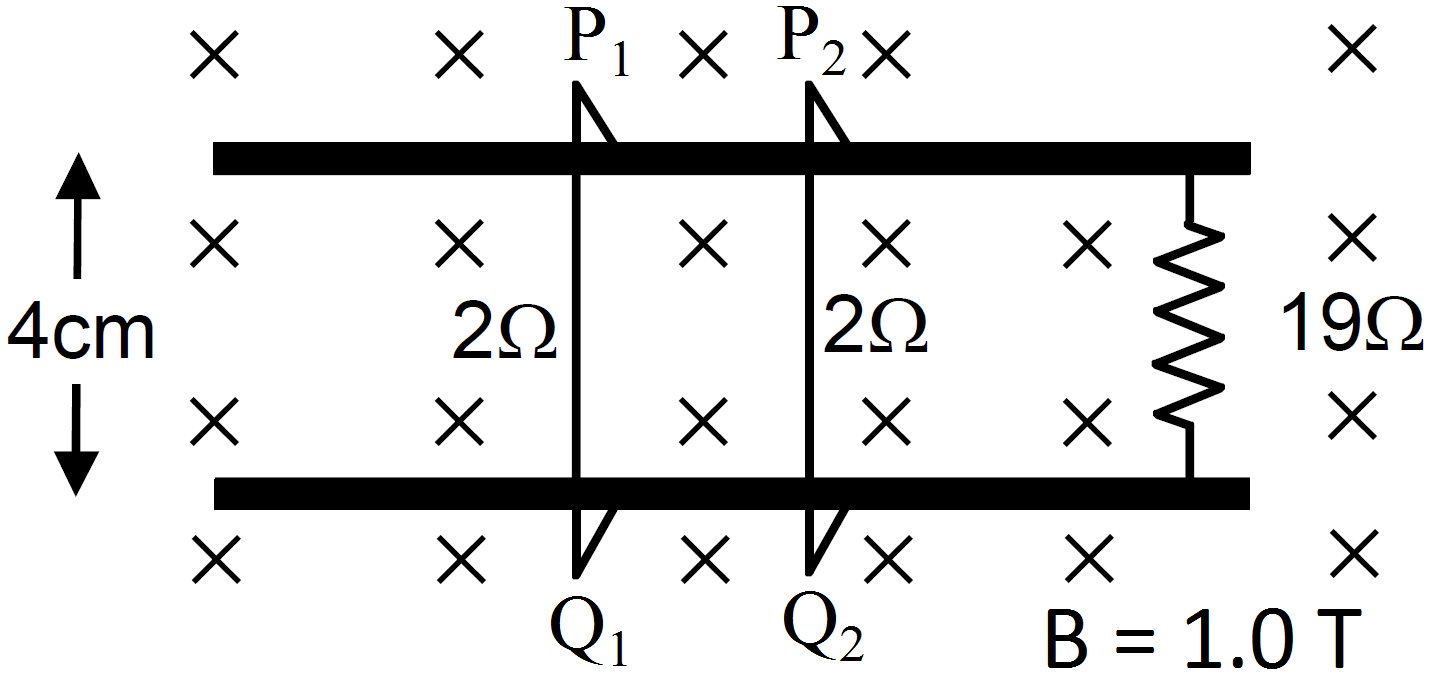
Consider the situation shown in figure. The wires $P_1Q_1$ and $P_2Q_2$ are made to slide on the rails with the same speed $5\ cm/s$. Find the electric current in the $19\Omega$ resistor if:
  1. Both the wires move towards right.
  2. If $P_1Q_1$ moves towards left but $P_2Q_2$ moves towards right.