MCQ
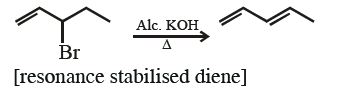
What is the major product of the following reaction ?

$\begin{array}{*{20}{c}}
  {C{H_2} = CHC{H_2}CHC{H_3} + KOH\xrightarrow[{heat}]{{{\text{alcohol}}}}} \\ 
  {|\,\,\,\,\,\,\,\,\,\,\,\,\,\,} \\
  {Br\,\,\,\,\,\,\,\,\,\,\,\,\,\,} 
\end{array}$

  • A
    $H_2C=CH-CH_2-CH=CH_2$
  • B
    $\,\begin{array}{*{20}{c}}
      {C{H_3}C{H_2}C{H_2}CHC{H_3}} \\ 
      {\,\,\,\,\,\,\,\,\,\,\,\,\,\,\,\,\,\,\,\,\,\,\,\,\,\,\,\,\,\,|\,\,\,\,\,\,\,\,\,\,\,\,\,} \\ 
      {\,\,\,\,\,\,\,\,\,\,\,\,\,\,\,\,\,\,\,OH} 
    \end{array}$
  • $H_2C=CH-CH=CH-CH_3$
  • D
    $\,\,\begin{array}{*{20}{c}}
      {C{H_2} = CHCHC{H_2}C{H_3}} \\ 
      {\,\,\,\,\,\,\,\,\,\,\,\,\,\,\,\,\,\,\,\,\,\,\,\,\,\,\,\,|\,\,\,\,\,\,\,\,\,\,\,\,\,\,\,\,\,\,\,\,\,\,\,\,\,} \\ 
      {\,\,\,\,\,\,\,\,\,\,\,\,\,\,\,\,\,\,\,\,\,OH\,\,\,\,\,\,\,\,\,\,\,\,\,\,\,\,} 
    \end{array}$
Answer

Correct option: C.
$H_2C=CH-CH=CH-CH_3$
c

Need a full question paper?

Generate a complete, print-ready paper with questions like this in minutes — across 16+ boards, with answer keys.

Start Generating Free

Similar questions

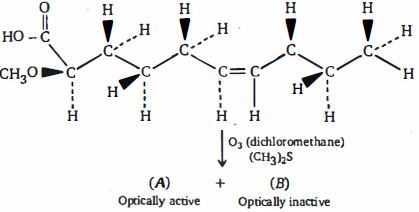
Product $(A)$ of above reaction is
For $F_2$ and $OF$ molecules consider the following statements 
$(a)$ Bond order for both is one
$(b)$ $OF$ is paramagnetic but $F_2$ is diamagnetic
$(c)$ $F_2$ is more likely to dissociate into atoms than $OF$
$(d)$ Both have greater number of electrons in $BMO$ than that in $ABMO$
Which of the following statements are true $(T)$ or false $(F)$ respectively
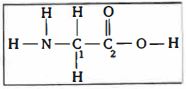
What are the hybridisation of the carbon atoms labeled $C_1$ and $C_2$, respectively in glycine?

$C_1$          $C_2$

Values of dissociation constant, $K_a$ are given as follows

      Acid       $K_a$
      $HCN$       $6.2\times 10^{-10}$
      $HF$       $7.2\times 10^{-4}$
      $HNO_2$       $4.0\times 10^{-4}$

Correct order of increasing base strength of the base $CN^-,F^-$ and $NO_2^-$ will be

Which of the following pairs have absence of carbocyclic ring in both compounds?
Which one of the following characteristics apply to both ethene and ethyne
Which of the following order is $CORRECT$ 
Which one of the following is the intermediate in the preparation of a ketone by hydration of an alkyne in the presence of sulfuric acid and mercury $(II)$ sulphate ?
$9.2$ grams of ${N_2}{O_{4(g)}}$ is taken in a closed one litre vessel and heated till the following equilibrium is reached ${N_2}{O_{4(g)}}$ $\rightleftharpoons$ $2N{O_{2(g)}}$.At equilibrium, $50\%$ ${N_2}{O_{4(g)}}$ is dissociated. What is the equilibrium constant (in mol litre$^{-1}$) (Molecular weight of ${N_2}{O_4} = 92)$
$C{{H}_{3}}-CH=CH-C{{H}_{3}}\underset{\left( Anti-Markownikoff's\text{ }addition \right)}{\mathop{\xrightarrow[{{R}_{2}}{{O}_{2}},\Delta ]{HBr}}}\,$

Comment on optical activity of the products