MCQ
What is the relationship between the two structures shown ?
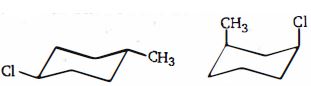
- ✓Constitutional isomers
- BStereoisomers
- CDifferent drawing of the same conformation of the same compound
- DDifferent conformation of the same compound
Generate a complete, print-ready paper with questions like this in minutes — across 16+ boards, with answer keys.
(1)${H_2} \to {H^ \bullet } + {H^ \bullet }$
(2)$B{r_2} \to B{r^ \bullet } + B{r^ \bullet }$
(3)$B{r^ \bullet } + HBr \to {H^ \bullet } + B{r_2}$
(4)${H^ \bullet } + B{r_2} \to HBr + B{r^ \bullet }$
(5)$B{r^ \bullet } + B{r^ \bullet } \to B{r_2}$

(at. mass $Ag =108; Br = 80$)
$(1)$ An electron in an orbital of high angular momentum stays away from the nucleus than an electron in the orbital of lower angular momentum.
$(2)$ For a given value of the principal quantum number, the size of the orbit is inversely proportional to the azimuthal quantum number
$(3)$ According to wave mechanics, the ground state angular momentum is equal to $\frac {h}{2\pi }$
$(4)$ The plot of $\Psi \,\,Vs\,\,r$ for various azimuthal quantum numbers, shows peak shifting towards higher $r$ value