Questions

2 Marks Questions

Take a timed test

60 questions · self-marked practice — reveal the answer and mark yourself.

Question 12 Marks
A small town with a demand of 800kW of electric power at 220V is situated 15km away from an electric plant generating power at 440V. The resistance of the two wire line carrying power is 0.5Ω per km. The town gets power from the line through a 4000-220V step-down transformer at a sub-station in the town.
  1. Estimate the line power loss in the form of heat.
  2. How much power must the plant supply, assuming there is negligible power loss due to leakage?
  3. Characterise the step up transformer at the plant.
Answer
If an iron core is inserted in the choke coil (which is in series with a lamp connected to the ac line), then the lamp will glow dimly. This is because the choke coil and the iron core increase the impedance of the circuit.
View full question & answer
Question 22 Marks
Write briefly the underlying principle used in Davison-Germer experiment to verify wave nature of electrons experimentally. What is the de-Broglie wavelength of an electron with kinetic energy (of).120 ev? Write briefly the underlying principle used in Davison-Germer experiment to verify wave nature of electrons experimentally. What is the de-Broglie wavelength of an electron with kinetic energy (of).120 ev?
Answer
Diffraction effects are observed for beams of electrons scattered by the crystals.
$\lambda = \frac{1.227 nm}{\sqrt{\text{V}}}$
$\lambda = \frac{1.227nm}{\sqrt{120}}$
Value $ = \lambda= 0.112 \text{ nm}$
Alternate Answer
$\lambda = \frac{\text{h}}{\sqrt{2\text{meV}}}$
$ = \frac{6.63\times10^{-34}}{\sqrt{2\times9.1\times10^{-31}\times1.6\times10^{-19}\times120}}$
$\lambda = 0.112\text{ nm }$.
View full question & answer
Question 32 Marks
State two properties of electromagnetic waves. How can we show that em waves carry momentum?
Answer
Any two properties of electromagnetic waves Such as (a) transverse nature (b) does not get deflected by electric fields or magnetic fields (c) same speed in vacuum for all waves (d) no material medium required for propagation (e) they get refracted, diffracted and polarised. Electric charges present on a plane, kept normal to the direction of propagation of an e.m. wave can be set and sustained in motion by the electric and magnetic field of the electromagnetic wave. The charges thus acquire energy and momentum from the waves.
Alternate Answer
Radiation Pressure – Electromagnetic waves exert radiation pressure. Hence, they carry momentum.
View full question & answer
Question 42 Marks
What is electrostatic shielding? How is this property used in actual practice? Is the potential in the cavity of a charged conductor zero?
Answer
The field inside a conductor is zero. Sensitive instruments are shielded from outside electrical influences by enclosing them in a hollow conductor. Potential inside the cavity is not zero/potential is constant.
View full question & answer
Question 52 Marks
  1. Distinguish between ‘Analog’ and ‘Digital’ forms of communication.
  2. Explain briefly two commonly used applications of the ‘Internet’.
Answer
  1.  
Analog signal
Digital Signal
It is single valued function of time or varies continuously with time.
These signals take only discrete set
of values i.e. 0 or 1.
Alternate Answer
Alternate Answer
  1. Uses of Internet: (Any two)
E.mail, E-banking, Chatting, File transfer, E-shopping, E-ticket, Surfing, etc.
View full question & answer
Question 62 Marks
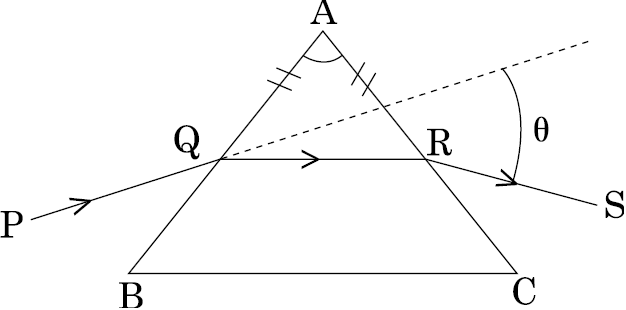
A ray PQ incident on the refracting face BA is refracted in the prism BAC as shown in the figure and emerges from the other refracting face AC as RS such that AQ = AR. If the angle of prism $A = 60^\circ$ and refractive index of material of prism is$\sqrt{3}$, calculate angle $\theta.$
Answer
Since AQ = AR, we have
QR|| BC
$\therefore\theta$ is the angle of minimum deviation.
Alternate Answer
Since AQ=AR, we get
$\angle\text{r}_{1} = \angle\text{r}_{2}$
$\therefore\theta$ is the angle of minimum deviation.)
$\mu = \frac{\sin(\frac{\text{A} + delta\text{m}}{2})}{\sin(\text{A}/2)}$
$\therefore\sqrt{3} = \frac{\sin(\frac{60 + \delta\text{m}}{2})}{\sin30^{o}}$
$\therefore\frac{\sqrt{3}}{2} = \sin(\frac{60 + \delta\text{m}}{2})$
$\therefore\frac{60 + \delta\text{m}}{2} = 60$
or $\delta\text{m} = 60 ^{o}$.
View full question & answer
Question 72 Marks
Why is base band signal not transmitted directly? Give any two reasons.
Answer
If base band signal were to be transmitted directly:
  1. The height of the antennae needed will be impractically large.
  2. The effective power radiated would be too low.
  3. There would be a high probability of different signals getting mixed up with one another.
View full question & answer
Question 82 Marks
Define the term ‘power loss’ in a conductor of resistance R carrying a current I. In what form does this power loss appear? Show that to minimise the power loss in the transmission cables connecting the power stations to homes; it is necessary to have the connecting wires carrying current at enormous high values of voltage.
Answer
Electrical energy lost per second in the resistor, is Power loss
$\because$ Power loss appears in the form of heat/e. m. radiations.
Consider a device ‘R’, to which power P is to be delivered via transmission cables having a resistance $\text{R}_{c}$, Let V be the voltage across ‘R’, and I be the current through it, then,
$\text{P} = \text{V I }$
$\therefore \text{I} = \frac{\text{P}}{\text{V}}$
Power dissipated in the cable $(\text{P}_{c}) = \text{I}^{2}\text{R}_{c}$
$ = \frac{\text{P}^{2}\text{R}_{c}}{\text{V}^{2}}$
$\therefore \text{P}_{c}\propto\frac{1}{\text{V}^{2}}$
$\therefore$ Energy transmission, at high voltage, minimises the power loss.
View full question & answer
Question 92 Marks
Derive an expression for the work done in rotating a dipole from the angle $\theta_{0}$ to $\theta_{1}$ in a uniform electric field E.
Answer
Work done against the restoring torque
$\text{dW} = \tau\text{ d}\theta$
$\text{dW} = \text{pE}\sin\theta\text{ d}\theta$
$\therefore , \text{W} = \text{pE}\int^{\theta1}_{\theta0}\sin\theta\text{d}\theta$
$ = \text{pE}\cos\theta_{0} -\cos\theta_{1}.$
View full question & answer
Question 102 Marks
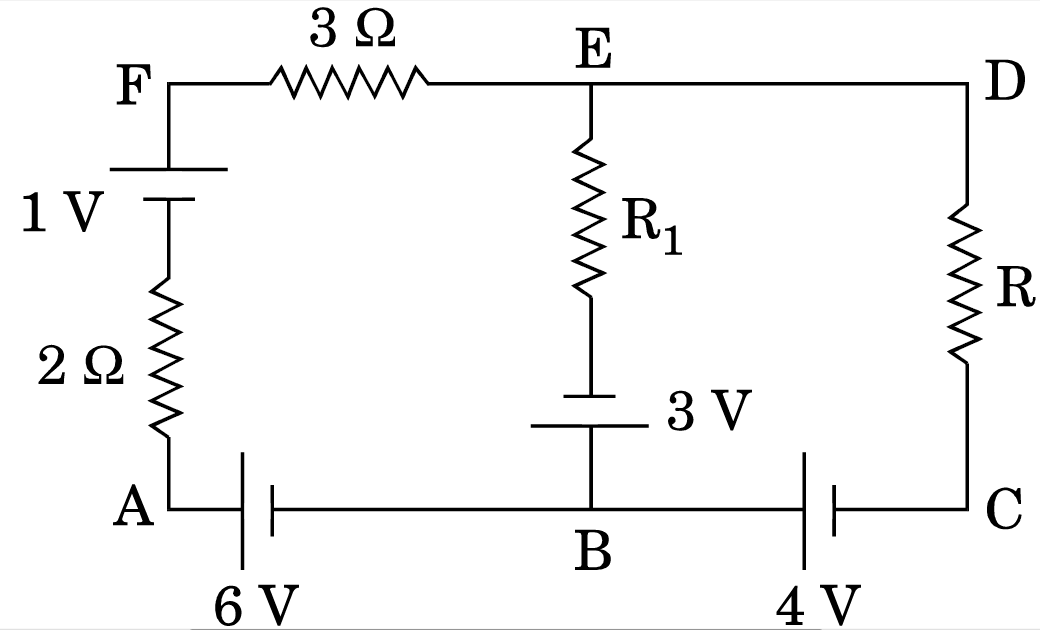
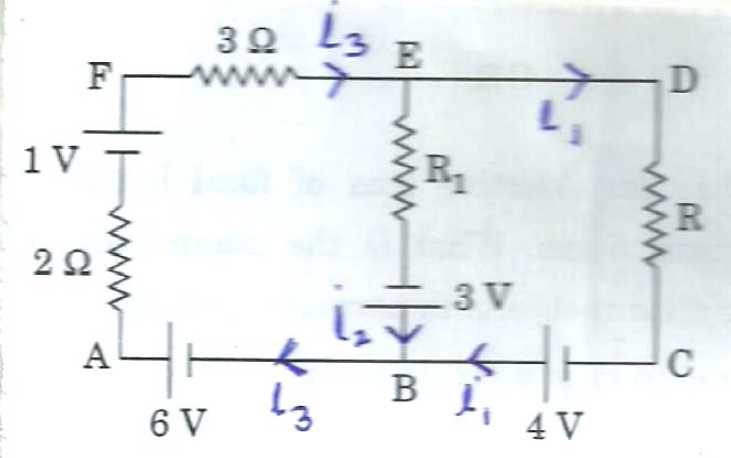
Use Kirchhoff ’s rules to determine the potential difference between the points A and D when no current flows in the arm BE of the electric network shown in the figure.
Answer

According to Kirchoff‟s Junction law at B
$\text{i}_{3} = \text{i}_{1} + \text{i}_{2} \therefore\text{i}_{3} = \text{i}_{1}$
(As $I_2=0$ (given)
Applying second law to loop AFEB
$\text{i}_{3}\times2 + \text{i}_{3} \times3 + \text{i}_{2}\text{R}_{1} = 1+ 3 + 6 $
$\therefore\text{i}_{3} = \text{i}_{1} = 2 \text{A}$
From A to D along AFD $\therefore\text{V}_{\text{AD}} = 2\text{i}_{3} -1 +3 \times\text{i}_{3}$
$ = ( 4- 1 + 6 ) \text{V}$
$= 9\ V.$
View full question & answer
Question 112 Marks
Why does current in a steady state not flow in a capacitor connected across a battery? However momentary current does flow during charging or discharging of the capacitor. Explain.
Answer
In the steady state, the displacement current and hence the conduction current, is zero as $|\overrightarrow{E}|$ between the plates, is constant.
During charging/discharging, the displacement current and hence the conduction current is non zero as $|\overrightarrow{E}|$ between the plates, is changing with time.
View full question & answer
Question 122 Marks
When vs potential difference is applied across a wire of length 0.1 m , the drift speed of electrons is $2.5 \times 10^{-4} \mathrm{~m} / \mathrm{s}$. If the electron density in the wire is $8 \times 10^{28} \mathrm{m}^{-3}$, calculate the resistivity of the material of wire.
Answer
$\text{R} = \rho\frac{l}{\text{A}};I = \text{neAv}_{d}$
$\therefore\rho = \frac{\text{V}}{\text{nelv}_{d}}$
Alternate Answer
$ \begin{pmatrix} \text{j} = \sigma\text{E} = \frac{\text{E}}{\rho}\text{ or }\frac{\text{E}}{\text{j}} =\rho\\ \\\therefore \rho= \frac{\text{V}}{lnev_d} \\ \end{pmatrix} $
$\therefore\rho = \frac{5}{0.1\times8\times10^{28}\times1.6\times10^{-19}\times2.5\times10^{-4}}\Omega -\text{m}$
$ = 1.56\times10^{-5}\Omega -\text{m}$
$\simeq1.6\times10^{-5}\Omega - \text{m}$.
View full question & answer
Question 132 Marks
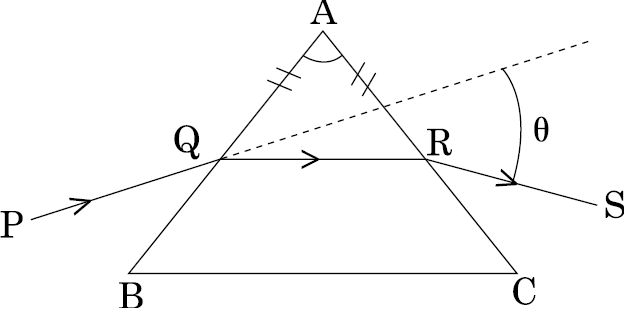
A ray PQ incident on the refracting face BA is refracted in the prism BAC as shown in the figure and emerges from the other refracting face AC as RS such that AQ = AR. If the angle of prism $A = 60^\circ$ and refractive index of material of prism is$\sqrt{3}$, calculate angle $\theta.$
Answer
Since AQ = AR, we have
QR|| BC
$\therefore\theta$ is the angle of minimum deviation.
Alternate Answer
Since AQ=AR, we get
$\angle\text{r}_{1} = \angle\text{r}_{2}$
$\therefore\theta$ is the angle of minimum deviation.
$\mu = \frac{\sin(\frac{\text{A} + delta\text{m}}{2})}{\sin(\text{A}/2)}$
$\therefore\sqrt{3} = \frac{\sin(\frac{60 + \delta\text{m}}{2})}{\sin30^{o}}$
$\therefore\frac{\sqrt{3}}{2} = \sin(\frac{60 + \delta\text{m}}{2})$
$\therefore\frac{60 + \delta\text{m}}{2} = 60$
or $\delta\text{m} = 60 ^{o}$.
View full question & answer
Question 142 Marks
State the concept of mobile telephony and explain its working.
Answer
Concept of mobile telephony is to divide the service area into a suitable number of cells centred on an office MTSO (Mobile Telephone Switching Office)/Mobile telephony means that you can talk to any person from anywhere.
Explanation:
  1. Entire service area is divided into smaller parts called cells.
  2. Each cell has a base station to receive and send signals to mobiles.
  3. Each base station is linked to MTSO. MTSO co-ordinates between base station and TCO (Telephone Control Office).
View full question & answer
Question 152 Marks
  1. How are infrared waves produced? Write their one important use.
  2. The thin Ozone layer on top of the stratosphere is crucial for human survival. Why?
Answer
  1. Infrared waves are produced by hot bodies and molecules. Important use.
  2. To treat muscular strains/To reveal the secret writings on the ancient walls/For producing dehydrated fruits/Solar Heater/Solar cooker Ozone layer protects us from harmful U-V rays.
View full question & answer
Question 162 Marks
Derive an expression for the work done in rotating a dipole from the angle $\theta_{0}$ to $\theta_{1}$ in a uniform electric field E.
Answer
Work done against the restoring torque
$\text{dW} = \tau\text{ d}\theta$
$\text{dW} = \text{pE}\sin\theta\text{ d}\theta$
$\therefore , \text{W} = \text{pE}\int^{\theta1}_{\theta0}\sin\theta\text{d}\theta$
$ = \text{pE}\cos\theta_{0} -\cos\theta_{1}.$
View full question & answer
Question 172 Marks
Calculate the shortest wavelength in the Balmer series of hydrogen atom. In which region (infra-red, visible, ultraviolet) of hydrogen spectrum does this wavelength lie?
Answer
$\frac{1}{\lambda} = \text{R}(\frac{1}{\text{n}_{1}^{2}} - \frac{1}{\text{n}_{2}^{2}})$
For shortest wavelength in Balmer series
$\text{n}_{1} =2 $
$\text{n}_{2} = \infty$
$\therefore \frac{1}{\lambda} =\text{R} ( \frac{1}{4} - \frac{1}{\infty})$
$ = \frac{\text{R}}{4}$
$\lambda = 3640\text{A}^{o}$
$\because \text{R} = 1.09\times10^{7}\text{m}^{-1}$
It will lie in Ultra Violet region.
View full question & answer
Question 182 Marks
Write the function of a (i) Transducer and (ii) Repeater in a communication system.
Answer
  1. Transducer: The device which converts one form of energy into another.
  2. Repeater: A repeater picks up signal, amplifies and retransmits them to receiver.
View full question & answer
Question 192 Marks
A proton and an a particle are accelerated through the same potential difference. Which one of the two has (i) greater de-Broglie wavelength, and (ii) less kinetic energy? Justify your answer.
Answer
  1. $\lambda =\frac{\text{h}}{\text{p}} =\frac{\text{h}}{\sqrt{2\text{mqV}}}$
$\because(\text{mq}) \text{is more for }\alpha - \text{particle} , \text{we have}$

$\lambda_{proton} > \lambda_{\propto} - particle$

(Also, $\frac{\lambda_{proton}}{\lambda_{\alpha}} =2\sqrt{2}(\text{ or }\sqrt{8} ) $
  1. K.E. = q V
$\because $q is less for proton, we have

$(\text{K.}\text{E} )_{proton} < (\text{K.}\text{E} )_{\alpha - particle}$

$\text{Also},\frac{(\text{K.E.})\propto}{(\text{K.E.})_{\rho}} = 2 ) $.
View full question & answer
Question 202 Marks
Show mathematically how Bohr's postulate of quantization of orbital angular momentum in hydrogen atom is explained by de-Broglie's hypothesis.
Answer
de Broglie wavelength, $\lambda = \frac{\text{h}}{\text{mv}}$
For electron moving in the $n^{th}$ orbit, $2 \pi\text{r} = \text{n}\lambda$
$\therefore2\pi\text{r} = \frac{\text{nh}}{\text{mv}}$
$\therefore\text{mvr} = \frac{\text{nh}}{2\pi} = \text{L}$ (orbital angular momentum)
This is Bohr’s Postulate of quantization of orbital angular momentum.
View full question & answer
Question 212 Marks
When an electron in hydrogen atom jumps from the third excited state to the ground state, how would the de Broglie wavelength associated with the electron change? Justify your answer.
Answer
$\lambda = \frac{\text{h}}{\text{P}} = \frac{\text{h}}{\sqrt{2\text{mK}}}$
$\frac{\lambda_{1}}{\lambda_{4}} = \sqrt{\frac{\text{K}_{4}}{\text{K}_{1}}}$
But $\text{K}_{n}( = - \text{E}_{n})\propto\frac{1}{\text{n}^{2}}$
Hence , $\frac{\lambda_{1}}{\lambda_{4}} = \sqrt{\frac{1}{16}}$
$\therefore \frac{\lambda_{1}}{\lambda_{4}} = \frac{1}{4}$
$\lambda_{4} = 4 \lambda_{1}$
i.e. $\lambda_{4} > \lambda_{1}$
Alternate Answer
$\lambda_{n} = \frac{\text{h}}{\text{P}_{n}} = \frac{\lambda}{\text{mv}_{n}}$
Velocity of electron in $n^{th}$ state $\upsilon_{n}\propto\frac{1}{n}$
$\lambda_{n}\propto\frac{1}{\upsilon_{n}}\therefore\lambda\propto\text{n}$
$\therefore \frac{\lambda_{4}}{\lambda_{1}} = \frac{\text{n}_{4}}{\text{n}_{1}} = \frac{4}{1}$
View full question & answer
Question 222 Marks
Distinguish between ‘sky wave’ and ‘space wave’ modes of propagation. Why is the sky wave mode of propagation restricted to frequencies up to 40 MHz?
Answer
Space Wave Sky Wave
In space wave mode, the waves travel in straight line directly from transmitter to receiver in. Reflected by Ionosphere.
Because frequencies is greater than 40 MHz, penetrate the ionosphere.
Alternate Answer
There frequencies (greater than 40 MHz) are not reflected by the ionosphere).
View full question & answer
Question 232 Marks
An alternating voltage of frequency f is applied across a series LCR circuit. Let $f_r$  be the resonance frequency for the circuit. Will the current in the circuit lag, lead or remain in phase with the applied voltage when $(i) f > f_r$, $(ii) f < f_r?$ Explain your answer in each case.
Answer
  1. $\text{f} > \text{f}_\text{r}$, current lags behind voltage/ voltage leads current Circuit becomes inductive $\big(\text{X}_\text{L}> \text{X}_\text{C}\big)$.
  2. $\text{f} < \text{f}_\text{r}$ current leads voltage/ voltage lags current. Circuit becomes capacitive $\big(\text{X}_\text{C}>\text{X}_\text{L}\big)$.
View full question & answer
Question 242 Marks
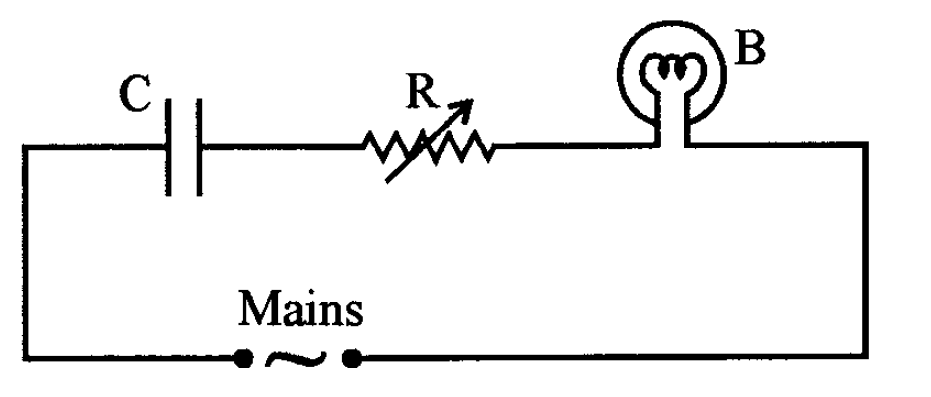
A capacitor'C', a variable resistor 'R' and a bulb oB' are connected in series to the ac mains in circuit as shown. The bulb glows with some brightness. How will the glow of the bulb change if (i) a dielectric slab is introduced between the plates of the capacitor, keeping resistance R to be the same; (ii) the resistance R is increased keeping the same capacitance?
Answer
  1. Reactance of the capacitor will decrease, resulting in increase of the current in the circuit. Therefore the bulb will glow brighter.
  2. Increased resistance will decrease the current in the circuit, which will decrease glow of the bulb.
View full question & answer
Question 252 Marks
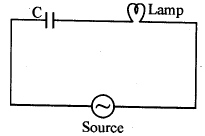
An electric lamp having coil of negligible inductance connected in series with a capacitor and an AC source is glowing with certain brightness. How does the brightness of the lamp change on reducing the (i) capacitance, and (ii) the frequency? Justify your answer.
Answer
  1. $\text{X}_{c} = \frac{1}{\omega\text{C}} = \frac{1}{2\pi\text{v}\text{C}}$
As C decreases, Xc will increase. Hence brightness will decrease.
  1. $\text{X}_{c} = \frac{1}{\omega\text{C}} = \frac{1}{2\pi\text{v}\text{C}}$
As frequence (ν) decreases, Xc will increase. Hence brightness will decrease
View full question & answer
Question 262 Marks
Distinguish between the terms 'average value' and 'rms value' of an alternating current. The instantaneous current from an a.c. source is I = 5 sin (314 t) ampere.
What are the average and rms values of the current?
Answer
Average value of an alternating current over time T is
$\text{I}_{\text{AV}} = \frac{1}{\text{T}}\int\limits_{0}^{T}\text{I}(\text{t})\text{dt}$
rms value of an alternating current is that value of stready current which when flowing through a resistance for a certain amount of time produces same amount of heat as the given A.C. does in the same resistance in the same time.
Average value over half cycle is ${2\over\pi}\text{I}_{0} = 3.18\text{A}$
or Aveage value over complete cycle is zero
rms value is ${\text{I}_{0}\over\sqrt{2}} = 3.54\text{A}\text{ or }{5\over\sqrt{2}}\text{A}.$
View full question & answer
Question 272 Marks
What is the power dissipated by an ideal inductor in ac circuit? Explain.
Answer
The power P $\text{V}_{\text{rms}}\text{I}_{\text{rms}}\cos\varphi$
An ideal inductor is the one whose resistive component is zero.
where $\cos\varphi=\frac{\text{R}}{\text{Z}};$ For ideal inductor R = 0,
$\therefore\cos\varphi=\frac{\text{R}}{\text{Z}}=0$
$\therefore\text{P}=\text{V}_{\text{rms}}\text{I}_{\text{rms}}\cos\varphi=0,$ i.e., power dissipated by an ideal inductor in ac circuit is zero.
View full question & answer
Question 282 Marks
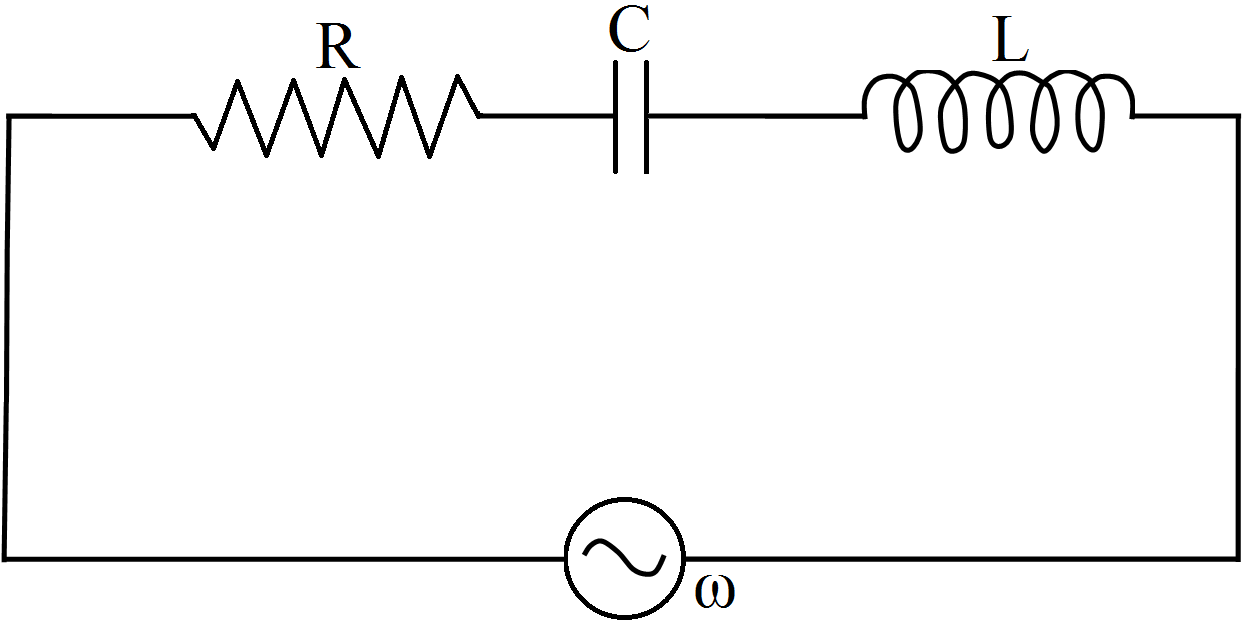
In the circuit shown below R represents an electric bulb. If the frequency $\text{v}=\Big(\frac{\omega}{2\pi}\Big)$ of the supply is doubled, how should the values of C and L be changed, so that the glow of bulb remains unchanged?
Answer
For same current value, the total impedance
$\sqrt{\text{R}^2+\Big(\omega\text{L}+\frac{1}{\omega\text{C}}\Big)}$
must remain same.
Therefore, $\omega\text{L}-\frac{1}{\omega\text{C}}$ must remain same. As frequency $(\omega)$ is doubled, L and C must both be halved simultaneously.
View full question & answer
Question 292 Marks
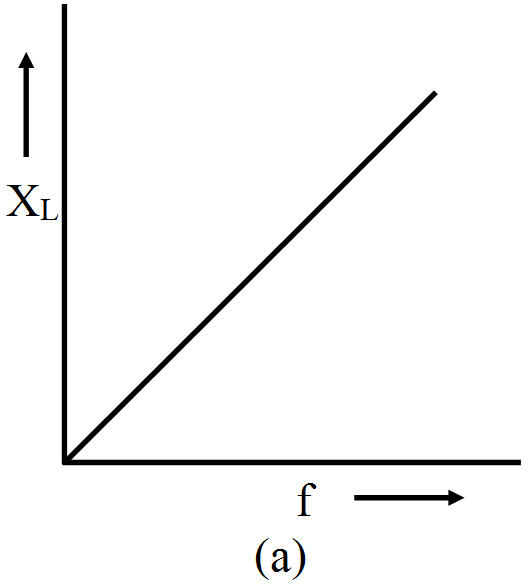
Draw the graphs showing variation of inductive reactance and capacitive reactance with frequency of applied a.c. source.
Answer
  1. $\text{X}_{\text{L}}=\text{w}_{\text{L}}=2\pi\text{vL};$ graph $X_L$ of f and f is a straight line.
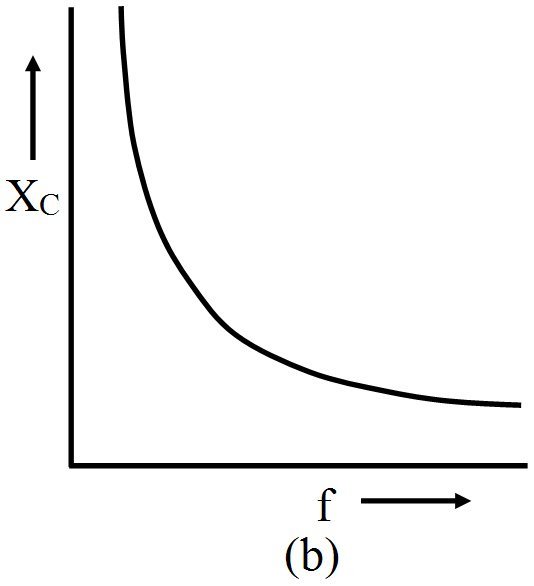
  2. $\text{X}_{\text{C}}=\frac{1}{\omega\text{C}}=\frac{1}{2\pi\text{vC}},$ graph of XC and f is a rectangular hyperbola as shown in figs.


​​​​​​​
View full question & answer
Question 302 Marks
  1. The peak voltage of an ac supply is 300V. What is the rms voltage?
  2. The rms value of current in an ac circuit is 10A. What is the peak current?
Answer
  1. Peak voltage of the ac supply, $V_0= 300V$ Rms voltage is given as:
$\text{V}=\frac{\text{V}_0}{\sqrt{2}}$

$=\frac{300}{\sqrt{2}}=212.1\text{V}$
  1. Therms value of current is given as:
I = 10A

Now, peak current is given as:

$\text{I}_0=\sqrt{2}\text{I}$

$=10\sqrt{2}=14.1\text{A}.$
View full question & answer
Question 312 Marks
A power transmission line feeds input power at 2300V to a stepdown transformer with its primary windings having 4000 turns. What should be the number of turns in the secondary in order to get output power at 230 V?
Answer
Input voltage, $\mathrm{V}_1=2300$
Number of turns in primary coil, $\mathrm{n}_1=4000$
Output voltage, $\mathrm{V}_2=230 \mathrm{~V}$
Number of turns in secondary coil $=\mathrm{n}_2$
Voltage is related to the number of turns as:
$\frac{\text{V}_1}{\text{V}_2}=\frac{\text{n}_1}{\text{n}_2}$
$\frac{2300}{230}=\frac{4000}{\text{n}_2}$
$\text{n}_2=\frac{4000\times230}{2300}=400$
Hence, there are 400 turns in the second winding.
View full question & answer
Question 322 Marks
Answer the following questions:
Why is choke coil needed in the use of fluorescent tubes with acmains? Why can we not use an ordinary resistor instead of the choke coil?
Answer
A choke coil is needed in the use of fluorescent tubes with ac mains because it reduces the voltage across the tube without wasting much power. An ordinary resistor cannot be used instead of a choke coil for this purpose because it wastes power in the form of heat.
View full question & answer
Question 332 Marks
In a series LCR circuit, the voltage across an inductor, a capacitor and a resistor are 30V, 30V and 60V respectively. What is the phase difference between the applied voltage and current in the circuit?
Answer
Given $V_L=30 \mathrm{~V}, V_C=30 \mathrm{~V}, V_R=60 \mathrm{~V}$
Phase difference $(\varphi)$ in series LCR circuit is given by
$\tan\varphi=\frac{\text{X}_{\text{C}}-\text{X}_{\text{L}}}{\text{R}}=\frac{\text{V}_{\text{C}}-\text{V}_{\text{L}}}{\text{V}_{\text{R}}}=\frac{30-30}{60}=0$
$\Rightarrow\varphi=0$
View full question & answer
Question 342 Marks
A transformer is designed to convert an AC voltage of 220V to an AC voltage of 12V. If the input terminals are connected to a DC voltage of 220V, the transformer usually burns. Explain.
Answer

In case of inductor:
$\text{V}-\text{L}\frac{\text{dI}}{\text{dt}}=0$
$\text{V}=\text{L}\frac{\text{dI}}{\text{dt}}$
$\int\text{dI}=\frac{\text{V}}{\text{L}}\int\text{dt}$
$\text{I}=\frac{\text{Vt}}{\text{L}}$
If direct current is connected across inductor current increases with time and transformer is also inductor. So, current can increase to large value and transfer can burn.
View full question & answer
Question 352 Marks
The peak power consumed by a resistive coil, when connected to an AC source, is 80W. Find the energy consumed by the coil in 100 seconds, which is many times larger than the time period of the source.
Answer
$\text{P}_0=80\text{W}$ (Given)
$\text{P}_\text{rms}=\frac{\text{P}_0}{2}=40\text{W.}$
Energy consumed $=\text{P}\times\text{t}=40\times100$
$=4000\text{J}=4.0\text{KJ}$
View full question & answer
Question 362 Marks
Answer the following questions:
An applied voltage signal consists of a superposition of a dc voltage and an ac voltage of high frequency. The circuit consists of an inductor and a capacitor in series. Show that the dc signal will appear across C and the ac signal across L.
View full question & answer
Question 372 Marks
In Exercises 7.3 and 7.4, what is the net power absorbed by each circuit over a complete cycle. Explain your answer.
Answer
In the inductive circuit,
Rrns value of current, I = 15.92A
Rms value of voltage, V = 220V
Hence, the net power absorbed can be obtained by the relation,
$\text{P}=\text{VI}\cos\phi$
Where,
$\phi=$ Phase difference between V and I
For a pure inductive circuit, the phase difference between alternattnq voltage and current is 90º i.e., $\phi=90^{\circ}$
Hence, P = 0 i.e., the net power is zero.
In the capacitive circuit,
Rrns value of current, I = 2.49A
Rms value of voltage, V = 110V
Hence, the net power absorbed can ve obtained as:
$\text{P}=\text{VI}\cos\phi$
For a pure capacitive circuit, the phase difference between alternating voltage and
current is 90º i.e., $\phi=90^{\circ}$
Hence, P = 0 i.e., the net power is zero.
View full question & answer
Question 382 Marks
What is the average value of ac voltage
$\text{V = V}_0\sin\omega\text{t}$
Over the time interval t = 0 to $\text{t}=\frac{\pi}{\omega}.$
Answer
$\text{V}_{\text{av}}=\frac{\int\limits^{\frac{\pi}{\omega}}_{0}\text{Vdt}}{\int\limits^{\frac{\pi}{\omega}}_{0}\text{dt}}=\frac{\int\limits^{\frac{\pi}{\omega}}_{0}\text{V}_0\sin\omega\text{t dt}}{[\text{t}]^{\frac{\pi}{\omega}}_0}$
$=\frac{\text{V}_0\big\{-\frac{\cos\omega\text{t}}{\omega}\big\}^{\frac{\pi}{\omega}}}{\frac{\pi}{\omega}}=-\frac{\text{V}_0}{\pi}[\cos\pi-\cos0]$
View full question & answer
Question 392 Marks
The instantaneous voltage from an ac source is given by $\text{E}=300\sin314\text{t};$ what is the rms voltage of the source.
Answer
Given equation is E $=300\sin314\text{t}$
Comparing with standard equation $\text{E = E}_0\sin\omega\text{t},$ we have
$\text{E}_0=300\text{volt}$
So, $\text{E}_{\text{rms}}=\frac{\text{E}_0}{\sqrt{2}}=\frac{300}{\sqrt{2}}=150\sqrt{2}\text{volt}$
$=150\times1.414=212\text{V}$
View full question & answer
Question 402 Marks
A charged 30μF capacitor is connected to a 27mH inductor. What is the angular frequency of free oscillations of the circuit?
Answer
Capacitance, $\mathrm{C}=30 \mu \mathrm{~F}=30 \times 10^{-6} \mathrm{~F}$
Inductance, $\mathrm{L}=27 \mathrm{mH}=27 \times 10^{-3} \mathrm{H}$
Angular frequency is given as:
$\omega_{\text{r}}=\frac{1}{\sqrt{\text{LC}}}$
$=\frac{1}{\sqrt{27\times10^{-3}\times30\times10^{-6}}}=\frac{1}{9\times10^{-4}}=1.11\times10^3\text{rad/s}$
Hence, the angular frequency of free oscillations of tile circuit is $\mathrm{1.11 × 10^3rad/s.}$
View full question & answer
Question 412 Marks
Answer the following questions:
A capacitor is used in the primary circuit of an induction coil.
Answer
High induced voltage is used to charge the capacitor.
A capacitor is used in the primary circuit of an induction coil. This is because when the circuit is broken, a high induced voltage is used to charge the capacitor to avoid sparks.
View full question & answer
Question 422 Marks
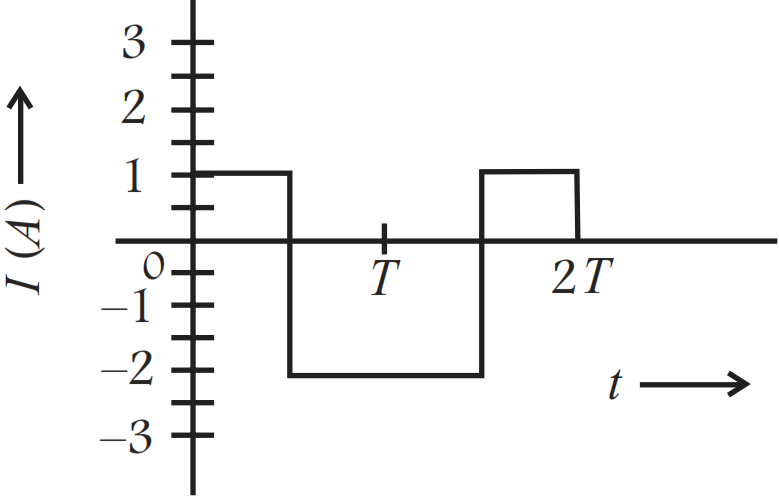
The alternating current in a circuit is described by the graph shown in Fig. Show rms current in this graph.
Answer
$I_{rms}= 1.6A$ (shown in Fig. by dotted line).
View full question & answer
Question 432 Marks
The current in a discharging LR circuit is given by $\text{i}=\text{i}_0\text{e}^{\frac{-\text{t}}{\tau}}$ where $\tau$ is the time constant of the circuit. Calculate the rms current for the period $\text{t}=0$ to $\text{t}=\tau.$
Answer
$\text{i}=\text{i}_0\text{e}^{\frac{-\text{t}}{\tau}}$
$\text{i}^2=\frac{1}{\tau}\int\limits_0^\tau\text{i}_0{^2}\text{e}^{\frac{-2\text{t}}{\tau}}\text{dt}$
$=\frac{\text{i}_0{^2}}{\tau}\int\limits_0^\tau\text{e}^{\frac{-2\text{t}}{\tau}}\text{dt}$
$=\frac{\text{i}_0{^2}}{\tau}\times\Big[\frac{\tau}{2}\text{e}^{\frac{-2\text{t}}{\tau}}\Big]_0^\tau$
$=-\frac{\text{i}_0{^2}}{\tau}\times\frac{\tau}{2}\big[\text{e}^{-2}-1\big]$
$\sqrt{\text{i}^2}=\sqrt{-\frac{\text{i}_0^2}{2}\Big(\frac{1}{\text{e}^2}-1\Big)}$
$=\frac{\text{i}_0^2}{2}\sqrt{\Big(\frac{\text{e}^2-1}{2}\Big)}$
View full question & answer
Question 442 Marks
Distinguish between the terms ‘effective value’ and peak value of alternating current.
Answer
Alternating current changes in magnitude as well as direction. The maximum value of the alternating current is called the peak value. It is denoted by $I_0$. The square root of mean square value of current is called the ‘effective value’ or ‘rms value’ of current. The two are related by
Effective value, $\text{E}_{\text{eff}}=\frac{\text{I}_0}{\sqrt{2}}$
View full question & answer
Question 452 Marks
A resistance is connected to an AC source. If a capacitor is included in the series circuit, will the average power absorbed by the resistance increase or decrease? If an inductor of small inductance is also included in the series circuit, will the average power absorbed increase or decrease further?
Answer
If capacitor is included
$\text{Z}=\sqrt{\text{R}^2+\text{X}_\text{C}^2}$
Hence, impedence increases so $I_{rms}$ decreases. Hence, ${I_{rms}}^2\ R$ decreases. If the inductor of small inductance is also included then,
$\text{Z}=\sqrt{\text{R}^2+\big(\text{X}_\text{C}-\text{X}_\text{L}\big)^2}$
Now, impedance gets decreased hence $I_{rms}$ increases and ${I_{rms}}^2\ R$ increases.
View full question & answer
Question 462 Marks
At a hydroelectric power plant, the water pressure head is at a height of 300m and the water flow available is $100m^3s^{-1}$. If the turbine generator efficiency is 60%, estimate the electric power available from the plant $(g = 9.8ms^{-2}).$
Answer
Height of water pressure head, $\mathrm{h}=300 \mathrm{~m}$
Volume of water flow per second, $\mathrm{V}=100 \mathrm{~m}^3 / \mathrm{s}$
Efficiency of turbine generator, $n=60 \%=0.6$
Acceleration due to gravity, $g=9.8 \mathrm{~m} / \mathrm{s}^2$
Density of water, $\rho=10^3 \mathrm{~kg} / \mathrm{m}^3$
Electric power available from the plant $=\eta \times \mathrm{h} \rho \mathrm{gV}$
$ =0.6 \times 300 \times 10^3 \times 9.8 \times 100$
$ =176.4 \times 10^6 \mathrm{~W}$
$ =176.4 \mathrm{MW} .$
View full question & answer
Question 472 Marks
Answer the following questions:
In any ac circuit, is the applied instantaneous voltage equal to the algebraic sum of the instantaneous voltages across the series elements of the circuit? Is the same true for rms voltage?
Answer
Yes; the statement is not true for rms voltage
It is true that in any ac circuit, the applied voltage is equal to the average sum of the instantaneous voltages across the series elements of the circuit. However, this is not true for rms voltage because voltages across different elements may not be in phase.
View full question & answer
Question 482 Marks
A 44mH inductor is connected to 220V, 50Hz ac supply. Determine the rms value of the current in the circuit.
Answer
Inductance of inductor, $L = 44mH = 44 × 10^{-3}H$
Supply voltage, $V = 220V$
Frequency, $v = 50Hz$
Angular frequency, $\omega=2\pi\text{v}$
Inductive reactance, $\text{X}_{\text{L}}=\omega\text{L}=2\pi\text{vL}=2\pi\times50\times44\times10^{-3}\Omega$
Rms value of current is given as:
$\text{I}=\frac{\text{v}}{\text{X}_{\text{L}}}$
$=\frac{220}{2\pi\times50\times44\times10^{-3}}=15.92\text{A}$
Hence, therms value of current in the circuit is 15.92A.
View full question & answer
Question 492 Marks
The dielectric strength of air is $3.0 × 10^6V/m.$ A parallel-plate air-capacitor has area $20cm^2$ and plate separation 0.10mm. Find the maximum rms voltage of an AC source that can be safely connected to this capacitor.
Answer
$E = 3 × 10^6V/m, A = 20cm^2, d = 0.1mm.$
Potential difference across the capacitor $= Ed = 3 × 10^6× 0.1 × 10^{-3}= 300V$
Maximum rms Voltage $=\frac{\text{V}}{\sqrt{2}}=\frac{300}{\sqrt{2}}=212\text{V}.$
View full question & answer
Question 502 Marks
A 100Ω resistor is connected to a 220V, 50Hz ac supply.
  1. What is the rms value of current in the circuit?
  2. What is the net power consumed over a full cycle?
Answer
Resistance of tile resistor, $\text{R}=100\Omega$
Supply voltage, v = 220V
Frequency, v = 50Hz
  1. The rms value of current in the circuit is given as:
$\text{I}=\frac{\text{V}}{\text{R}}$

$=\frac{220}{100}=2.20\text{A}$
  1. The net power consumed over a full cycle is given as:
P = VI

= 220 × 2.2 = 484W.
View full question & answer
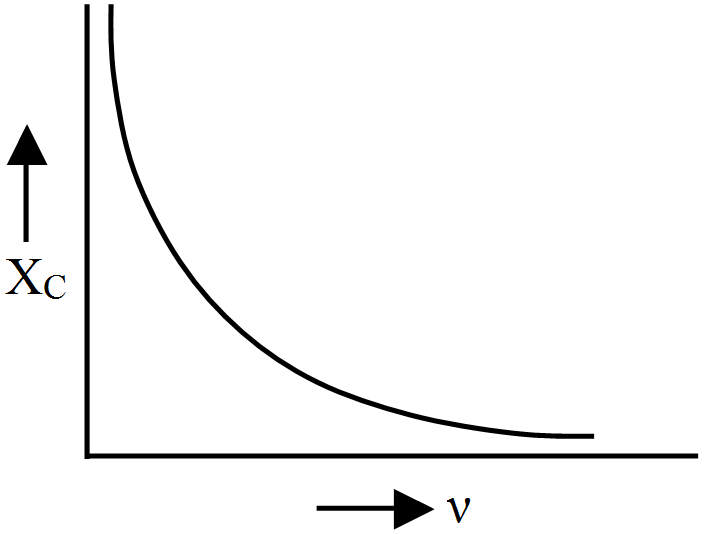
Question 512 Marks
Sketch a graph showing variation of reactance of a capacitor with frequency in an AC circuit.
Answer
Capacitive reactance, The graph of capacitive reactance XC and frequency ν is shown in figure.
View full question & answer
Question 522 Marks
What will be the effect on inductive reactance XL and capacitive reactance XC if frequency of ac source is increased?
Answer
The inductive reactance $\text{X}_{\text{L}}=\omega\text{L}=2\pi\text{vL}$ will increase with the increase of frequency v, while capacitive reactance $\text{X}_{\text{C}}=\frac{1}{\omega\text{C}}=\frac{1}{2\pi\text{vC}}$ will decrease with the increase of frequency v.
View full question & answer
Question 532 Marks
Suppose the initial charge on the capacitor in Exercise 7.7 is 6mC. What is the total energy stored in the circuit initially? What is the total energy at later time?
Answer
Capacitance of the capacitor, $\mathrm{C}=30 \mu \mathrm{~F}=30 \times 10^{-6} \mathrm{~F}$
Inductance of the inductor, $\mathrm{L}=27 \mathrm{mH}=27 \times 10^{-3} \mathrm{H}$ Charge on
the capacitor, $\mathrm{Q}=6 \mathrm{mC}=6 \times 10^{-3} \mathrm{C}$
Total energy stored in the capacitor can be calculated by the relation,
$\text{E}=\frac{1}{2}\frac{\text{Q}^2}{\text{C}}$
$=\frac{1}{2}\times\frac{(6\times10^{-3})^2}{30\times10^{-6}}$
$=\frac{6}{10}=0.6\text{J}$
Total energy at a later time will remain the same because energy is shared between the capacitor and the inductor.
View full question & answer
Question 542 Marks
Answer the following questions:
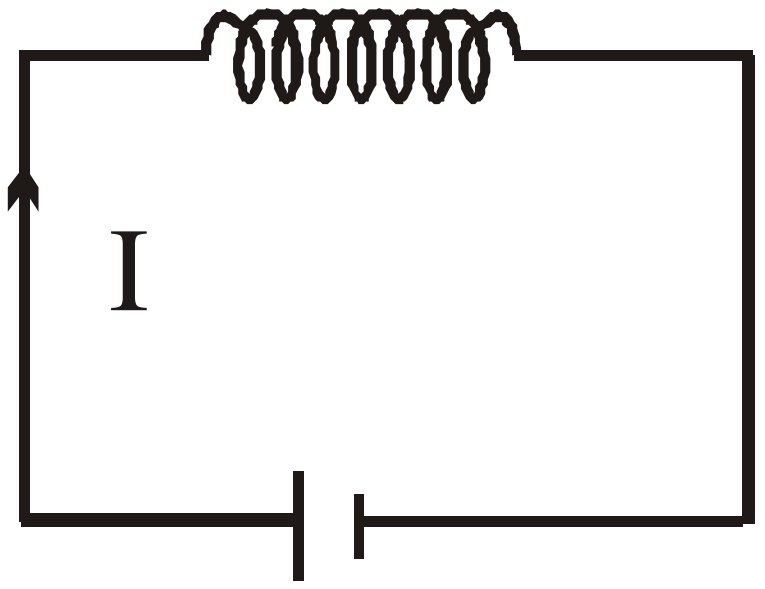
A choke coil in series with a lamp is connected to a dc line. The lamp is seen to shine brightly. Insertion of an iron core in the choke causes no change in the lamp’s brightness. Predict the corresponding observations if the connection is to an ac line.
Answer
If an iron core is inserted in the choke coil (which is in series with a lamp connected to the ac line), then the lamp will glow dimly. This is because the choke coil and the iron core increase the impedance of the circuit.
View full question & answer
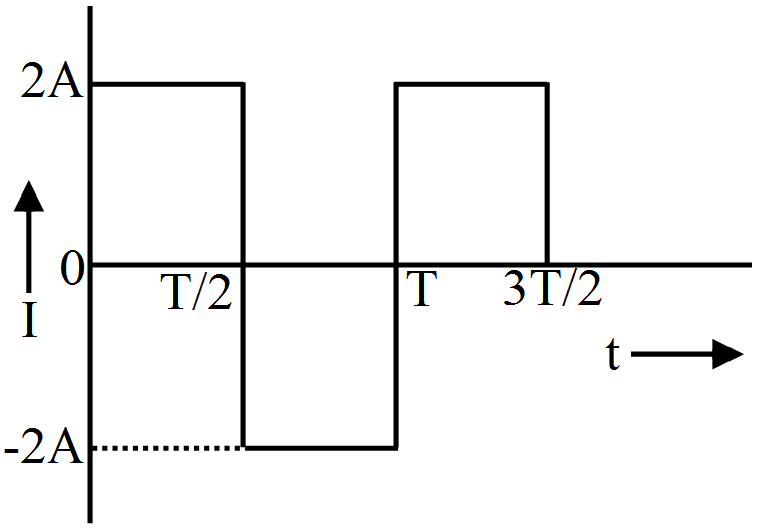
Question 552 Marks
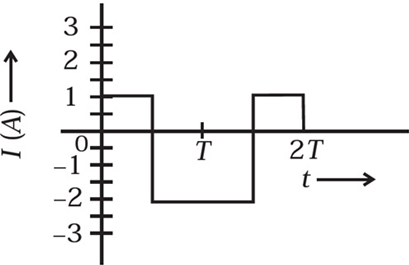
What is the rms value of alternating current shown in figure?
Answer
$(\text{I}^2)_{\text{mean}}=\frac{\int\limits^{\text{T}}_{0}\text{I}^2\text{dt}}{\int\text{dt}}=\frac{\int\limits^{\frac{\text{T}}{2}}_0(2)^2\text{dt}+\int\limits^{\text{T}}_{\frac{\text{T}}{2}}(-2)^2\text{dt}}{\text{T}}=\frac{\int\limits^{\text{T}}_04\text{dt}}{\text{T}}=4$
$\text{I}_{\text{rms}}=\sqrt{4}=2\text{A}$
View full question & answer
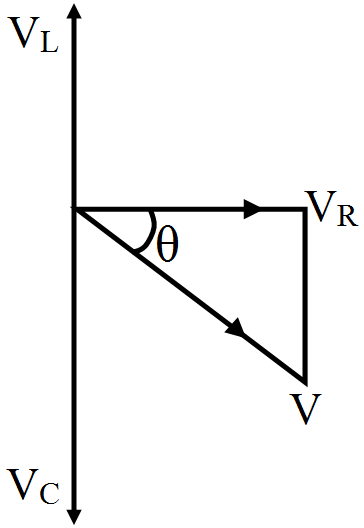
Question 562 Marks
Can the voltage drop across the inductor or the capacitor in a series LCR circuit be greater than the applied voltage of the a.c. source? Justify your answer.
Answer
Yes; because As $V_C$ and $V_L$ have opposite faces, $V_C$ or $V_L$ may be greater than V. The situation may be as shown in figure where $V_C > V$
View full question & answer
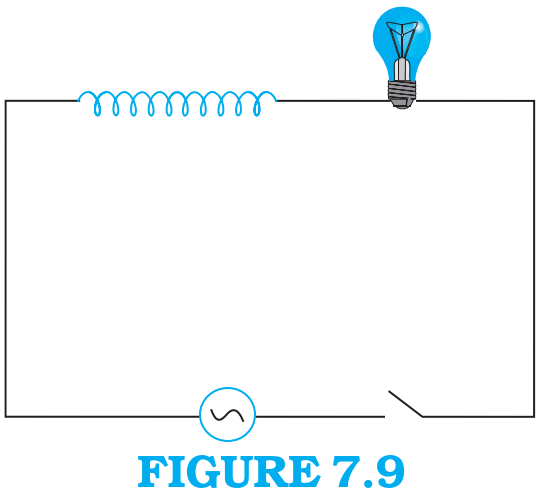
Question 572 Marks
A light bulb and an open coil inductor are connected to an ac source through a key as shown in Fig. 7.9.
Image
The switch is closed and after sometime, an iron rod is inserted into the interior of the inductor. The glow of the light bulb (a) increases; (b) decreases; (c) is unchanged, as the iron rod is inserted. Give your answer with reasons.
Answer
As the iron rod is inserted, the magnetic field inside the coil magnetizes the iron increasing the magnetic field inside it. Hence, the inductance of the coil increases. Consequently, the inductive reactance of the coil increases. As a result, a larger fraction of the applied ac voltage appears across the inductor, leaving less voltage across the bulb. Therefore, the glow of the light bulb decreases.
View full question & answer
Question 582 Marks
A $15.0 \mu F$ capacitor is connected to a $220 V , 50 Hz$ source. Find the capacitive reactance and the current (rms and peak) in the circuit. If the frequency is doubled, what happens to the capacitive reactance and the current?
Answer
The capacitive reactance is
$
X_C=\frac{1}{2 \pi v C}=\frac{1}{2 \pi(50 Hz )\left(15.0 \times 10^{-6} F \right)}=212 \Omega
$
The rms current is
$
I=\frac{V}{X_C}=\frac{220 V }{212 \Omega}=1.04 A
$
The peak current is
$
i_m=\sqrt{2} I=(1.41)(1.04 A )=1.47 A
$
This current oscillates between $+1.47 A$ and $-1.47 A$, and is ahead of the voltage by $\pi / 2$.
If the frequency is doubled, the capacitive reactance is halved and consequently, the current is doubled.
View full question & answer
Question 592 Marks
A lamp is connected in series with a capacitor. Predict your observations for dc and ac connections. What happens in each case if the capacitance of the capacitor is reduced?
Answer
When a de source is connected to a capacitor, the capacitor gets charged and after charging no current flows in the circuit and the lamp will not glow. There will be no change even if $C$ is reduced. With ac source, the capacitor offers capacitative reactance $(1 / \omega C)$ and the current flows in the circuit. Consequently, the lamp will shine. Reducing $C$ will increase reactance and the lamp will shine less brightly than before.
View full question & answer
Question 602 Marks
A light bulb is rated at $100 W$ for a $220 V$ supply. Find (a) the resistance of the bulb; (b) the peak voltage of the source; and (c) the rms current through the bulb.
Answer
(a) We are given $P=100 W$ and $V=220 V$. The resistance of the bulb is
$
R=\frac{V^2}{P}=\frac{(220 V )^2}{100 W }=484 \Omega
$
(b) The peak voltage of the source is
$
v_m=\sqrt{2} V =311 V
$
(c) Since, $P=I V$
$
I=\frac{P}{V}=\frac{100 W }{220 V }=0.454 A
$
View full question & answer