Question

What is the stopping potential when the metal with work function 0.6 eV is illuminated with the light of 2 eV

(a) 2.6 V

(b) 3.6 V

(c) 0.8 V  

(d) 1.4 V

Answer

(d) 1.4 V

Need a full question paper?

Generate a complete, print-ready paper with questions like this in minutes — across 16+ boards, with answer keys.

Start Generating Free

Similar questions

The electric field E, current density J and conductivity s  of a conductor are related as

(a) σ = E/j  

(b) σ = j/E

(c) σ = jE

(d) σ = 1/jE

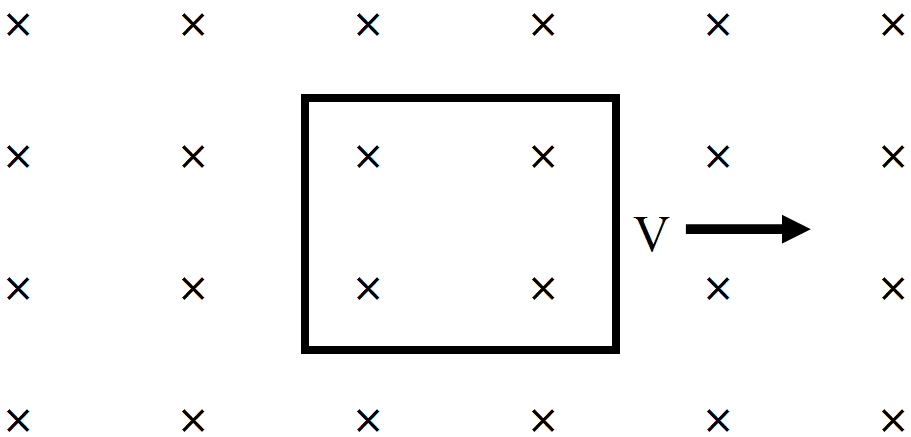
A conducting square loop of side l and resistance R moves in its plane with a uniform velocity u perpendicular to one of its sides. A uniform and constant magnetic field B exists along the perpendicular to the plane of the loop as shown in figure. The current induced in the loop is:
  1. $\frac{\text{Blv}}{\text{R}}$ clockwise.
  2. $\frac{\text{Blv}}{\text{R}}$ anticlockwise.
  3. $\frac{2\text{Blv}}{\text{R}}$ anticlockwise.
  4. $\text{Zero.}$

If a high power heater is connected to electric mains, then the bulbs in the house become dim, because there is a

(a) Current drop

(b) Potential drop

(c) No current drop

(d) No potential drop

A beam of electrons and protons move parallel to each other in the same direction, then they

(a) Attract each other

(b) Repel each other

(c) No relation  

(d) Neither attract nor repel

Two light beams superimposed each other constructively this results in:
There is no hole current in conductors, because they have:
The energy band gap (distance between the conduction band and valence band) in conductor is.

In Millikan's oil drop experiment an oil drop carrying a charge Q is held stationary by a potential difference 2400 V  between the plates. To keep a drop of half the radius stationary the potential difference had to be made 600 V. What is the charge on the second drop

(a)  

(b)   

(c) Q

(d)  

An object is placed at a distance u from a simple microscope of focal length f. The angular magnification obtained depends:

To deposit one litre of hydrogen at 22.4 atmosphere from acidulaled water, the quantity of electricity that must pass through is

(a) 1 coulomb

(b) 22.4 coulomb


(c) 96500 coulomb

(d) 193000 coulomb