Question

What is the total charge on the parallel plate capacitor shown?
Image

Answer

  1. 0
Explanation:
Since the total charge on a capacitor is given by sum of the charges on the two parallel plates, here charge on each plate is equal and opposite, hence –Q + Q = 0. Therefore, the total charge on the capacitor is 0.

Need a full question paper?

Generate a complete, print-ready paper with questions like this in minutes — across 16+ boards, with answer keys.
Start Generating Free

Similar questions

The rate of disintegration at a given instant, is directly proportional to the number of atoms present at that instant. This is the statement of:
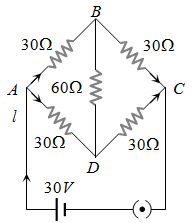
The current between $B$ and $D$ in the given figure is
In order to quadruple the resistance of a uniform wire, a part of its length was uniformly stretched till the final length of the entire wire was $1.5$ times the original length, the part of the wire was fraction equal to
In positive logic, the logic state 1 corresponds to:
Two concentric coplanar circular loops of radii $r_1$ and $r_2$ carry currents of respectively $i_1$ and $i_2$ in opposite directions $($one clockwise and the other anticlockwise.$)$ The magnetic induction at the centre of the loops is half that due to $i_1$ alone at the centre. If $r_1=r_2$. the value of $\frac{i_1}{i_2}$ is
A person uses spectacles of power +2D. He is suffering from(a) Short sightedness or myopia(b) Long sightedness or hypermetropia(c) Presbyopia(d) Astigmatism
   
   
At a point 20 cm from the centre of a uniformly charged dielectric sphere of radius 10 cm, the electric field is 100 V/m. The electric field at 3 cm from the centre of the sphere will be(a) 150 V/m(b) 125 V/m(c) 120 V/m(d) Zero
       
The energy of a charged capacitor is given by the expression $( q=$ charge on the conductor and $C=$ its capacity$)$
Assertio  :   In the phenomenon of mutual induction, self induction of each of the coils persists.
Reason   : Self induction arises when strength of current in same coil changes. In mutual induction, current is changing in both the individual coils.(a) If both assertion and reason are true and the reason is the correct explanation of the assertion.(b) If both assertion and reason are true but reason is not the correct explanation of the assertion.(c) If assertion is true but reason is false.(d) If the assertion and reason both are false.


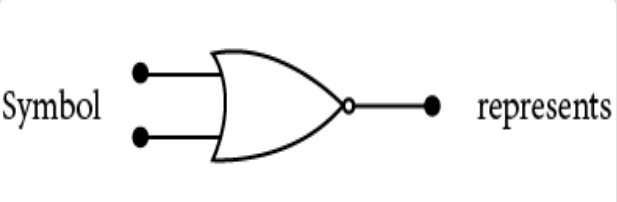
Identify the logic gate in figure.