Question
What is the total work done on moving a test charge on an equipotential surface?

Answer

  1. Zero
Explanation:
The potential difference between any two points on an equipotential surface is zero.
Work done = Test charge x potential difference(0)

Need a full question paper?

Generate a complete, print-ready paper with questions like this in minutes — across 16+ boards, with answer keys.
Start Generating Free

Similar questions

The radius of the convex surface of plano-convex lens is 20 cm and the refractive index of the material of the lens is 1.5. The focal length of the lens is(a) 30 cm(b) 50 cm(c) 20 cm(d) 40 cm
       
Three observers $A, B$ and $C$ measure the speed of light coming from a source to be $vA, 0B$ and $vc.$ The observer $A$ moves towards the source and $C$ moves away from the source at the same speed. The observer $B$ stays stationary. The surrounding space is vacuum everywhere.
If the half life of a radioactive sample is 10 hours, its mean life is(a) 14.4 hours(b) 7.2 hours(c) 20 hours(d) 6.93 hours
       
If the refractive index of denser medium 1 relative to rare medium 2 is $n_{12}$ and the critical angle for the pair of these mediums is $i_{ c }$, then the relationship between $n _{12}$ and $i_c$ is :
In $L-R$ circuit, for the case of increasing current, the magnitude of current can be calculated by using the formula
A dry cell has an e.m.f. of 1.5 V and an internal resistance of 0.05Ω. The maximum current obtainable from this cell for a very short time interval is(a) 30 A(b) 300 A(c) 3 A(d) 0.3 A
       
Fusion process takes place at high temperature because at high temperature :
According to classical theory, path of electron in Rutherford model :
Magnetic dipole moment is a(a) Scalar quantity(b) Vector quantity(c) Constant quantity(d) None of these
       
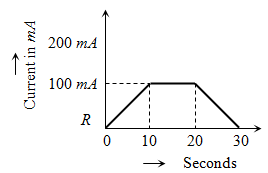
In a copper voltameter, mass deposited in $30$ second is $m \ gm.$ If the time$-$current graph is as shown in figure, $\text{ECE}$ of copper is