MCQ
What is the valence electron in alkali metal?
- AF-electron
- BP-electron
- CS-electron
- DD-electron
Explanation:
The valence electron in an alkali metal is an s-electron.
Generally, they make up Group 1 of the periodic table.
The different examples that come under this category are lithium, potassium, and francium.
Generate a complete, print-ready paper with questions like this in minutes — across 16+ boards, with answer keys.
In given figure, the potentiometer wire AB has a resistance of 5 W and length 10 m. The balancing length AM for the emf of 0.4 V is

|
(a) 0.4 m |
(b) 4 m |
(c) 0.8 m |
(d) 8 m |
In Young's double slit experiment, the phase difference between the light waves reaching third bright fringe from the central fringe will be (λ =6000 Å )
|
(a) Zero |
(b) 2π |
(c) 4 π |
(d) 6 π |
Two electric bulbs A and B are rated as 60 W and 100 W. They are connected in parallel to the same source. Then,
|
(a) Both draw the same current |
|
(b) A draws more current than B |
|
(c) B draws more current than A |
|
(d) Current drawn are in the ratio of their resistances |
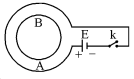
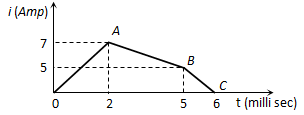
The current through a 4.6 H inductor is shown in the following graph. The induced emf during the time interval t = 5 milli-sec to 6 milli-sec will be
|
(a) 103 V |
(b) – 23 × 103 V |
(c) 23 × 103 V |
(d) Zero |