Question
What is venturi-meter? On which principle does it work? How is the principle of venturi-meter applied in automobiles?

Answer

Venturi-meter is a device used to measure the flow speed of a liquid. It is basically based on Bernoulli's principle and works on the principle that when a liquid flows in the tube from wide neck to a narrow constriction, the speed of flow increases and the pressure falls.
Bernoulli's principle states that with the increase in the velocity of the fluid its pressure decreases (or) there is a decrease in the fluid pressure energy. This decrease in the fluid pressure in the areas where the flow velocity is increased is called the Bernoulli effect.
It is utilised in the carburettor of automobiles. The carburettor has a venturi channel (fine nozzle) through which air flows with a large speed. The pressure is then lowered at the narrow neck as a result, the valve of petrol chambers opens and the petrol is sucked up in the chamber to provide the correct mixture of air and petrol necessary for combustion.

Need a full question paper?

Generate a complete, print-ready paper with questions like this in minutes — across 16+ boards, with answer keys.
Start Generating Free

Similar questions

  1. Describe a Carnot's cycle.
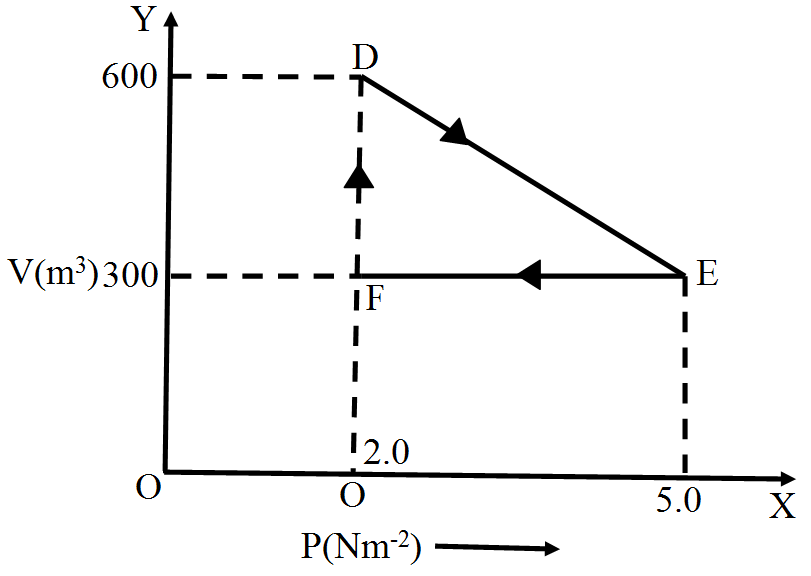
  2. A thermodynamic system is taken from an original state to an intermediate state by the linear process shown in below figure. Its volume is then reduced to the original value from $E$ to $F$ by an isobaric process. Calculate the work done by the gas from $D$ to $E$ to $F$.
The weight of a body on the surface of earth is 250N. Calculate its weight at distance equal to half of the radius of earth below the surface of earth. (Radius of earth = 6400km).
In science sometimes we observe certain phenomenon experimentally but are unable to give a logical equation or theory for that. Sometimes, it also happens that we have a scientific theory supported by mathematical formulation yet are unable to test it immediately. Cite one such example.
Water near the bed of a deep river is quiet while that near the surface flows. Give reasons.
$^{228}Th$ emits an alpha particle to reduce to $^{224}Ra$. Calculate the kinetic energy of the alpha particle emitted in the following decay:$\text{ }^{228}\text{Th}\rightarrow\text{ }^{224}\text{Ra}^*+\alpha$
$\text{ }^{224}\text{Ra}^*\rightarrow\text{ }^{224}\text{Ra}+\gamma(217\text{kev}).$
Atomic mass of $^{228}Th$ is 228.028726u, that of $^{224}Ra$ is 224.020196u and that of $\text{ }^4_2\text{He}$ is 4.00260u.
Estimate the change in the density of water in ocean at a depth of $400m$ below the surface. The density of water at the surface = $1030kg/m^3$ and the bulk modulus of water = $2 \times 10^9N/m^2$.
A person standing on a platform finds that a train moving with velocity $0.6c$ takes one second to pass by him. Find:
  1. The length of the train as seen by the person and.
  2. The rest length of the train.
Draw the following graphs for an object projected upward with a velocity $v _0$, which comes back to the same point after some time:
i. Acceleration versus time graph,
ii. Speed versus time graph,
iii. Velocity versus time graph.
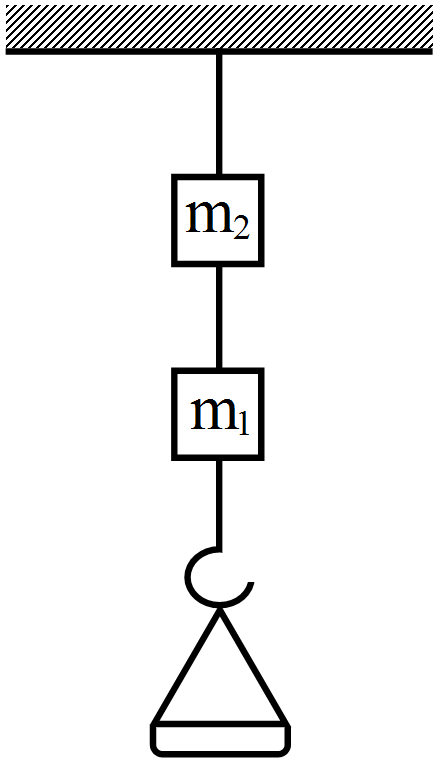
The two wires shown in are made of the,

same material which has a breaking stress of $8 \times 10^8N/m^2$. The area of cross$-$section of the upper wire is $0.006\ cm^2$ and that of the lower wire is $0.003\ cm^2$. The mass $m_1 = 10\ kg, m_2= 20\ kg$ and the hanger is light:
  1. Find the maximum load that can be put on the hanger without breaking a wire. Which wire will break first if the load is increased?
  2. Repeat the above part if $m_1 = 10\ kg$ and $m_2 = 36\ kg$.
A boy travelling in an open car moving on a levelled road with constant speed tosses a ball vertically up in the air and catches it back. Sketch the motion of the ball as observed by a boy standing on the footpath. Give explanation to support your diagram.