Question
The weight of a body on the surface of earth is 250N. Calculate its weight at distance equal to half of the radius of earth below the surface of earth. (Radius of earth = 6400km).

Answer

Given: W = mg = 250N $\text{d}=\frac{6400}{2}=3200\text{km}$ $\text{R}=6400\text{km}$ $\text{W}'=\text{mg}'=?$ $\text{g}'=\text{g}\Big(1-\frac{\text{d}}{\text{R}}\Big)$ $\text{mg}'=\text{mg}\Big(1-\frac{\text{d}}{\text{R}}\Big)$ $\text{W}'=250\Big(1-\frac{3200}{6400}\Big)$ $=250\Big(1-\frac{1}{2}\Big)=125\text{N}.$

Need a full question paper?

Generate a complete, print-ready paper with questions like this in minutes — across 16+ boards, with answer keys.
Start Generating Free

Similar questions

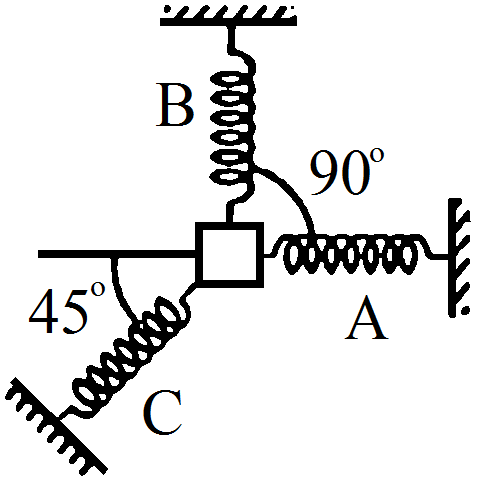
A particle of mass in is attatched to three springs A, B and C of equal force constants k as shown in figure If the particle is pushed slightly against the spring C and released, find the time period of oscillation.
Does a nucleus lose mass when it suffers gamma decay?
A fat man is used to consuming about 3000k/ cal worth of food everyday. His food contains 50g of butter plus a plate of sweets everyday. besides items which provide him with other nutrients (proteins, vitamins, minerals, etc.) in addition to fats and carbohydrates. The calorific value of 10g of butter is 60k/ cal and that of a plate of sweets is of average 700k/ cal. What dietary strategy should he adopt to cut down his calories to about 2100k/ cal per day? Assume the man cannot resist eating the full plate of sweets once it is offered to him.
A particle executes the motion described by $\text{x}(\text{t})=\text{x}_0(1-\text{e}^{-\gamma\text{t}});\text{t}\ge0,\text{x}_0>0.$ Where does the particle start and with what velocity?
A constant retarding force of $50N$ is applied to a body of mass $20kg$ moving initially with a speed of $15ms^{-1}$. How long does the body take to stop?
A sphere of mass $40kg$ is attracted by another mass of $15kg$ when their centres are $20cm$ apart, with a force of $1 \times 10^{-6} N$. Calculate the value of gravitational constant.
A straight wire carrying an electric current is placed along the axis of a uniformly charged ring. Will there be a magnetic force on the wire if the ring starts rotating about the wire? If yes, in which direction?
Compute the following with regards to significant figures.
  1. $4.6\times0.128$
  2. $\frac{0.9995\times1.53}{1.592}$
  3. $876+0.4382$
The industrial revolution in England and Western Europe more than two centuries ago was triggered by some key scientific and technological advances. What were these advances?
A simple microscope has a magnifying power of $3.0$ when the image is formed at the near point $(25\ cm)$ of a normal eye.
  1. What is its focal length?
  2. What will be its magnifying power if the image is formed at infinity?