Gujarat BoardEnglish MediumSTD 12 ScienceChemistryElectrochemistry3 Marks
Question
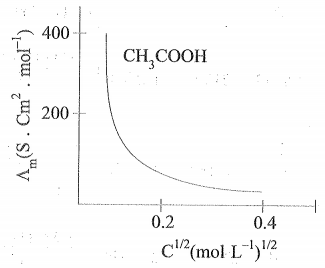
What is weak electrolyte? Explain relation between concentration of weak electrolyte and molar conductivity.
✓
Answer
→ "Electrolyte which is incompletely ionized in its aqueous solution are known as weak electrolyte. →" Weak electrolytes like acetic acid have lower degree of dissociation at higher concentrations and hence for such electrolytes, the change in $\hat{m}_{ m }$ with dilution is due to increase in the degree of dissociation and consequently the number of ions in total volume of solution that contains 1 mol of electrolyte. → In such cases $\wedge_{ m }$ increases steeply on dilution especially near lower concentrations. Therefor $\wedge_{ m }^0$ cannot be obtained by extra polation of $\wedge_{ m }^0$ zero concentration. → At infinite dilution (i.e. concentration $c \rightarrow$ zero electrolyte dissociates completely $(\alpha=1)$, but such low concentration the conductivity of the solution is so low that it cannot be measured accurately. → Therefore, $\wedge_{ m }^0$ for weak electrolytes is obtained by using Kohlrausch law of independent migration of ions. → At any concentration c , if a is the degree of dissociation then it can be approximated to the ratio of molar conductivity $\wedge_{ m }$ at the concentration c to limiting molar conductivity, $\wedge_{ m }^0$ Thus we have : $\begin{aligned} \alpha & =\frac{\Lambda_{ m }}{\Lambda_{ m }^0} \\ k _{ a } & =\frac{ c \alpha^2}{1-\alpha}=\frac{ c \Lambda_{ m }^2}{\Lambda_{ m }^{02}\left(1-\frac{\Lambda_{ m }}{\Lambda_{ m }^0}\right)}=\frac{ c \Lambda_{ m }^2}{\Lambda_{ m }^0 \Lambda_{ m }^0-\Lambda_{ m }}\end{aligned}$
Need a full question paper?
Generate a complete, print-ready paper with questions like this in minutes — across 16+ boards, with answer keys.