Question
What is weathering? Explain different types of weathering.

Answer

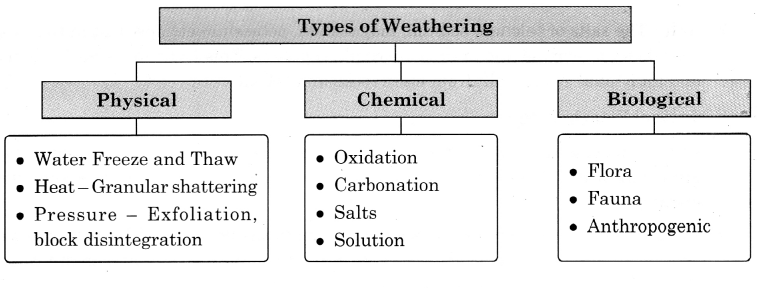
Weathering refers to the break down or disintegration and decomposition of rocks in situ through mechanical and chemical changes in the rocks and their minerals affected by water temperature, wind, different atmospheric gases and organisms. Following are the types of weathering- Image
Let us study the types in details:
Physical Weathering:
(i) Water:
  1. In areas where diurnal temperature range is high, water inside the crack’s freezes during night and melts during daytime.
  2. Due to this continuous freezing and thawing, the cracks widen and disintegration of rocks takes place. This is called freeze and thaw weathering.
(ii) Heat:
  1. In hot deserts the temperature increases during the day. The minerals present in the rock react differently to the increased temperature.
  2. The minerals within the rock expand leading to stress and the rock breaks into individual mineral grains. This is called as granular disintegration.
  3. In the similar process, in the deserts during day time the rock surface gets heated and shatters. It may produce a breaking sound. This is called shattering.
  4. In rocks such as granite which have joints, heat can cause weathering by breaking the rocks along the joints into blocks. This is called block disintegration.
Pressure:
  1. Due to overlying rocks, the rocks beneath the surface experience a lot of pressure.
  2. When the underlying rock gets exposed to the surface, they are subjected to low pressure. As a result of pressure differences, the rock mass expands outwards.
  3. The expansion causes outer layer to separate from lower layer. It is called dislodgement which happens due to pressure release. It is mainly observed in igneous rocks which are more homogeneous. The continuous removal of outer layer of the rock is called exfoliation.
Chemical Weathering:
  1. Oxidation: When oxygen from air and water reacts with iron or bauxite present in the rocks, iron and aluminium oxides are formed. The colour of the rock changes and it is called rusting.
  2. Carbonation: When carbon-dioxide reacts with the minerals in the soil, carbonation takes place. The decomposition of dead produces C02, which reacts with minerals in the rocks.
  3. Solution: When some minerals in the rocks reacts with water in the rock or moisture in the air and gets dissolved, it is called solution. For example, chalk dissolves in water.
  4. Salt: The salts of calcium, sodium, magnesium, potassium etc., present in the rocks have a tendency to expand due to their thermal properties. This leads to crystallization of salts and individual grains spilt from main rocks and fall off at the end.
Biological Weathering:
Flora : Roots of trees penetrate into the soil in search of minerals. Sometimes the plants grow within the fissures in the rock leading to widening of the fissures and eventually disintegrating.

Fauna : Microscopic organisms such as algae, moss, lichens and bacteria grow on rock surface and produce chemicals, which react with the rock surface and create weathering. Burrowing animals like moles, mice, rats, reptiles, like snakes etc., dig holes in the soil and speeds up disintegration.

Anthropogenic weathering:
Man is responsible for weathering as he constructs roads, railways, do mining etc.
  1. Man being a biological agent affects weathering.
  2. With economic and technological development, man has become the most powerful weathering and erosion agent.
  3. Mining, blasting of hills and ridges for road and dam construction, quarrying for industrial and building materials, etc result in a fast rate of disintegration of rocks.
  4. This may be accomplished by natural weathering processes in thousands to millions of years.
  5. Man accelerates the rate of weathering on hill slopes through activities like deforestation.

Need a full question paper?

Generate a complete, print-ready paper with questions like this in minutes — across 16+ boards, with answer keys.
Start Generating Free