Question
What is work and also give examples of the following :(i) Zero work(ii) Positive work(iii) Negative work
Answer

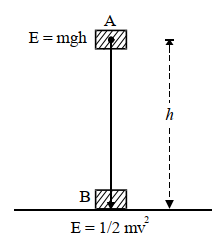
Suppose a constant force F is acting on an object of mass $m$ due to which the displacement of the
object in the positive $x$-direction is $\overrightarrow{ S }$, as shown in the figure.

Image
Therefore the work done by a force is defined as 'the product of the magnitude of displacement and component of force along the direction of displacment. Therefore,
$
W=(F \cos \theta) s=\overrightarrow{F} \cdot \overrightarrow{S} \ \ldots(1)
$
(i) Zero work : It is clear from equation (1) that if the displacement of the object is zero then no matter how great is the magnitude of force, the work done by the object is zero. No work is considered completed if
(a) the displacement is zero
(b) force is zero
(c) force and displacement are perpendicular to each other. Since $\theta=\frac{\pi}{2}$ and $\cos \frac{\pi}{2}=0$ is always zero.
The centripetal force on an object moving in a circular path with constant speed is perpendicular to the displacement hence the work done by the centripetal force is zero.
(ii) Positive work : If $\theta \geq 0^{\circ}$ and $\theta<90^{\circ}$ then the value of $\cos \theta$ is positive. In such a situation the work is positive. For example, when a man pulls a roller, the value of work is positive.
(iii) Negative work: When $90^{\circ}<\theta \leq 180^{\circ}$ then the value of $\cos \theta$ is negative. Hence the work is negative.
For example, when a roller is pulled on a rough surface, the friction force and displacement are in opposite directions hence the work done by the friction force is negative.

Need a full question paper?

Generate a complete, print-ready paper with questions like this in minutes — across 16+ boards, with answer keys.
Start Generating Free

Similar questions

A vessel $A$ contains hydrogen and another vessel $B$ whose volume is twice of $A$ contains same mass of oxygen at the same temperature. Compare $(i)$ average kinetic energies of hydrogen and oxygen molecules $(ii)$ root mean square speeds of the molecules $(iii)$ pressure of gases in $A$ and $B$. Molecular weights of hydrogen and oxygen are $2$ and $32$ respectively.
State Wien's displacement law. Draw graph showing energy emitted versus wavelength for a blackbody at different temperature.
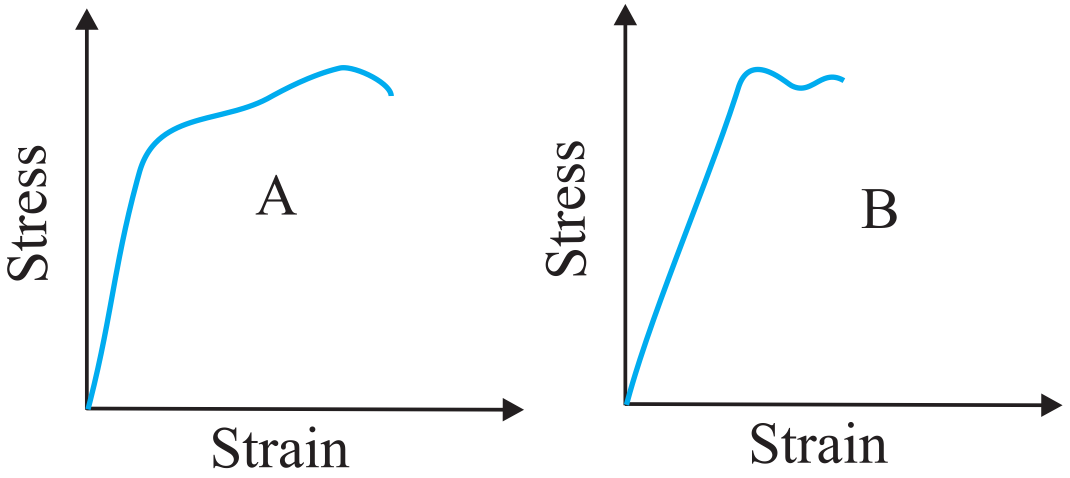
The stress-strain graphs for materials $A$ and $B$ are shown in Fig. The graphs are drawn to the same scale.
  1. Which of the materials has the greater Young’s modulus?
  2. Which of the two is the stronger material?
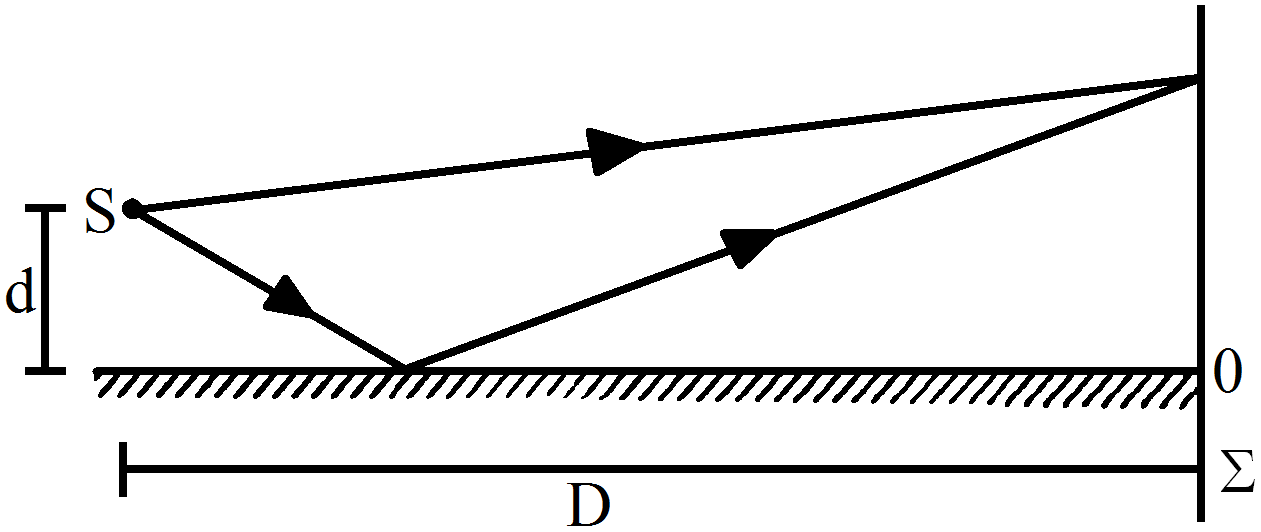
A narrow slit $S$ transmitting light of wavelength $\lambda$ is placed a distance d above a large plane mirror as shown in figure $(17-E1).$ The light coming directly from the slit and that coming after the reflection interfere at a screen $\sum$ placed at a distance $D$ from the slit.
  1. What will be the intensity at a point just above the mirror, i.e., just above $O?$
  2. At what distance from $0$ does the first maximum occur?
The gravitational force acting on a particle of $1g$ due to a similar particle is equal to $6.67 \times 10^{-17}N$. Calculate the separation between the particles.
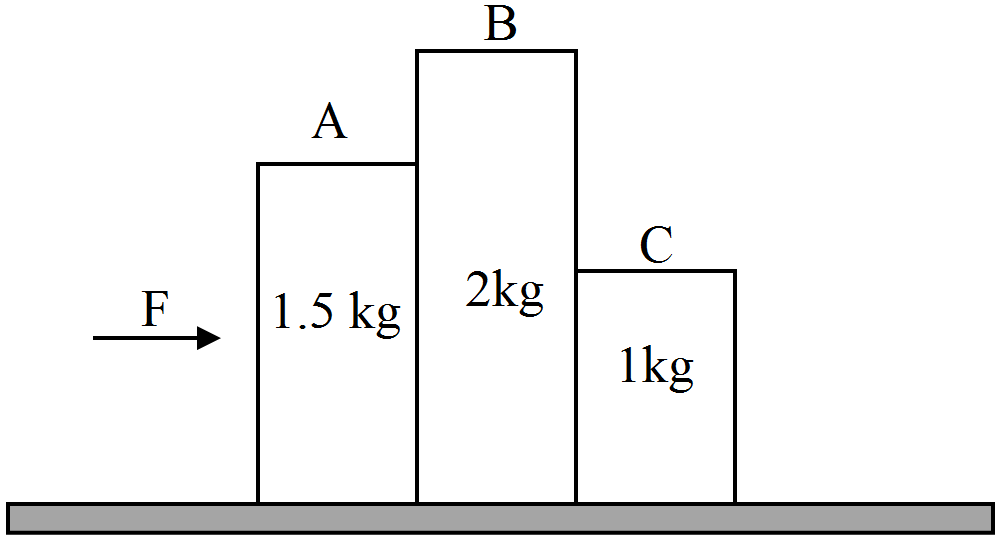
In the system of three blocks $A , B$ and C shown in figure,
(i) how large a force $F$ is needed to give the blocks an acceleration of $3 m / s ^2$, if the coefficient of friction between blocks and table is $0.27$
(ii) how large a force does the block $A$ exert on the block $B$ ?
A 40cm wire having a mass of 3.2g is stretched between two fixed supports 40.05cm apart. In its fundamental mode, the wire vibrates at 220Hz. If the area of cross-section of the wire is $1.0mm^2$, find its Young's modulus.
The magnifying power of a simple microscope is given by $1+\frac{\text{D}}{\text{f}},$ where D is the least distance for clear vision. For farsighted persons, D is greater than the usual. Does it mean that the magnifying power of a simple microscope is greater for a farsighted person as compared to a normal person? Does it mean that a farsighted person can see an insect more clearly under a microscope than a normal person?
A steel wire has a length of $12 m$ and a mass of $2.10 kg$ . What will be the speed of a transverse wave on this wire when a tension of $2.06 \times 10^4 N$ is applied?
Let AE denote the energy gap between the valence band and the conduction band. The population of conduction electrons (and of the holes) is roughly proportional to $\text{e}^{\frac{-\Delta\text{E}}{2\text{kT}}}.$ Find the ratio of the concentration of condu.ction electrons in diamond to that in silicon at room temperature 300K. $\Delta\text{E}$ for silicon is 1.1eV and for diamond is 6.0eV. How many conduction electrons are likely to be in one cubic metre of diamond?