MCQ
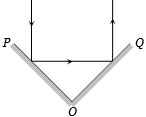
What should be the angle between two plane mirrors so that whatever be the angle of incidence, the incident ray and the reflected ray from the two mirrors be parallel to each other.....$^o$
  • A
    $60$
  • $90$
  • C
    $120$
  • D
    $175$

Answer

Correct option: B.
$90$
b
( b)Incident ray and finally reflected ray are parallel to each other means $\delta = {180^o}$
From $\delta = 360 - 2\theta $$ \Rightarrow 180 = 360 - 2\theta $$ \Rightarrow \theta = {90^o}$

Need a full question paper?

Generate a complete, print-ready paper with questions like this in minutes — across 16+ boards, with answer keys.

Start Generating Free

Similar questions

Which of the following cannot be seen by a microscope?
The correct curve representing the variation of capacitive reactance $X_c$​ with frequency f is.
The half life of a radioactive sample undergoing $\alpha$ - decay is $1.4 \times 10^{17}$ s. If the number of nuclei in the sample is $2.0 \times 10^{21}$, the activity of the sample is nearly
If induction of magnetic field at a point is $B$ and energy density is $U$ then which of the following graphs is correct
Threshold frequency for a metal is ${10^{15}}Hz$. Light of $\lambda = 4000{Å}$ falls on its surface. Which of the following statements is correct
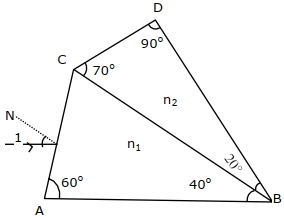
A prism of refractive index $n_{1}$ and another prism of refractive index $n_{2}$ are stuck together (as shown in the figure). $n_{1}$ and $n_{2}$ depend on $\lambda$, the wavelength of light, according to the relation

${n}_{1}=1.2+\frac{10.8 \times 10^{-14}}{\lambda^{2}} \text { and } {n}_{2}=1.45+\frac{1.8 \times 10^{-14}}{\lambda^{2}}$

The wavelength for which rays incident at any angle on the interface $B C$ pass through without bending at that interface will be $....\,nm.$
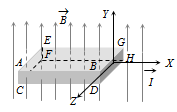
A metallic block carrying current I is subjected to a uniform magnetic induction $\vec B$ as shown in the figure. The moving charges experience a force $\vec F$ given by ........... which results in the lowering of the potential of the face ........ Assume the speed of the carriers to be v

If $\lambda_{\alpha u}$ is the wavelength of $K_\alpha X$-ray line of copper (atomic number $29$ ) and $\lambda_{\text {M. }}$ is the wavelength of the $K_\alpha X$-ray line of molybdenum (atomic number $42$ ), then the ratio $\lambda$ is close to
Assertion : If three capacitors of capacitances $C_1 < C_2 < C_3$ are connected in parallel then their equivalent capacitance $C_P > C_S$.

Reason : $\frac{1}{{{C_p}}} = \frac{1}{{{C_1}}} + \frac{1}{{{C_2}}} + \frac{1}{{{C_3}}}$

Electromagnetic waves