MCQ
What will be the electrode potential of $Cu$ electrode dipped in $0.025\,M\, CuSO_4$ solution if at $298\, K\, Cu$ has the standard reduction potential $0.34\, V$ ............ $\mathrm{V}$
- A$0.047$
- ✓$0.293$
- C$0.31$
- D$0.387$
${{\text{E}}_{{\text{C}}{{\text{u}}^{ + 2}}/{\text{Cu}}}} = {\text{E}}_{{\text{C}}{{\text{u}}^{ + 2}}/{\text{Cu}}}^\circ - \frac{{0.059}}{2}\log \frac{1}{{\left[ {{\text{C}}{{\text{u}}^{ + 2}}} \right]}}$
${{\text{E}}_{{\text{C}}{{\text{u}}^{ + 2}}/{\text{Cu}}}} = 0.34 + \frac{{0.059}}{2}\log 0.025$
$=0.34+0.0295[2 \times 0.7-3] $
$=0.34\,-\,0.0472$
$ \mathrm{E}=0.2928\,\mathrm{V}$
Generate a complete, print-ready paper with questions like this in minutes — across 16+ boards, with answer keys.

${P} \xrightarrow[\substack{\text { 2. } \mathrm{H}^{+}, \mathrm{H}_2 \mathrm{O} \\ \text { 3. } \mathrm{H}_2 \mathrm{SO}_4, \Delta}]{\text { 1. MeMgBr }}Q \xrightarrow[\text { 2. } \mathrm{Zn}, \mathrm{H}_2 \mathrm{O}]{1 . \mathrm{O}_3} {R} \xrightarrow[\text { 2. } \Delta]{1 . \mathrm{OH}^{-}} {S}$
$1.$ The structure of the carbonyl compound ${P}$ is
$Image$
$2.$ The structures of the products ${Q}$ and ${R}$, respectively, are
$Image$
$3.$ The structure of the product ${S}$ is
$Image$
Give hte answer question $1,2$ and $3.$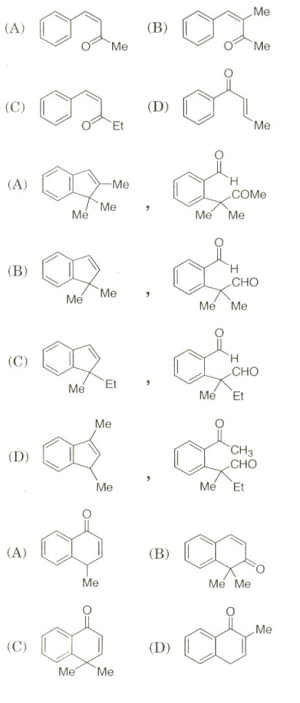
|
List $I$ (Anion) |
List $II$ $($Gas evolved on reaction with dil $H _{2} SO _{4})$ |
| $A.$ $CO _{3}^{2-}$ | $I.$ Colourless gas which turns lead acetate paper black |
| $B.$ $S^{2-}$ | $II.$ Colourless gas which turns acidified potassium dichromate solution green. |
| $C.$ $SO_{3}{ }^{2-}$ | $III.$ Brown fumes which turns acidified KI solution containing starch blue. |
| $D.$ $NO _{2}^{-}$ | $IV.$ Colourless gas evolved with brisk effervescence, which turns lime water milky. |
Choose the correct answer from the options given below