Question
What will be the path difference between two light waves $y_1=a_1 \sin \omega t$ and $y_2=a_2 \cos (\omega t+$ $\phi)$ ?

Answer

Equation of first wave
$y_1=a_1 \sin \omega t$
Equation of second wave
$y_2=a_2 \cos (\omega t+\phi)$
or $y_2=\sin \left(\omega t+\phi+\frac{\pi}{2}\right)$
Phase difference between first and second wave
$\Delta \phi=\phi_2-\phi_1$
$=\left(\omega t+\phi+\frac{\pi}{2}\right)-\omega t$
or $\Delta \phi=\phi+\frac{\pi}{2}$
Phase difference due to path difference
$\Delta \phi=\frac{2 \pi}{\lambda} \times \Delta x$
Path difference
$\Delta x=\frac{\Delta \phi \times \lambda}{2 \lambda}$
$\therefore$ For given waves $I^{\text {st }}$ and $2^{\text {nd }}$, the path difference
$\Delta x=\frac{\lambda}{2 \pi}\left(\phi+\frac{\pi}{2}\right)$ $\qquad Ans. $

Need a full question paper?

Generate a complete, print-ready paper with questions like this in minutes — across 16+ boards, with answer keys.
Start Generating Free

Similar questions

An apple falls from a tree. An insect in the apple finds that the earth is falling towards it with an acceleration $g.$ Who exerts the force needed to accelerate the earth with this acceleration $g$ ?
  1. Plot a graph showing variation of voltage vs the current drawn from the cell. How can one get information from this plot about the emf of the cell and its internal resistance?
  2. Two cells of emf’s $E_1$ and $E_2$ and internal resistance $r_1$ and $r_2$ are connected in parallel. Obtain the expression for the emf and internal resistance of a single equivalent cell that can replace this combination?
A load resistor of $2\text{k}\Omega$ is connected in the collector branch of an amplifier circuit using a transistor in common-emitter mode. The current gain $\beta=50.$ The input resistance of the transistor is $0.50\text{k}\Omega.$ If the input current is changed by $50\mu\text{A}.$
  1. By what amount does the output voltage change?
  2. By what amount does the input voltage change?
  3. What is the power gain?
Consider a non-conducting plate of radius r and mass m that has a charge q distributed uniformly over it. The plate is rotated about its axis with an angular speed $\omega.$ Show that the magnetic moment $\mu$ and the angular momentum of the plate are related as $\mu=\frac{\text{q}}{2\text{m}}\text{l}.$
A particle A having a charge of $2.0 \times 10^{-6}C$ is held fixed on a horizontal table. A second charged particle of mass $80g$ stays in equilibrium on the table at a distance of $10\ cm$ from the first charge. The coefficient of friction between the table and this second particle is $\mu=0.2.$ Find the range within which the charge of this second particle may lie.
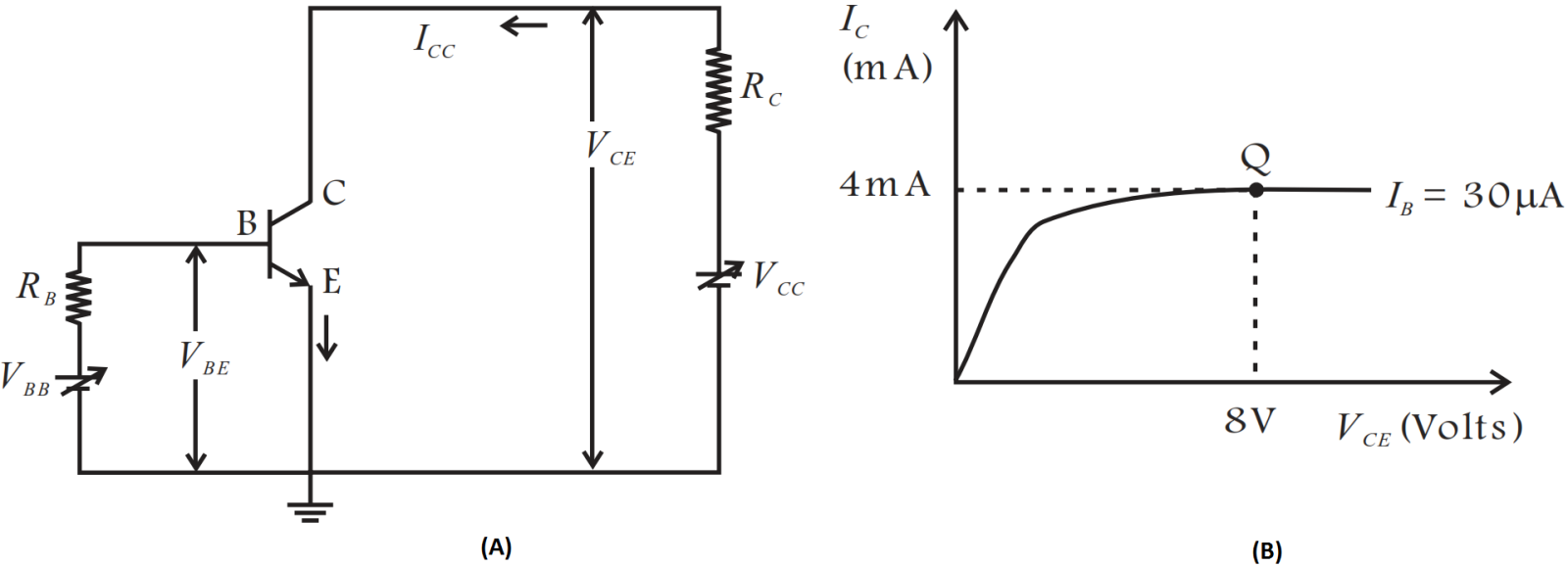
Consider the circuit arrangement shown in Fig $(a)$ for studying input and output characteristics of npn transistor in $CE$ configuration.

Select the values of $R_B$ and $R_C$ for a transistor whose $V_{BE} = 0.7V,$ so that the transistor is operating at point $Q$ as shown in the characteristics shown in Fig. $(b).$
Given that the input impedance of the transistor is very small and $V_{CC} = V_{BB} = 16V,$ also find the voltage gain and power gain of circuit making appropriate assumptions.
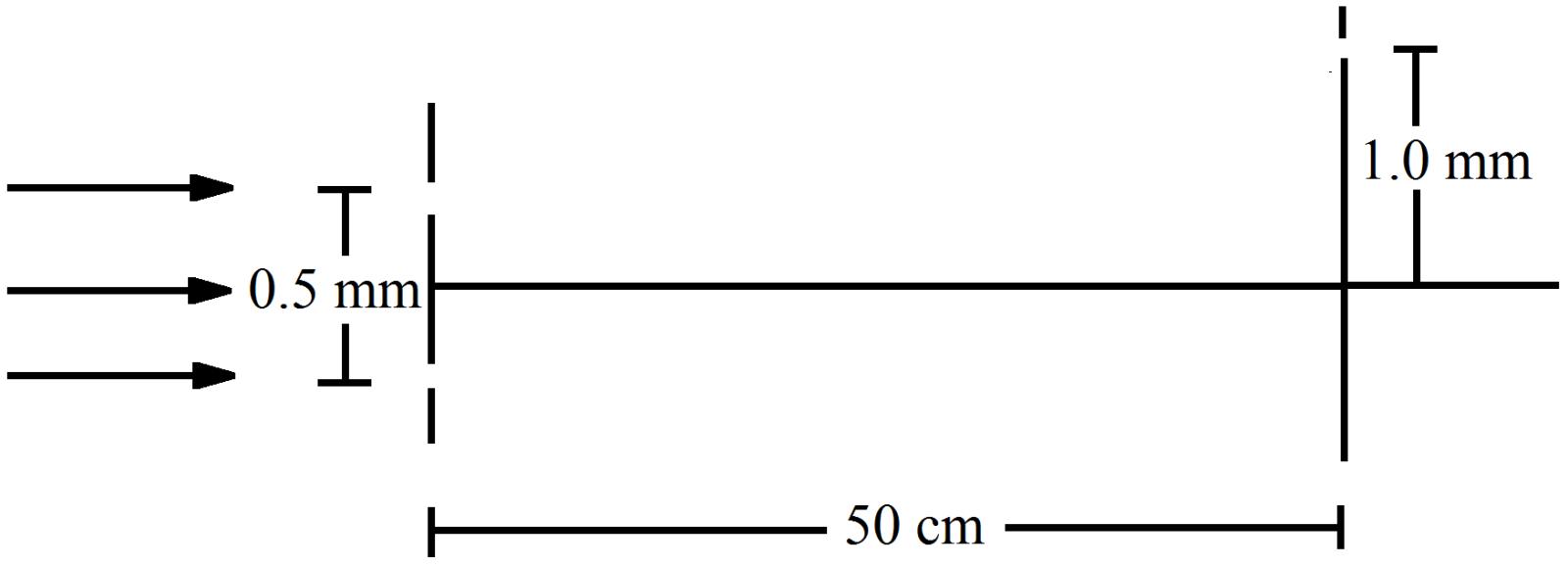
White coherent light $(400\ nm - 700\ nm)$ is sent through the slits of a Young's double slit experiment $($figure.$)$ The separation between the slits is $0.5\ mm$ and the screen is $50\ cm$ away from the slits. There is a hole in the screen at a point $1.0\ mm$ away $($along the width of the fringes$)$ from the central line.
  1. Which wavelength $(s)$ will be absent in the light coming from the hole?
  2. which wavelength $(s)$ will have a strong intensity?
The current−voltage characteristic of an ideal $p-n$ junction diode is given by $\text{i}=\text{i}_0\Big(\text{e}^{\frac{\text{eV}}{\text{kT}}}-1\Big)$ where, the drift current $i_0$ equals $10\mu\text{A}.$ Take the temperature $T$ to be $300K.$
  1. Find the voltage $V_0$ for which $\text{e}^{\frac{\text{eV}}{\text{KT}}}=100.$ One can neglect the term $1$ for voltages greater than this value.
  2. Find an expression for the dynamic resistance of the diode as a function of $V$ for $V > V_0.$
  3. Find the voltage for which the dynamic resistance is $0.2\Omega.$
Explain electric charge. Verify by experiment that there is repulsion between like charges and attraction between unlike charges.
Radiation coming from transition $n = 2$ to $n = 1$ of hydrogen atoms falls on helium ions in $n = 1$ and $n = 2$ states. What are the possible transitions of helium ions as they absorbs energy from the radiation?