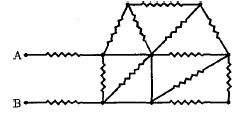
Wheatstone bridge principle is used to measure the specific resistance $\left(S_1\right)$ of given wire, having length $L$, radius $r$. If $X$ is the resistance of wire, then specific resistance is: $S_1=X\left(\frac{\pi r^2}{L}\right)$. If the length of the wire gets doubled then the value of specific resistance will be :
JEE MAIN 2024, Diffcult


Download our appand get started for free
Experience the future of education. Simply download our apps or reach out to us for more information. Let's shape the future of learning together!No signup needed.*
Similar Questions
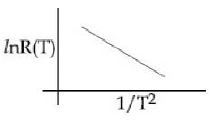
- 1View SolutionIn an experiment, the resistance of a material is plotted as a function of temperature (in some range). As shown in the figure, it is a straight line. One may conclude that:
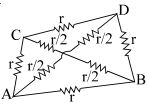
- 2The figure shows a tetrahedron, each side of which has a resistance $r$ Choose the correct statement $(s)$ related to the resistance between any two points.View Solution
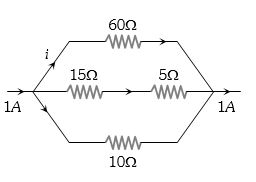
- 3The magnitude of $i$ in ampere unit isView Solution
- 4The heat produced by a $100\, watt$ heater in $2$ minute will be equal toView Solution
- 5In the given circuit, calculate the value of current in $4.5\,\Omega $ resistor .............. $\mathrm{A}$View Solution
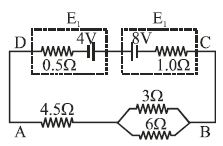
- 6View SolutionWhich of the following is not a correct statement
- 7Determine the charge on the capacitor in the following circuit ................ $\mu C$View Solution
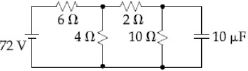
- 8In the circuit shown in figure, the $5\,\Omega $ resistance develops $20.00\,cal/s$ due to the current flowing through it. The heat developed in $2\,\Omega $ resistance (in $cal/s$ ) isView Solution
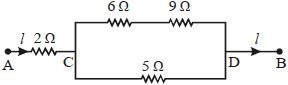
- 9A piece of fuse wire melts when a current of $15\, ampere$ flows through it. With this current, if it dissipates $22.5\, W$, the resistance of fuse wire will be .............. $\Omega$View Solution
- 10In the given circuit all resistances are of value $R\,ohm$ each. The equivalent resistance between $A$ and $B$ isView Solution