Question

When a beam of accelerated electrons hits a target, a continuous X-ray spectrum is emitted from the target. Which of the following wavelength is absent in the X-ray spectrum, if the X-ray tube is operating at 40,000 volts

(a) 0.25 Å

(b) 0.5 Å

(c) 1.5 Å  

(d) 1.0 Å

Answer

(a) 0.25 Å

Need a full question paper?

Generate a complete, print-ready paper with questions like this in minutes — across 16+ boards, with answer keys.

Start Generating Free

Similar questions

The length of Milky way is

(a) 100,000 light years

(b) 10,000 light years

(c) 1000 light years

(d) 100 light years

When a bar magnet is broken into two pieces:

The energy of a hydrogen atom in its ground state is -13.6eV. The energy of the level corresponding to the quantum number n = 2 (first excited state) in the hydrogen atom is

(a) – 2.72 eV

(b) – 0.85 eV

(c) – 0.54 eV

(d) – 3.4 eV

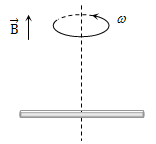
A conducting rod of length 2l is rotating with constant angular speed w about its perpendicular bisector. A uniform magnetic field   exists parallel to the axis of rotation. The e.m.f. induced between two ends of the rod is

(a) Bω    

(b)  Bω

(c)  Bω

(d) Zero

Select the correct statement

(a) In a full wave rectifier, two diodes work alternately

(b) In a full wave rectifier, two diodes work simultaneously

(c) The efficiency of full wave and half wave rectifiers is same

(d) The full wave rectifier is bi-directional.

A thin lens is made up of a material of refractive index $\mu=1.51$. It is dipped into the water $(\mu=1.33)$. This lens will behave :
Let $\overrightarrow{\text{C}}=\overrightarrow{\text{A}}+\overrightarrow{\text{B}}.$
  1. $|\overrightarrow{\text{C}}|$ is always greater than $|\overrightarrow{\text{A}}|$
  2. It is possible to have $|\overrightarrow{\text{C}}|<|\overrightarrow{\text{A}}|$ and $|\overrightarrow{\text{C}}|<|\overrightarrow{\text{B}}|$
  3. C is always equal to A + B
  4. C is never equal to A + B.

In producing a pure spectrum, the incident light is passed through a narrow slit placed in the focal plane of an achromatic lens because a narrow slit:

The dimensional formula of $\frac{1}{2}\in_{0}E^{2}$ is identical to :

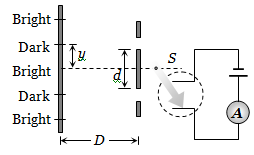
In the following arrangement y = 1.0 mm, d = 0.24 mm and D = 1.2 m. The work function of the material of the emitter is 2.2 eV. The stopping potential V needed to stop the photo current will be

(a) 0.9 V

(b) 0.5 V

(c) 0.4 V  

(d) 0.1 V