Question
When a body moves in a circular path, no work is done by the force since

Answer

The radial force and displacement are normal to each other in circular motion.

Need a full question paper?

Generate a complete, print-ready paper with questions like this in minutes — across 16+ boards, with answer keys.
Start Generating Free

Similar questions

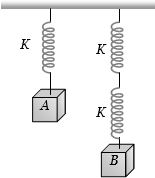
The springs shown are identical. When $A = 4kg$, the elongation of spring is $1\, cm$. If $B = 6\,kg$, the elongation produced by it is  ..... $ cm$
Microscope is an optical instrument which
Area of liquid film is $6 \times 10\, cm^2$ and surface tension is $T = 20\, dyne/cm$. What is the work done to change area upto $12 \times 10\, cm^2$
A motor cycle driver doubles its velocity when he is having a turn. The force exerted outwardly will be
The horizontal component of earth's magnetic field at a place is $3.5 \times 10^{-5} \mathrm{~T}$. A very long straight conductor carrying current of $\sqrt{2} A$ in the direction from South east to North West is placed. The force per unit length experienced by the conductor is$..............$ $\times 10^{-6} \mathrm{~N} / \mathrm{m}$.
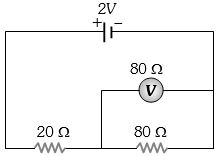
In the adjoining circuit, the $e.m.f.$ of the cell is $2\, volt$ and the internal resistance is negligible. The resistance of the voltmeter is $80 \,ohm$. The reading of the voltmeter will be ............. $volt$
If $T$ be the surface tension, the amount of work done in blowing a soap bubble from a diameter $d$ to diameter $D$ is
A gas for which $\gamma = 1.5$ is suddenly compressed to $\frac{1}{4}$ th of the initial volume. Then the ratio of the final to the initial pressure is
When a tuning fork of frequency $341$ is sounded with another tuning fork, six beats per second are heard. When the second tuning fork is loaded with wax and sounded with the first tuning fork, the number of beats is two per second. The natural frequency of the second tuning fork is
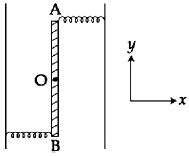
Two light identical springs of spring constant $k$ are attached horizontally at the two ends of a uniform horizontal rod $AB$ of length $l$ and mass $m$. the rod is pivoted at its centre $‘O’$ and can rotate freely in horizontal plane. The other ends of the two springs are fixed to rigid supports as shown in figure. The rod is gently pushed through a small angle and released. The frequency of resulting oscillation is