MCQ
When a body moves with a constant speed along a circle
  • No work is done on it
  • B
    No acceleration is produced in the body
  • C
    No force acts on the body
  • D
    Its velocity remains constant

Answer

Correct option: A.
No work is done on it
a
(a)When speed is constant in circular motion, it means work done by centripetal force is zero.

Need a full question paper?

Generate a complete, print-ready paper with questions like this in minutes — across 16+ boards, with answer keys.

Start Generating Free

Similar questions

$P-V$ diagram of a diatomic gas is a straight line passing through origin. The molar heat capacity of the gas in the process will be 
For a transistor, the current amplification factor is $0.8.$ The transistor is connected in common emitter configuration. The change in the collector current when the base current changes by $6\, mA$ is .....$mA$
For constructive interference to take place between two monochromatic light waves of wavelength $\lambda$, the path difference should be
A signal of $100 \,THz$ frequency can be transmitted with maximum efficiency by
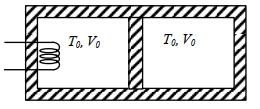
A thermally insulating cylinder has a thermally insulating and frictionless movable partition in the middle, as shown in the figure below. On each side of the partition, there is one mole of an ideal gas, with specific heat at constant volume, $C_v=2 R$. Here, $R$ is the gas constant. Initially, each side has a volume $V_0$ and temperature $T_0$. The left side has an electric heater, which is turned on at very low power to transfer heat $Q$ to the gas on the left side. As a result the partition moves slowly towards the right reducing the right side volume to $V_0 / 2$. Consequently, the gas temperatures on the left and the right sides become $T_L$ and $T_R$, respectively. Ignore the changes in the temperatures of the cylinder, heater and the partition.

($1$) The value of $\frac{T_R}{T_0}$ is

$(A)$ $\sqrt{2}$ $(B)$ $\sqrt{3}$ $(C)$ $2$ $(D)$ $3$

($2$) The value of $\frac{Q}{R T_0}$ is

$(A)$ $4(2 \sqrt{2}+1)$ $(B)$ $4(2 \sqrt{2}-1)$ $(C)$ $(5 \sqrt{2}+1)$ $(D)$ $(5 \sqrt{2}-1)$

Give the answer or qution ($1$) and ($2$)
A sphere is rolling without slipping on a fixed horizontal plane surface. In the figure $A$ is the point of contact, $B$ is the centre of sphere and $C$ is its topmost point, then

$(i){\vec V_C} - {\vec V_A} = 2\left( {{{\vec V}_B} - {{\vec V}_C}} \right)$

$(ii){\vec V_C} - {\vec V_B} = {\vec V_B} - {\vec V_A}$

$(iii)\left| {{{\vec V}_C} - {{\vec V}_A}} \right| = 2\left| {{{\vec V}_B} - {{\vec V}_C}} \right|$

$(iv)\left| {{{\vec V}_C} - {{\vec V}_A}} \right| = 4\left| {{{\vec V}_B}} \right|$
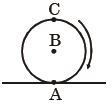
Which of the following is true
The conversion of $1 \;MW$ power in a new system having basic unit of mass, length and time as $10 \;kg , 1 \;dm$ and $1 \;minute$ respectively is:
In isothermic process, which statement is wrong
A thin lens made of glass (refractive index $= 1.5$) of focal length $f=16\; \mathrm{cm}$ is immersed in a liquid of refractive index $1.42 .$ If its focal length in liquid is $f_{l},$ then the ratio $f_{l} /f$ is closest to the integer