MCQ
When a body moves with some friction on a surface
  • A
    It loses kinetic energy but momentum is constant
  • B
    It loses kinetic energy but gains potential energy
  • Kinetic energy and momentum both decrease
  • D
    Mechanical energy is conserved

Answer

Correct option: C.
Kinetic energy and momentum both decrease
c
(c) Friction is a non-conservative external force to the system, it decreases momentum and kinetic energy both.

Need a full question paper?

Generate a complete, print-ready paper with questions like this in minutes — across 16+ boards, with answer keys.
Start Generating Free

Similar questions

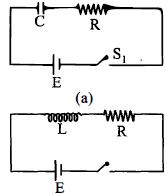
In the circuits $(a)$ and $(b)$ switches $S_1$ and $S_2$  are closed at $t = 0$  and are kept closed for a long time. The variation of current in the two circuits for $t \ge 0$ are roughly shown by figure (figures are schematic and not drawn to scale)
Two metal rods $1$ and $2$ of same lengths have same temperature difference between their ends. Their thermal conductivities are $K_1$ and $K_2$ and cross sectional areas $A_1$ and $A_2$ , respectively. If the rate of heat conduction in $1$ is four times that in $2$, then
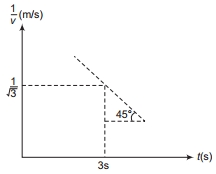
The diagram shows the variation of $1 / v$ (where, $v$ is velocity of the particle) with respect to time. At time $t=3\,s$ using the details given in the graph, the instantaneous acceleration will be equal to $...........m/s^{2}$
A particle of charge $16\times10^{-16}\, C$ moving with velocity $10\, ms^{-1}$ along $x-$ axis enters a region where magnetic field of induction $\vec B$ is along the $y-$ axis and an electric field of magnitude $10^4\, Vm^{-1}$ is along the negative $z-$ axis. If the charged particle continues moving along $x-$ axis, the magnitude of $\vec B$ is
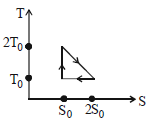
The temperature-entropy diagram of a reversible engine cycle is given in the figure. Its efficiency is
Consider a uniform rod of mass $\mathrm{M}=4 \mathrm{m}$ and length $\ell$ pivoted about its centre. A mass $m$ moving with velocity $v$ making angle $\theta=\frac{\pi}{4}$ to the rod's long axis collides with one end of the rod and sticks to it. The angular speed of the rod-mass system just after the collision is
If $L$ and $R$ are respectively the inductance and resistance, then the dimensions of $\frac{R}{L}$ will be
Assertion : Radioactive nuclei emit ${\beta ^ - }$ particles.

Reason : Electrons exist inside the nucleus

What is the relation between displacement, time and acceleration in case of a body having uniform acceleration
A jar contains a gas and few drops of water at $T K.$ The pressure in the jar is $830 \,mm$ of mercury. The temperature of jar is reduced by $1\%.$ The saturated vapour pressure of water at the two temperatures are $30 \,mm$ and $ 25\, mm$ of mercury. Then the new pressure in the jar will be ..... $mm$ of $Hg$