MCQ
When a car is at rest, its driver sees rain drops falling on it vertically. When driving the car with speed $v,$ he sees that rain drops are coming at an angle $60^{\circ}$ from the horizontal. On further increasing the speed of the car to $(1+\beta) v ,$ this angle changes to $45^{\circ} .$ The value of $\beta$ is close to$......$
  • A
    $0.41$
  • B
    $0.50$
  • C
    $0.37$
  • $0.73$

Answer

Correct option: D.
$0.73$
d
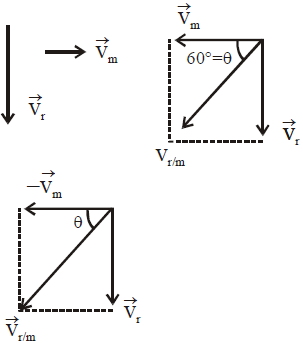
Rain is falling vertically downwards.

$\vec{v}_{r / m}=\vec{v}_{r}-\vec{v}_{m}$

$\tan 60^{\circ}=\frac{ V _{ r }}{ v _{ m }}=\sqrt{3}$

$v _{ r }= v _{ m } \sqrt{3}= v \sqrt{3}$

Now, $v _{ m }=(1+ B ) v$

and $\theta=45^{\circ}$

$\tan 45=\frac{ v _{ r }}{ v _{ m }}=1$

$v _{ r }= v _{ m }$

$v \sqrt{3}=(1+\beta) v$

$\sqrt{3}=1+\beta$

$\Rightarrow \beta=\sqrt{3}-1=0.73$

Need a full question paper?

Generate a complete, print-ready paper with questions like this in minutes — across 16+ boards, with answer keys.

Start Generating Free

Similar questions

The work per unit volume to stretch the length by $1\%$ of a wire with cross sectional area of $1\,m{m^2}$ will be. $[Y = 9 \times {10^{11}}\,N/{m^2}]$
A particle $P$ is moving in a circle of radius $'a'$ with a uniform speed $v$ . $C$ is the centre of the circle and $AB$ is a diameter. When passing through $B$ the angular velocity of $P$ about $A$ and $C$ are in the ratio 
The diatomic molecule is treated as:
The excess pressure in a soap bubble is thrice that in other one. Then the ratio of their volume is
The value of densities of two diatomic gases at constant temperature and pressure are ${d_1}$ and ${d_2}$, then the ratio of speed of sound in these gases will be
Six wire each of cross-sectional area $A$ and length $l$ are combined as shown in the  figure. The thermal conductivities of copper and iron are $K_1$ and $K_2$ respectively.  The equivalent thermal resistance between points $A$ and $C$ is :-
The volume of an ideal gas $(\gamma=1.5)$ is changed adiabatically from $5$ litres to $4$ litres. The ratio of initial pressure to final pressure is:
A particle of mass $m$ moves in a circular orbit under the central potential field, $U ( r )=\frac{- C }{ r }$, where $C$ is a positive constant

The correct radius - velocity graph of the particle's motion is:

A block of weight $W$ rests on a horizontal floor with coefficient of static friction $\mu .$ It is desired to make the block move by applying minimum amount of force. The angle $\theta $ from the horizontal at which the force should be applied and magnitude of the force $F$ are respectively.
Let $\bar v,\;{v_{rms}}$ and ${v_p}$ respectively denote the mean speed, root mean square speed and most probable speed of the molecules in an ideal monoatomic gas at absolute temperature $T.$ The mass of a molecule is $m.$ Then