When a charge of $3\, coulomb$ is placed in a uniform electric field, it experiences a force of $3000\, Newton$. Within this field, potential difference between two points separated by a distance of $1\, cm$ is........$volts$
Easy


Download our appand get started for free
Experience the future of education. Simply download our apps or reach out to us for more information. Let's shape the future of learning together!No signup needed.*
Similar Questions
- 1A parallel plate capacitor is made of two circular plates separated by a distance $5\ mm$ and with a dielectric of dielectric constant $2.2$ between them. When the electric field in the dielectric is $3 \times 10^4$ $ Vm^{-1}$ the charge density of the positive plate will be close toView Solution
- 2charge $Q$ is uniformly distributed over a long rod $AB$ of length $L$ as shown in the figure. The electric potential at the point $O$ lying at distance $L$ from the end $A$ isView Solution

- 3There exists an electric field of magnitude $E$ in $x$-direction. If the work done in moving a charge of $0.2 \,C$ through a distance of $2 \,m$ along a line making an angle $60^{\circ}$ with $x$-axis is $4 \,J$, then the value of $E$ is ........ $N / C$View Solution
- 4Four equal charges $Q$ are placed at the four corners of a square of each side is $'a'$. Work done in removing a charge $-Q$ from its centre to infinity isView Solution
- 5Consider two charged metallic spheres $S_{1}$ and $\mathrm{S}_{2}$ of radii $\mathrm{R}_{1}$ and $\mathrm{R}_{2},$ respectively. The electric $\left.\text { fields }\left.\mathrm{E}_{1} \text { (on } \mathrm{S}_{1}\right) \text { and } \mathrm{E}_{2} \text { (on } \mathrm{S}_{2}\right)$ on their surfaces are such that $\mathrm{E}_{1} / \mathrm{E}_{2}=\mathrm{R}_{1} / \mathrm{R}_{2} .$ Then the ratio $\left.\mathrm{V}_{1}\left(\mathrm{on}\; \mathrm{S}_{1}\right) / \mathrm{V}_{2} \text { (on } \mathrm{S}_{2}\right)$ of the electrostatic potentials on each sphere isView Solution
- 6Two capacitor having capacitances $8\ \mu F$ and $16\ \mu F$ have breaking voltages $20\ V$ and $80\ V$. They are combined in series. The maximum charge they can store individually in the combination is...... $\mu C$View Solution
- 7A thin spherical conducting shell of radius $R$ has a charge $q$. Another charge $Q$ is placed at the centre of the shell. The electrostatic potential at a point $p$ at distance $\frac{R}{2}$ from the centre of the shell isView Solution
- 8A disk of radius $R$ with uniform positive charge density $\sigma$ is placed on the $x y$ plane with its center at the origin. The Coulomb potential along the $z$-axis isView Solution
$V(z)=\frac{\sigma}{2 \epsilon_0}\left(\sqrt{R^2+z^2}-z\right)$
A particle of positive charge $q$ is placed initially at rest at a point on the $z$ axis with $z=z_0$ and $z_0>0$. In addition to the Coulomb force, the particle experiences a vertical force $\vec{F}=-c \hat{k}$ with $c>0$. Let $\beta=\frac{2 c \epsilon_0}{q \sigma}$. Which of the following statement($s$) is(are) correct?
$(A)$ For $\beta=\frac{1}{4}$ and $z_0=\frac{25}{7} R$, the particle reaches the origin.
$(B)$ For $\beta=\frac{1}{4}$ and $z_0=\frac{3}{7} R$, the particle reaches the origin.
$(C)$ For $\beta=\frac{1}{4}$ and $z_0=\frac{R}{\sqrt{3}}$, the particle returns back to $z=z_0$.
$(D)$ For $\beta>1$ and $z_0>0$, the particle always reaches the origin.
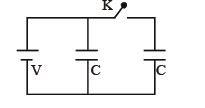
- 9Consider the arrangement shown in figure. The total energy stored is $U_1$ when key is closed. Now the key $K$ is made off (opened) and two dielectric slabs of relative permittivity ${ \in _r}$ are introduced between the plates of the two capacitors. The slab tightly fit in between the plates. The total energy stored is now $U_2$. Then the ratio of $U_1/U_2$ isView Solution
- 10If some charge is given to a solid metallic sphere, the field inside remains zero and by Gauss's law all the charge resides on the surface. Now, suppose that Coulomb's force between two charges varies as $1 / r^{3}$. Then, for a charged solid metallic sphereView Solution