When a current of $2\,A$ flows in a battery from negative to positive terminal, the potential difference across it is $12\,V$. If a current of $3\,A$ flows in the opposite direction potential difference across the terminals of the battery is $15\,V$, the emf of the battery is ............... $\mathrm{V}$
Medium
Download our app for free and get started
$\mathrm{T} . \mathrm{P.D.}=\mathrm{E}-\mathrm{I} \mathrm{r} \Rightarrow 12=\mathrm{E}-2 \mathrm{r}$ ..........$(1)$
$\mathrm{T.P.D.}=\mathrm{E}+\mathrm{Ir} \Rightarrow 15=\mathrm{E}+3 \mathrm{r} $ .........$(2)$
Solve ${\rm{e}}{{\rm{q}}^n}$ $(1)$ and $(2)$

Download our appand get started for free
Experience the future of education. Simply download our apps or reach out to us for more information. Let's shape the future of learning together!No signup needed.*
Similar Questions
- 1$A$ current $I$ flows through a uniform wire of diameter $d$ when the mean electron drift velocity is $V$. The same current will flow through a wire of diameter $d/2$ made of the same material if the mean drift velocity of the electron is :View Solution
- 2In the box shown current $i$ enters at $H$ and leaves at $C$. If $i_{AB} = \frac{{\text{i}}}{6}$ , $i_{DC} = \frac{{\text{2i}}}{3}$ ,$i_{HA} = \frac{{\text{i}}}{2} , i_{GF} = \frac{{\text{i}}}{6} , i_{HE} = \frac{{\text{i}}}{6}$ , choose the branch in which current is zeroView Solution

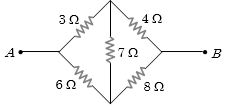
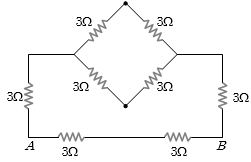
- 3Calculate the net resistance of the circuit between $A$ and $B$View Solution
- 4When current supplied by a cell to a circuit is $0.3 \,A$, its terminal potential difference is $0.9 \,V$. When the current supplied becomes $0.25 \,A$, its terminal potential difference becomes $1.0 \,V$. The internal resistance of the cell is ............ $\Omega$View Solution
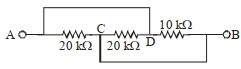
- 5The equivalent resistance between $A$ and $B$ as shown in figure is $........\,k\Omega$View Solution
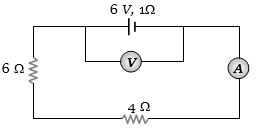
- 6View SolutionIn the circuit shown here, the readings of the ammeter and voltmeter are
- 7Two wires '$A$' and '$B$' of the same material have their lengths in the ratio $1 : 2$ and radii in the ratio $2 : 1$. The two wires are connected in parallel across a battery. The ratio of the heat produced in '$A$' to the heat produced in '$B$' for the same time isView Solution
- 8Equivalent resistance between $A$ and $B$ will be ............ $ohm$View Solution
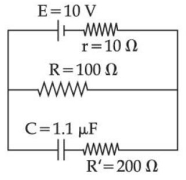
- 9As show in the figure, in steady state, the charge stored in the capacitor is....... $\times 10^{-6}\,C$.View Solution
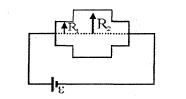
- 10A cylindrical resistance is connected across battery $\varepsilon $ . Cylinder has uniform free electron density, mid part of cylinder has larger radius as shown in figure. Then $V_d$ (drift velocity) $V/S$ (distance across the length of the resistance)View Solution