Question
When a circuit element ‘X’ is connected across an a.c. source, a current of $\sqrt{2}\text{A}$ flows through it and this current is in phase with the applied voltage. When another element ‘Y’ is connected across the same a.c. source, the same current flows in the circuit but it leads the voltage by $\frac{\pi}{2}$ radians.
  1. Name the circuit element X and Y.
  2. Find the current that flows in the circuit when the series combination of X and Y is connected across the same a.c. voltage.
  3. Net impedance.

Answer

  1. When circuit element is X, the current is in phase with the applied emf, this implies that X is pure resistance.
When circuit element Y is connected, the current leads the voltage by $\frac{\pi}{2}$ so Y is pure capacitance.
  1.  
Resistance of X = R; $\text{I}=\frac{\text{V}}{\text{R}}$
$\sqrt{2}=\frac{\text{V}}{\text{R}} \ ...(\text{i})$
Reactance of $\text{Y, X}_{\text{C}}=\frac{1}{\omega\text{C}},\text{I}=\frac{\text{V}}{\text{X}_{\text{C}}}\Rightarrow\sqrt{2\text{C}}=\frac{\text{V}}{\text{X}_{\text{C}}} \ ...(\text{ii})$
This implies $\text{X}_{\text{C}}=\text{R}$
When R and C are connected in series across same voltage source, then
Impedance $\text{Z}=\sqrt{\text{R}^2+\text{X}^2_{\text{C}}}=\sqrt{\text{R}^2+\text{R}^2}=\sqrt{2}\text{R} \ ...(\text{iii})$
$\therefore$ Current in circuit $\text{I}=\frac{\text{V}}{\text{Z}}=\frac{\text{V}}{\sqrt{2}\text{R}}$
From (1), $\frac{\text{V}}{\text{R}}=\sqrt{2},\therefore\text{I}=\frac{1}{\sqrt{2}}\times\sqrt{2}=1\text{A}$
  1.  
$\text{Z}=\sqrt{\text{R}^2+\Big(\frac{1}{\omega\text{C}}\Big)^2}$
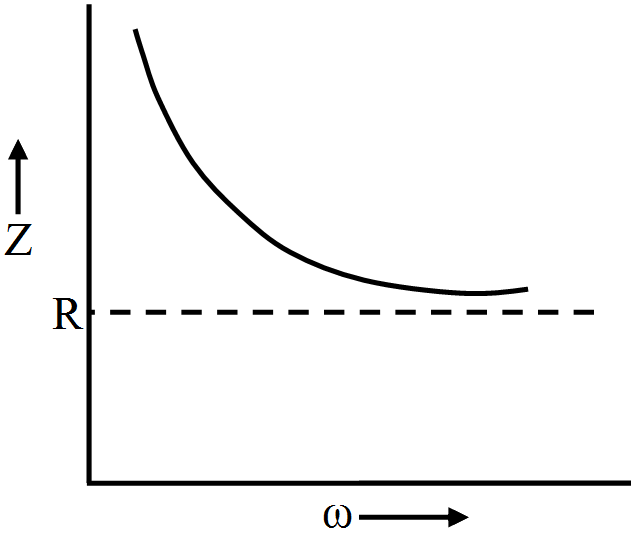
i.e., impedance decreases with increase of angular frequency $\omega$
When $\omega=0,\text{Z}=\infty$
When $\omega=0,\text{Z = R}$
The graph of impedance Z versus $\omega$ is shows in fig.

Need a full question paper?

Generate a complete, print-ready paper with questions like this in minutes — across 16+ boards, with answer keys.

Start Generating Free

Similar questions

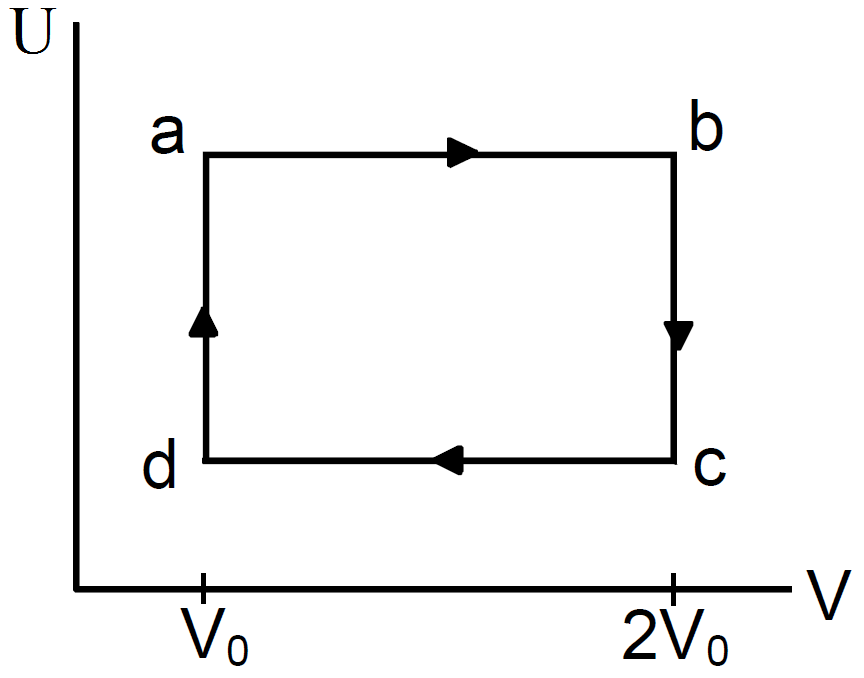
Figure. shows the variation in the internal energy $U$ with the volume $V$ of $2.0\ mol$ of an ideal gas in a cyclic process abcda. The temperatures of the gas at $b$ and $c$ are $500K$ and $300K$ respectively. Calculate the heat absorbed by the gas during the process.
Oxygen is filled in a closed metal jar of volume $1.0 \times 10^{-3}m^3$ at a pressure of $1.5 \times 10^5Pa$ and temperature $400K$ The jar has a small leak in it. The atmospheric pressure is $1.0 \times 10^5Pa$ and the atmospheric temperature is $300K$ Find the mass of the gas that leaks out by the time the pressure and the temperature inside the jar equalise with the surrounding.
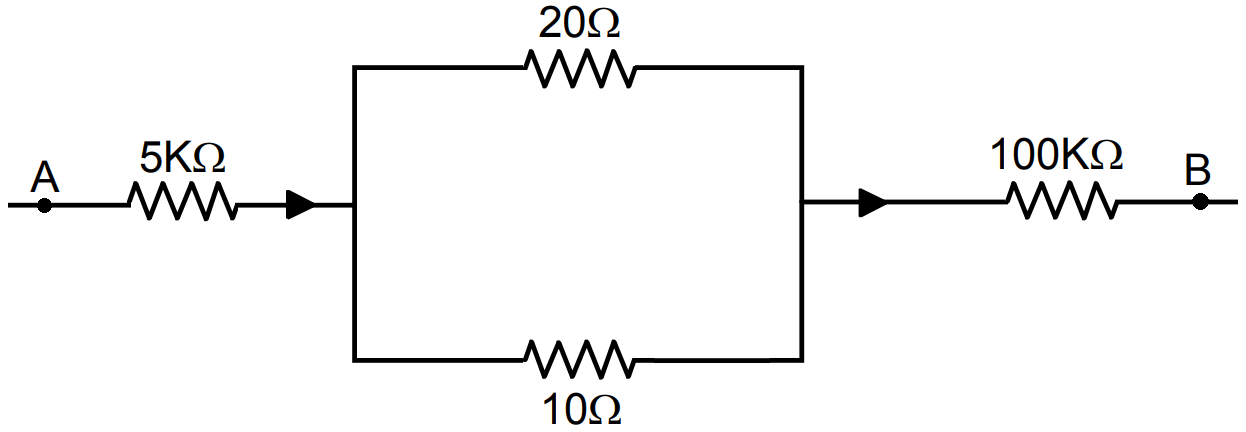
Figure. shows a part of a circuit. If a current of $12mA$ exists in the $5\text{k}\Omega$ resistor, find the currents in the other three resistors. What is the potential difference between the points $A$ and $B?$
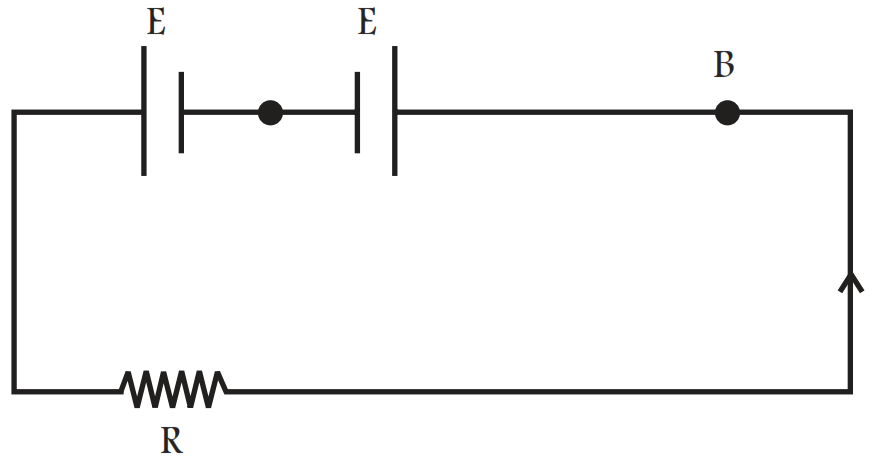
Two cells of same emf $E$ but internal resistance $r_1$ and $r_2$ are connected in series to an external resistor $R ($Fig$).$ What should be the value of $R$ so that the potential difference across the terminals of the first cell becomes zero.
What is the speed of a photon with respect to another photon if:
  1. The two photons are going in the same direction and.
  2. They are going in opposite directions?
The conduction band of a solid is partially filled at 0K. Will it be a conductor, a semiconductor or an insulator?
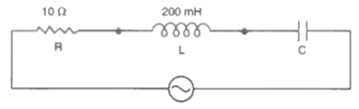
In the following circuit, calculate:
$i$. the capacitance of the capacitor, if the power factor of the circuit is unity,
$ii$. the $Q-$ factor of this circuit. What is the significance of the $Q-$ factor in ac circuit? Given the angular frequency of the ac source to be $100 \text{ rad/s}.$ Calculate the average power dissipated in the circuit.

Image
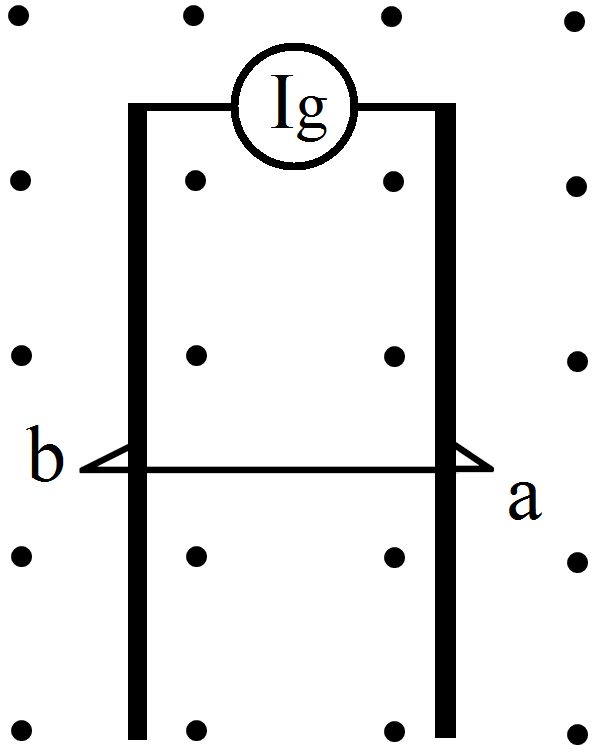
The system containing the rails and the wire of the previous problem is kept vertically in a uniform horizontal magnetic field B that is perpendicular to the plane of the rails (figure). It is found that the wire stays in equilibrium. If the wire ab is replaced by another wire of double its mass, how long will it take in falling through a distance equal to its length?
Consider an excited hydrogen atom in state $n$ moving with a velocity $u(ν << c)$. It emits a photon in the direction of its motion and changes its state to a lower state $m$. Apply momentum and energy conservation principles to calculate the frequency $ν$ of the emitted radiation. Compare this with the frequency $ν_0$ emitted if the atom were at rest.
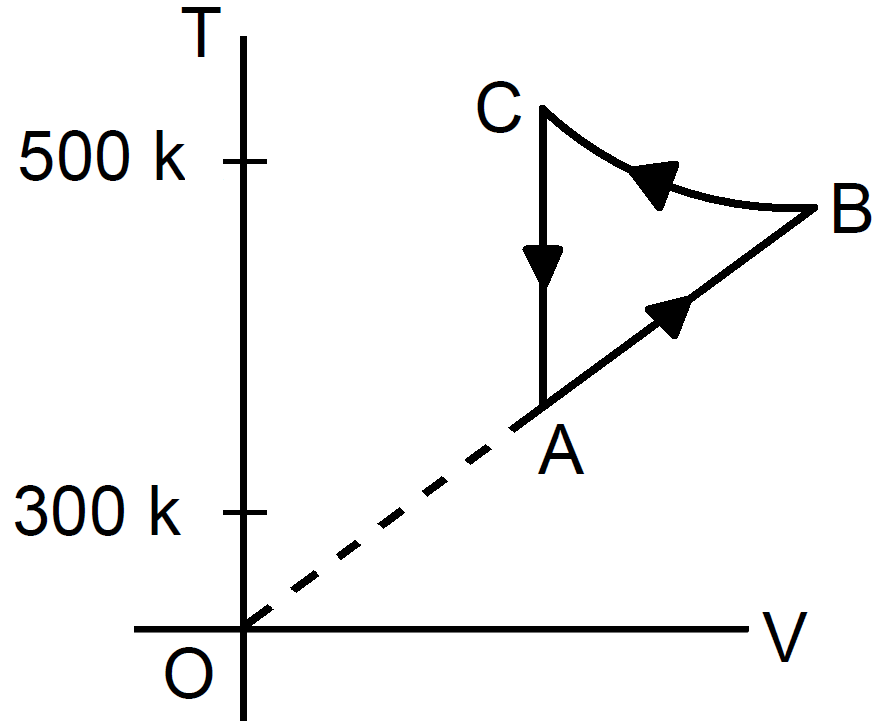
Consider the cyclic process ABCA, shown in figure. performed on a sample of 2.0 mol of an ideal gas. A total of 1200J of heat is withdrawn from the sample in the process. Find the work done by the gas during the part BC.