MCQ
When a forward bias is applied to a $p-n$ junction, it
  • A
    Raises the potential barrier
  • B
    Reduce the majority carrier current to zero
  • Lower the potential barrier
  • D
    None of the above

Answer

Correct option: C.
Lower the potential barrier
c
When forward bias is applied to a $p-n$ junction, it lower the values of potential barrier. In the case of forward bias, the potential barrier is opposed by the applied voltage. Hence, the potential barrier across the junction gets reduced.

Need a full question paper?

Generate a complete, print-ready paper with questions like this in minutes — across 16+ boards, with answer keys.
Start Generating Free

Similar questions

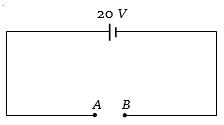
In the shown circuit, what is the potential difference across $A$ and $B$ ......... $V$
Two equal charges $q$ of opposite sign separated by a distance $2a$ constitute an electric dipole of dipole moment $p$. If $P$ is a point at a distance $r$ from the centre of the dipole and the line joining the centre of the dipole to this point makes an angle $\theta $ with the axis of the dipole, then the potential at $P$ is given by $(r > > 2a)$ (Where $p = 2qa$)
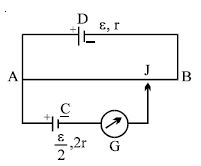
In the figure, the potentiometer wire $AB$ of length $L$ and resistance $9r$ is joined to the cell $D$ of $\mathrm{emf}$ $\varepsilon$ and internal resistance $r$. The cell $C’s$ $\mathrm{emf}$ is $\varepsilon /2$ and its internal resistance is $2r$. The galvanometer $G$ will show no deflection when the length $AJ$ is
The result after adding $3.8 \times 10^{-6}$ with $4.2 \times 10^{-5}$ with due regard to significant figures is
If $\overrightarrow A \times \overrightarrow B = \overrightarrow C ,$then which of the following statements is wrong
The terminal potential difference of a cell when short-circuited is ($E$ = $E.M.F.$ of the cell)
A parallel plate capacitor is charged to a potential difference of $100\,V$ and disconnected from the source of $emf$ . A slab of dielectric is then inserted between the plates. Which of the following three quantities change?

$(i)$  The potential difference

$(ii)$ The capacitance

$(iii)$ The charge on the plates

If electronic charge $e$, electron mass $m$, speed of light in vacuum $c$ and Planck 's constant $h$ are taken as fundamental quantities, the permeability of vacuum $\mu _0$ can be expressed in units of
In space of horizontal $EF$ ($E = (mg)/q$) exist as shown in figure and a mass $m$ attached at the end of a light rod. If mass $m$ is released from the position shown in figure find the angular velocity of the rod when it passes through the bottom most position
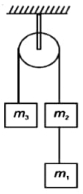
Three blocks of masses $m_1=4 \,kg , m_2=2 \,kg , m_3=4 \,kg$ are connected with ideal strings passing over a smooth. massless pulley as shown in figure. The acceleration of blocks will be ......... $m / s ^2$ $\left(g=10 \,m / s ^2\right)$