Question
When a glass capillary tube is dipped at one end in water, water rises in the tube. The gravitational potential energy is thus increased. Is it a violation of conservation of energy?

Answer

No, it does not violate the principle of conservation of energy.
There is a force of attraction between glass and water, which is why the liquid rises in the tube. However, when water and glass are not in contact, there exists a potential energy in the system. When they are brought into contact, this potential energy is first converted into kinetic energy, which lets the liquid rush upwards in the tube, and then into gravitational potential energy. Therefore, energy is not created in the process.

Need a full question paper?

Generate a complete, print-ready paper with questions like this in minutes — across 16+ boards, with answer keys.
Start Generating Free

Similar questions

In motor vehicles, a convex mirror is attached near the driver's seat to give him the view of the traffic behind. What is the special function of this convex mirror which a plane mirror can not do?
A magnetic dipole of magnetic moment $0.72A-m^2$ is placed horizontally with the north pole pointing towards bsouth. Find the position of the neutral point if the horizontal component of the earth's magnetic field is $18\mu\text{T.}$
Read the passage given below and answer the following questions from 1 to 5. Centre of Mass:
The centre of mass of a body or a system of bodies is the point which moves as though all of the mass were concentrated there and all external forces were applied to it. Hence, a point at which the entire mass of the body or system of bodies is supposed to be concentrated is known as the centre of mass. If a system consists of more than one particles (or bodies) and net external force on the system in a particular direction is zero with centre of mass at rest. Then, the centre of mass will not move along that direction. Even though some particles of the system may move along that direction.
  1. The centre of mass of a system of two particles divides, the distance between them:
  1. in inverse ratio of square of masses of particles
  2. in direct ratio of square of masses of particles
  3. in inverse ratio of masses of particles
  4. in direct ratio of masses of particles
  1. Two bodies of masses 1kg and 2 kg are lying in xy-plane at ( -1, 2 ) and ( 2, 4 ) respectively. What are the coordinates of the centre of mass?
  1. $\big(1,\frac{10}{3}\big)$
  2. (1, 10)
  3. (0, 1)
  4. None of these
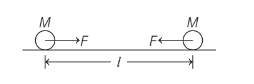
  1. Two balls of same masses start moving towards each other due to gravitational attraction, if the initial distance between them is l. Then, they meet at:
  1. $\frac{\text{ l}}{2}$
  2. l
  3. $\frac{\text{ l}}{3}$
  4. $\frac{\text{ l}}{4}$
  1. All the particles of a body are situated at a distance R from the origin. The distance of centre of mass of the body from the origin is:
  1. $=\text{R}$
  2. $\leq\text{R}$
  3. $>\text{R}$
  4. $\geq\text{R}$
  1. Two particles A and B initially at rest move towards each other under a mutual force of attraction. At the instant, when the speed of A is v and the speed of B is 2v, the speed of centre of mass of the system is:
  1. zero
  2. v
  3. 1. 5v
  4. 3v
Read the passage given below and answer the following questions from 1 to 5. The kinetic energy possessed by an object of mass, m and moving with a uniform velocity, v is $\text{K}=\frac{1}{2}\times\text{mv}^2=\frac{1}{2}\text{v}.\text{v}$ Kinetic energy is a scalar quantity. The kinetic energy of an object is a measure of the work and The energy possessed by an object is thus measured in terms of its capacity of doing work. The unit of energy is, therefore, the same as that of work, that is, joule (J). Work energy theorem: The change in kinetic energy of a particle is equal to the work done on it by the net force. Mathematically $K_f - K_i = W$ Where Ki and Kf are respectively the initial and final kinetic energies of the object. Work refers to the force and the displacement over which it acts. Work is done by a force on the body over a certain displacement.
  1. Kinetic energy is:
  1. Scalar quantity
  2. Vector quantity
  3. None of these
  1. Which of the following has same unit?
  1. Potential energy and work
  2. Kinetic energy and work
  3. Force and weight
  4. All of the above
  1. What is work energy theorem?
  1. Kinetic energy is scalar quantity. Justify the statement.
  1. Give formula for kinetic energy of body.
A silver ball of radius 4.8cm is suspended by a thread in a vacuum chamber. Ultraviolet light of wavelength 200 run is incident on the ball for some time during which a total light energy of $1.0 \times 10^{-7} \mathrm{~J}$ falls on the surface. Assuming that on the average one photon out of every ten thousand is able to eject a photoelectron, find the electric potential et the surface of the bell assuming zero potential at infinity. What is the potential at the centre of the bell?
The magnetometer of the previous problem is used with the same magnet in $\tan-\text{B}$ position. Where should the magnet be placed to produce a 37° deflection of the needle?
Indian style of cooling drinking water is to keep it in a pitcher having porous walls. Water comes to the outer surface very slowly and evaporates. Most of energy needed for evaporation is taken from the water itself and the water is cooled down. Assume that a pitcher contains 10kg of water and 0.2g of water comes out per second. Assuming no backward heat transfer from the atmosphere to the water, calculate the time in which the temperature decrease by 5°C. Specific heat capacity of water $= 4200\ J\ kg^{-1} \ ^\circ C^{-1} $ and latent heat of vaporization of water $= 2.27 \times 10^6 J kg^{-1}.$
50cc of oxygen is collected in an inverted gas jar over water. The atmospheric pressure is 99.4kPa and the room temperature is 27°C. The water level in the jar is same as the level outside. The saturation vapour pressure at 27°C is 3.4kPa. Calculate the number of moles of oxygen collected in the jar.
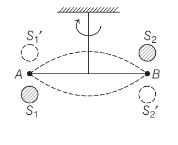
Read the passage given below and answer the following questions from 1 to 5. Cavendish’s Experiment The figure shows the schematic drawing of Cavendish’s experiment to determine the value of the gravitational constant. The bar AB has two small lead spheres attached at its ends. The bar is suspended from a rigid support by a fine wire. Two large lead spheres are brought close to the small ones but on opposite sides as shown. The value of G from this experiment came to be $6.67\times10^{-11}\frac{\text{N-m}^2}{\text{Kg}^2}$
  1. The big spheres attract the nearby small ones by a force which is:
  1. equal and opposite
  2. equal but in same direction
  3. unequal and opposite
  4. None of the above
  1. The net force on the bar is:
  1. non-zero
  2. zero
  3. Data insufficient
  4. None of these
  1. The net torque on the bar is:
  1. zero
  2. non-zero
  3. F times the length of the bar, where F is the force of attraction between a big sphere and its neighbouring
  4. Both (b) and (c)
  1. The torque produces twist in the suspended wire. The twisting stops when:
  1. restoring torque of the wire equals the gravitational torque
  2. restoring torque of the wire exceeds the gravitational torque
  3. the gravitational torque exceeds the restoring torque of the wire
  4. None of the above
  1. After Cavendish’s experiment, there have been given suggestions that the value of the gravitational constant G becomes smaller when considered over very large time period (in billions of years) in the future. If that happens, for our earth:
  1. nothing will change
  2. we will become hotter after billions of years
  3. we will be going around but not strictly in closed orbits
  4. None of the above
Find the change in the volume of 1.0 litre kerosene when it is subjected to an extra pressure of $2.0 \times 10^5 \mathrm{~N} / \mathrm{m}^2$ from the following data. Density of kerosene $=800 \mathrm{~kg} / \mathrm{m}^3$ and speed of sound in kerosene $=1330 \mathrm{~m} / \mathrm{s}$.