MCQ
When a glass rod is rubbed with silk, it
  • A
    Gains electrons from silk
  • Gives electrons to silk
  • C
    Gains protons from silk
  • D
    Gives protons to silk

Answer

Correct option: B.
Gives electrons to silk
b
(b) On rubbing glass rod with silk, excess electron transferred from glass to silk. So glass rod becomes positive and silk becomes negative.

Need a full question paper?

Generate a complete, print-ready paper with questions like this in minutes — across 16+ boards, with answer keys.

Start Generating Free

Similar questions

Which of the following mirrors is used in searchlight?
The acceleration of an electron in the first orbit of the hydrogen atom $(z\, = 1)$ is
When the speed of electrons increases, then the value of its specific charge
When a ray of light emerges from a block of glass, the critical angle is
A capacitor of capacitance $C$ is charged to a potential difference $V$ from a cell and then disconnected from it. A charge $+Q$ is now given to its positive plate. The potential difference across the capacitor is now $Q$

 if $V < CV$

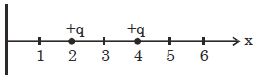
Two charged particles, each with a charge of $+q$, are located along the $x$ -axis at $x = 2$ and $x = 4$, as shown below. Which of the following shows the graph of the magnitude of the electric field along the $x$ -axis from the origin to $x = 6$?
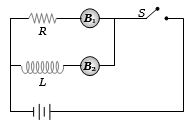
The adjoining figure shows two bulbs $B_1$ and $B_2$ resistor $R$ and an inductor $L$ When the switch $S$ is turned off
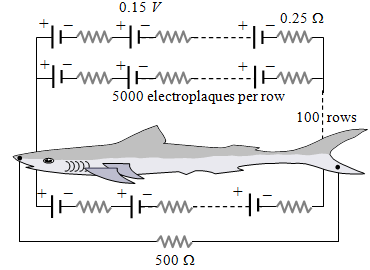
Eels are able to generate current with biological cells called electroplaques. The electroplaques in an eel are arranged in 100 rows, each row stretching horizontally along the body of the fish containing 5000 electroplaques. The arrangement is suggestively shown below. Each electroplaques has an emf of 0.15 V and internal resistance of 0.25 W


The water surrounding the eel completes a circuit between the head and its tail. If the water surrounding it has a resistance of 500 W, the current an eel can produce in water is about
A lens which has focal length of $4 \;cm$ and refractive index of $1.4$ is immersed in a liquid of refractive index $1.6,$ then the focal length will be.......$cm$
The velocity of emitted electrons in photelectric effect depends :