MCQ
When a hydrogen atom is raised from the ground state to an excited state
  • P.E. increases and K.E. decreases
  • B
    P.E. decreases and K.E. increases
  • C
    Both kinetic energy and potential energy increase
  • D
    Both K.E. and P.E. decrease

Answer

Correct option: A.
P.E. increases and K.E. decreases

Need a full question paper?

Generate a complete, print-ready paper with questions like this in minutes — across 16+ boards, with answer keys.
Start Generating Free

Similar questions

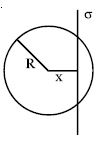
An infinite, uniformly charged sheet with surface charge density $\sigma$ cuts through a spherical Gaussian surface of radius $R$ at a distance $x$ from its center, as shown in the figure. The electric flux $\Phi $ through the Gaussian surface is
An electron of mass $\mathrm{m}$ and magnitude of charge $|e|$ initially at rest gets accelerated by a constant electric field $\mathrm{E}$. The rate of change of de-Broglie wavelength of this electron at time $t$ ignoring relativistic effects is 
A charge $q_1$ exerts some force on a second charge $q_2$. If third charge $q_3$ is brought near, the force of $q_1$ exerted on $q_2$
A hydrogen atom, initially in the ground state is excited by absorbing a photon of wavelength $980\,\mathop A\limits^o $. The radius of the atom in the excited state, in  terms of Bohr radius $a_0,$ will be $(hc\,=\,12500\,eV-\mathop A\limits^o)$
Which of the following is$/$are optoelectronic devices?
When a white light passes through a hollow prism, then
Unpolarised light is incident from air on a plane surface of a material of refractive index $\mu .$ At a particular angle of incidence $i,$ it is found that the reflected and refracted rays are perpendicular to each other. Which of the following options is correct for this situation? 
The capacity of a parallel plate capacitor increases with the
In an interference experiment, the spacing between successive maxima or minima is

(Where the symbols have their usual meanings)

Two radioactive materials $A$ and $B$ have decay constants $10\,\lambda $ and $\lambda $, respectively. If initially they have the same number of nuclei, then the ratio of the number of nuclei of a to that of $B$ will be $1/e$ after a time