Question
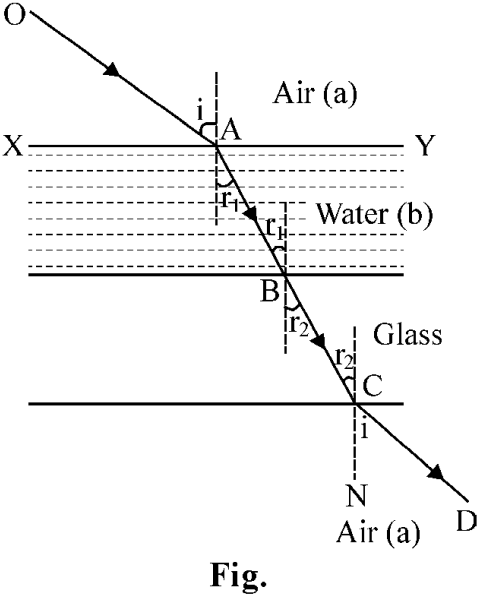
When a light ray passes from the atmosphere (a) through the combination of two mediums water (b) and glass (c), then find the relationship between the refractive indices of the three mediums.

Need a full question paper?

Generate a complete, print-ready paper with questions like this in minutes — across 16+ boards, with answer keys.
Start Generating Free

Similar questions

A composite slab is prepared by pasting two plates of thicknesses L1 and L2 and thermal conductivities K1 and K2. The slabs have equal cross-sectional area. Find the equivalent conductivity of the composite slab.
Derive an expression for the gravitational field due to a uniform rod of length L and mass M at a point on its perpendicular bisector at a distance d from the centre.
(a) A point-image (object) is placed on the principal axis of a convex spherical surface of radius of curvature $R$, the refractive index of the medium on one side of this surface is $n _1$ and the refractive index of the medium on the other side is $n_2$, where $n_2>n_1$. For this, draw a ray diagram and derive the relation between object distance $(u)$, image distance $(v)$ and radius of curvature $( R )$ for refraction from rarer medium to denser medium on a convex spherical surface.
(b) Use the above relation in terms of $n_1$ and $n_2$, to obtain the condition for the position of the object and the radius of curvature when a real image is formed.
Define electric dipole moment. Calculate the value of electric potential generated from electric dipole and prove that its value is maximum at the point situated on the axis and zero at the equatorial point? ###Define electric dipole moment of electric dipole. Obtain an expression for the electric potential at a common point due to electric dipole. Also draw necessary diagram.
A charge Q located at a point $\vec{\text{r}}$ is in equilibrium under the combined electric field of three charges q1, q2, q3. If the charges q1, q2 are located at points $\vec{\text{r}}_1$ and $\vec{\text{r}}_2$ respectively, find the direction of the force on Q, due to q3 in terms of q1, q2$\vec{\text{r}}_1,\ \vec{\text{r}}_2$ and $\vec{\text{r}}.$
Find the charge required to flow through an electrolyte to liberate one atom of.
  1. A monovalent material.
  2. A divalent material.
In a p-n junction diode, the current I can be expressed as,
$I=I_0\ \text{exp}\Big(\frac{\text{eV}}{2\text{k}_{\text{B}}\text{T}}-1\Big)$
where $I_0$ is called the reverse saturation current, V is the voltage across the diode and is positive for forward bias and negative for reverse bias, and $I$ is the current through the diode, kg is the Boltzmann constant (8.6×10⁻⁵ eV/K) and T is the absolute temperature. If for a given diode $I_0$ = 5×10-12 A and T = 300 K, then,
  1. What will be the forward current at a forward voltage of 0.6V?
  2. What will be the increase in the current if the voltage across the diode is increased to 0.7V?
  3. What is the dynamic resistance?
  4. What will be the current if reverse bias voltage changes from 1V to 2V?
Do permeability and relative permeability have the same dimensions?
Neglect the effect of rotation of the earth. Suppose the earth suddenly stops attracting objects placed near its surface. A person standing on the surface of the earth will:
  1. Fly up.
  2. Slip along the surface.
  3. Fly along a tangent to the earth's surface.
  4. Remain standing.
$\text{ }^{212}_{33}\text{Bi}$ can disintegrate either by emitting an $\alpha$-particle of by emitting a $\beta^-$-particle.
  1. Write the two equations showing the products of the decays.
  2. The probabilities of disintegration $\alpha$ and $\beta$ -decays are in the ratio $\frac{7}{13}.$ The overall half-life of 212Bi is one hour. If 1g of pure 212Bi is taken at 12.00 noon, what will be the composition of this sample at 1P.m. the same day?