Questions

5 Marks Questions

Take a timed test

8 questions · self-marked practice — reveal the answer and mark yourself.

Question 15 Marks
Define total internal reflection. Establish the relation between $u, v$ and $f$ for a spherical mirror. Draw the necessary ray diagram. ### Define lateral displacement. Derive the lens maker formula.
$
\frac{1}{f}=\left(n_{21}-1\right)\left(\frac{1}{R_1}-\frac{1}{R_2}\right)
$
Draw the necessary ray diagram. (Where the signs have their usual meanings.)
Answer
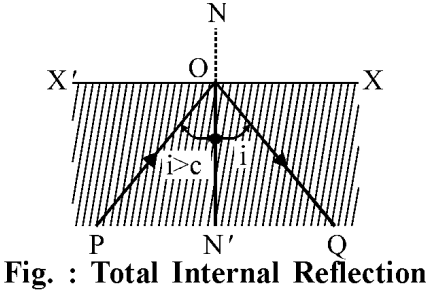
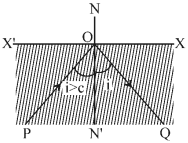
Total Internal Reflection : When the value of the angle of incidence in a dense medium is increased slightly beyond the critical angle, then the entire incident light gets reflected according to the laws of reflection and returns back to the dense medium. As shown in the fig. below. This phenomenon is called total internal reflection of light.
Image
Fig. : Total internal reflection
Relation between $u, v$ and $f$ for the Spherical Mirror :
Formula for spherical mirror :
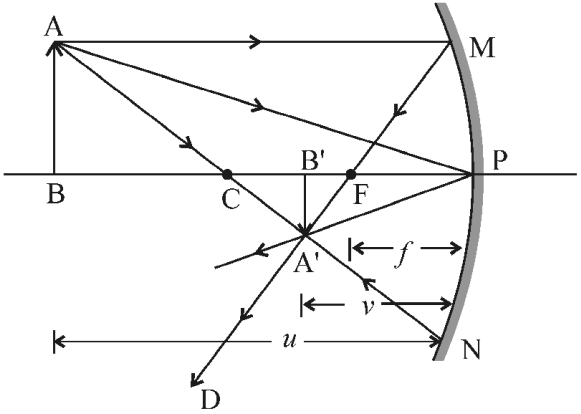
The relationship between $u, v$ and $f$ is shown in the figure to form an image from a concave mirror. At point B on the principal axis, a parallel ray AM from the object AB hits the surface of the mirror AM and passes through the focus after reflection. Ray AC from point A hits the mirror and returns to the same path due to being normal. These two reflected rays meet each other at point $A^{\prime}$. Hence the image of $A B$ becomes $B ^{\prime} A ^{\prime}$. Draw lines joining AP and AP . In the figure $\triangle MPF$ and $\triangle A ^{\prime} F ^{\prime} B , \angle A ^{\prime} FB ^{\prime}=\angle MFP$ due to opposite angle (mirror is of small aperture) hence MP is a straight line.
Since $\angle FPM =\angle A ^{\prime} FB B ^{\prime}$ is a right angle, so due to which $\triangle MPF , \triangle AF ^{\prime} B ^{\prime}$ is a similar triangle.
Therefore,$\frac{B^{\prime} A^{\prime}}{PM}=\frac{B^{\prime} F}{FP}$
$
\text { or } \quad \frac{B^{\prime} A^{\prime}}{BA}=\frac{B^{\prime} F}{FP}(\because PM=AB) \ldots(1)
$
Because $\angle APB =\angle APB ^{\prime}$, right angled triangles ABP and ABP are also similar.
Therefore, $\quad \frac{ B ^{\prime} A ^{\prime}}{ BA }=\frac{ B ^{\prime} P }{ BP } \ldots(2) $
By comparing equation (1) and (2), we will get
$
\frac{B^{\prime} F}{F P}=\frac{B^{\prime} P-F P}{F P}=\frac{B^{\prime} P}{B P} \ldots(3)
$
Equation (3) involves the magnitudes of distances. According to Cartesian sign convention, the signs of these three will be negative, hence
$
B^{\prime} P=-v, FP=-f, BP=-u
$
Image
Fig. : Ray diagram of image formation by a concave mirror
Using these in equation (3), we get
$\frac{-v+f}{-f}=\frac{-v}{-u}$
or $\quad \frac{v-f}{f}=\frac{v}{u}$
$\frac{v}{f}-1=\frac{v}{u}$
or $\quad\frac{v}{f}=\frac{v}{u}+1=\frac{v+u}{u}$
or $\quad \frac{1}{f}=\frac{v+u}{u v}=\frac{v}{u v}+\frac{u}{u v}$
or $\quad \frac{1}{v}+\frac{1}{u}=\frac{1}{f}$ $\ldots(4)$
This relation is called mirror equations
OR

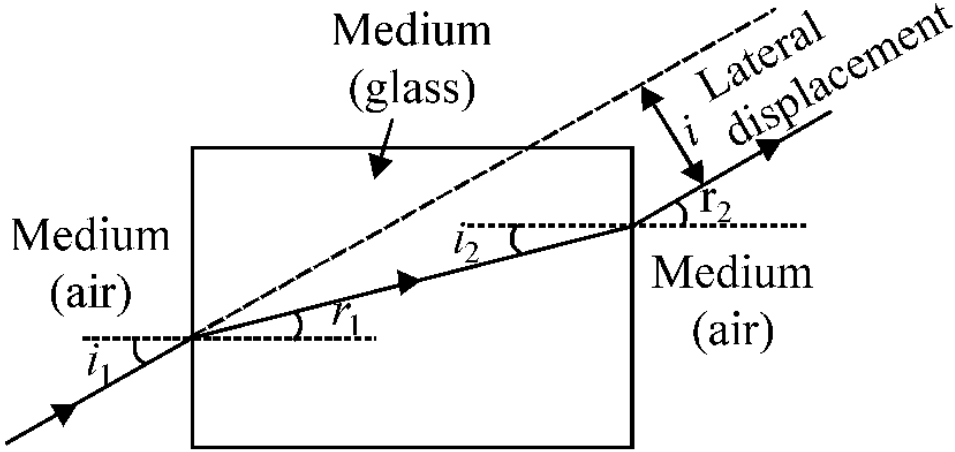
A ray of light travels in a definite straight line. After refraction through the glass slab, it emerges in a direction parallel to the original direction but slightly displaced from the line. This is called lateral displacement.
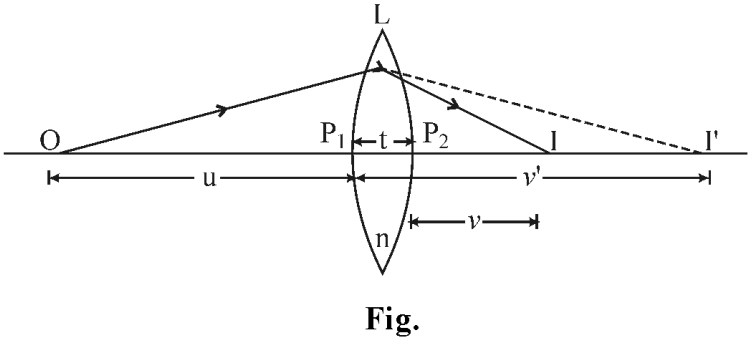
When the medium on either side of the lens is same : In the following figure, a thin lens L is placed in the air. Refractive index of the lens material relative to air is $n$ and the radii of curvature of its first and second surfaces are $R _1$ and $R _2$ respectively. Let the thickness of the lens be $t$.
Image
A point object $O$ is placed on the principal axis of the lens at a distance $u$ from the pole $P _1$ of its first surface. Due to refraction on the first surface, the image of object $O$ is formed at $I ^{\prime}$. Let the distance of $I ^{\prime}$ from the pole $P _1$ of the surface be $v^{\prime}$. Then according to the formula of refraction at a single spherical surface
$
\frac{n}{v^{\prime}}-\frac{1}{u}=\frac{n-1}{R_1} \ldots(1)
$
The image thus formed is $I^{\prime}$ for the second surface of the lens whose radius of curvature is $R _2$ will work as an object. The distance of I' from the pole $P _2$ of the other surface will be $\left(v^{\prime}-t\right)$. The image of second surface of I is I' at a distance from $v$. In this way the final image of the O of entire lens becomes at I .
On the second surface, because the light ray enters the air through the refractive index $n$, hence in the formula of refraction, writin $1 / n$ at place of $n$.
$
\frac{1 / n}{v}-\frac{1}{\left(v^{\prime}-1\right)}=\frac{\frac{1}{n}-1}{R_2} \ldots(2)
$
For thin lenses. The value of $t$ is negligible compared to $v^{\prime}$. So in comparison of $v$, on omitting $t$, the equation (2) will be as follows :
$\frac{1}{v}-\frac{n}{v^{\prime}}=\frac{-(n-1)}{ R _2} \ldots(3) $
By adding equations (1) and (3)
$
\frac{1}{v}-\frac{1}{u}=(n-1)\left(\frac{1}{R_1}-\frac{1}{R_2}\right) \ldots(4)
$
When the object is placed at infinity, the image will be formed at the second focus (principal focus) of the lens. That is $u=\infty$, then $v=f$, where $f$ is the second focal length (primary focal length) of the lens.
Putting the value in equation (4)
$
\frac{1}{f}-\frac{1}{\infty}=(n-1)\left(\frac{1}{R_1}-\frac{1}{R_2}\right)
$
or $\quad \frac{1}{f}=(n-1)\left(\frac{1}{R_1}-\frac{1}{R_2}\right) \ldots(5) $
Which is called lens makers formula.

View full question & answer
Question 25 Marks
(a) What is meant by compound microscope? Draw a ray diagram of image formation by a compound microscope. Briefly describe its working and derive the formula for its total magnification.
(b) How does the resolving power of a microscope change when :
(i) The diameter of the objective lens decreases,
(ii) The wavelength of incident light increases?Justify your answer in each case.
Answer
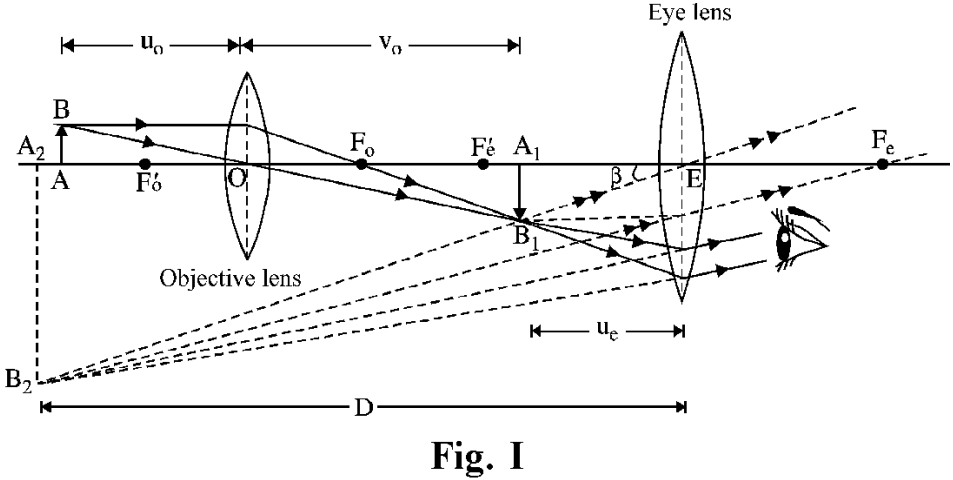
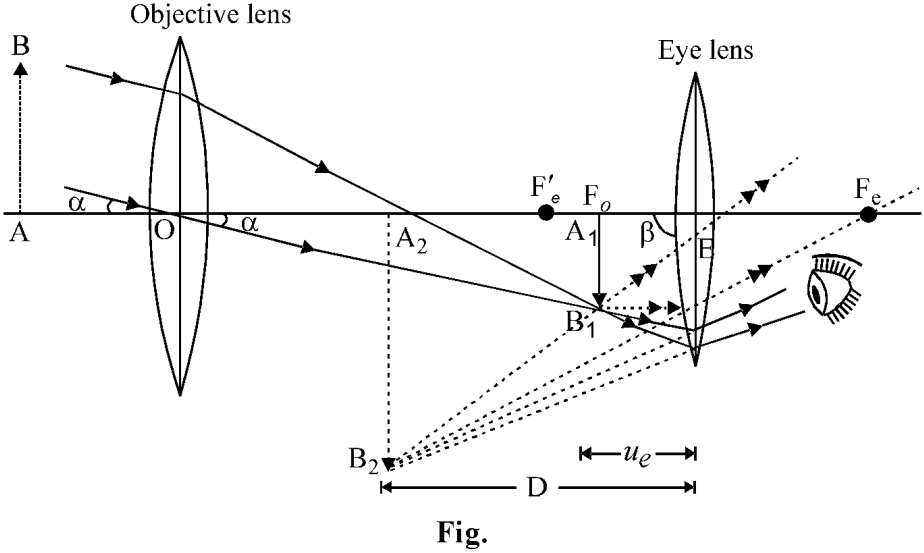
(a) Compound microscope : It is an optical instrument made of two lenses which forms a magnified image of a nearby microscopic object. The angle of view formed by this image on the observer's eye is very large, as a result the eye can see the big object.
Ray diagram of image formation by compound microscope :
Image
Image
Working method: As shown in the figure, the object AB is placed in front of the objective lens at a distance beyond the focal length of the lens. The rays emanating from the object get refracted through this lens and form $A _1 B_1$ real, inverted and magnified images of the object. This image acts as an object for the eye lens.
Now we adjust the eye lens in such a way that images $A _1 B_1$ are formed between the focus of the eye lens and the center of light. The eye lens actually functions as a simple microscope and now its magnified virtual image $A _2 B_2$ is formed. The position of the eye lens is adjusted such that the final image $A _2 B_2$ formed at a distance D from the eye $A _2 B_2$ is erect with respect to the images $A _1 B_1$ but inverted with respect to the object AB .
Magnifying power : The magnifying power of a compound microscope is the ratio of the angle of view formed on the eye by the final image formed by it and the angle of view formed on the eye by the object (when the object is at the minimum is equal to distance of clear vision and is being seen directly without the instrument). Hence magnifying power i.e. angular magnification
$
\begin{array}{l}
m=\frac{\text { The angle made by the final image at the eye }}{\text { The angle made by the object at the eye }} \\
\text { (when the object is at distance D) }
\end{array}
$
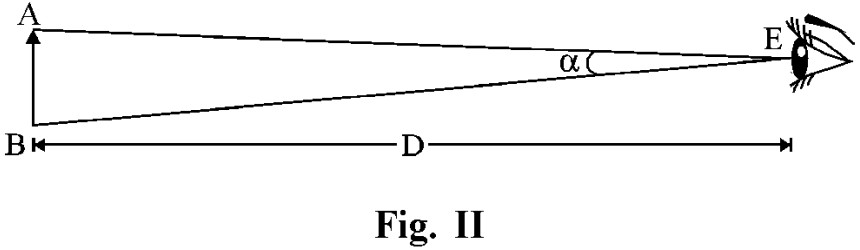
Suppose the last image $A _2 B_2$ make an angle B at eyepiece $E$. Since the eye is close to the eyepiece, hence $\beta$ can be considered as the angle formed by $A _2 B_2$ on the eye (Fig. I). If the object AB is placed at the minimum distance D of clear vision from the eye and makes an angle $\alpha$ at the eye when held straight by the eye (Fig. II), then the magnifying power of the microscope
$
m=\frac{\beta}{\alpha} \ldots(1)
$
Since the object is small, the angles $\alpha, \beta$ will also be very small. Therefore, in their place we can take their tangent $(\tan )$
Therefore $\alpha=\tan \alpha$ and $\beta=\tan \beta$
$
\therefore \quad m=\frac{\tan \beta}{\tan \alpha} \ldots(2)
$
But (Fig. II) from right angled triangle ABE,
$
\tan \alpha=\frac{A B}{D}\ldots(3)
$
and (Fig. I) from right angled triangle $B _1 A_1 E$,
$
\tan \beta=\frac{A_1 B_1}{EA_1}\ldots(4)
$
After putting the values of equation (3) and (4) in equation (2),
$ m=\frac{A_1 B_1 / EA_1}{AB / D}=\frac{A_1 B_1}{AB}\left(\frac{D}{EA_1}\right) \ldots(5)$
If the distances of the object AB and the images $A _1 B_1$ from the objective O are $u_0$ and $v_0$ respectively, then taking their proper signs,
$\frac{ A _1 B_1}{ AB }=\frac{+v_0}{-u_0}$
$\left(\because \frac{\text { Size of the image }}{\text { Size of the object }}=\frac{\begin{array}{c}\text { Distance of the lens from } \\ \text { image }\end{array}}{\begin{array}{c}\text { Distance of the object from } \\ \text { the lens }\end{array}}\right)$
If the distance of $A _1 B_1$ from the eyepiece E (for this, the virtual object) is $u_{ e }$ then with appropriate sign
$EA _1=-u_e$
$\therefore$ Putting these values in equation (5) and taking D as negative,
$m=\frac{+v_0}{-u_0}\left(\frac{- D }{-u_e}\right)$
or $\quad m=\left[\frac{v_0}{u_0}\left(\frac{D}{u_e}\right)\right] \ldots(6)$
(b) The resolving power of the microscope is $\propto \frac{n \sin \theta}{\lambda}$ where $\theta$ a half angle of the cone.
(i) If the diameter of the objective lens decreases then the resolving power of the microscope also decreases, since the resolving power is directly proportional to the diameter.
(ii) Resolving power $\propto \frac{1}{\lambda}$. This means that as the value of wavelength $(\lambda)$ increases, the resolution power of that decreases.

View full question & answer
Question 35 Marks
Draw a labelled diagram of a refracting telescope. Obtain an expression for its magnifying power. Write two main disadvantages of refracting telescope as compared to reflecting telescope. ### What is meant by telescope? Draw the ray diagram of image formation by a refracting telescope. Briefly describe its working and derive the formula for its magnifying power.
Answer
Ray diagram of refracting telescope :
Image
Magnifying Power : Magnifying power ' $m$ ' of the telescope is equal to the ratio of the angle of view made at the eye by the final image formed by it and the angle of view made at the eye by the object (when the object is in its actual position).
$\therefore m=\frac{\text { Angle of vision formed by the final image of the eye }}{\begin{array}{l}
\text { Angle of vision made by the object on the } \\
\text { eye, when the object is in its original position }
\end{array}}$
Since it is the ratio of two angles, it is also called angular magnification.Since the eye is near the eyepiece E , the angle of view formed on the eyepiece by the final image $A_2 B_2$ can be considered as the angle of vision $\beta$ formed on the eye by $A _2 B_2$. Along with this, because the object AB is located at a very far distance (infinity) from the telescope, hence the angle of vision $\alpha$ made by the object AB on the objective O can be considered as the angle made by the object on the eye. Hence magnifying power
$m=\frac{\begin{array}{l}\text { Angle of vision formed on the } \\ \text { eyepiece by the final image } A _2 B_2\end{array}}{\begin{array}{l}\text { Angle of vision formed by the } \\ \text { object on the objective }\end{array}}$
i.e. $m=\frac{\beta}{\alpha}$
Since the angles $\alpha$ and $\beta$ are very small, hence its tangent $(\tan )$ can be taken in place of them.
Then $\quad m=\frac{\tan \beta}{\tan \alpha}$
but in the fig. at right angle
$\angle A _1 OB _1=\alpha(\because$ opposite angle $)$
Therefore from right angle $\Delta OA _1 B_1$,
$\tan \alpha=\frac{A_1 B_1}{OA_1}$
and from right angle $\Delta EA _1 B_1$,
$\begin{aligned}
\tan \beta & =\frac{A_1 B_1}{EA_1} \\
m & =\frac{\left(A_1 B_1 / EA_1\right)}{\left(A_1 B_1 / OA_1\right)} \\
& =\frac{OA_1}{EA_1}
\end{aligned}$
If the focal length of the objective O is $f_o$ and the distance of $A _1 B_1$ from the eyepiece E is $u_e$ (since $A _1 B_1$ act as objects for the eyepiece). On taking the appropriate sign,
$\begin{aligned}
OA_1 & =+f_o \text { and } EA_1=-u_e \\
m & =\frac{+f_e}{-u_e} \text { or } m=-\left(\frac{f_o}{u_e}\right) \ldots(1)
\end{aligned}$
This is the general formula for magnifying power.
Disadvantages of refracting telescope compared to reflecting telescope :
(1) Absorption of light is more in refracting telescope. Therefore, the image formed by it is not brighter than that of a reflecting telescope.
(2) Final image formed by refracting telescope has chromatic aberration defect. It is not completely free from defects, whereas the image formed by a reflecting telescope is completely free from chromatic aberration defects.

View full question & answer
Question 45 Marks
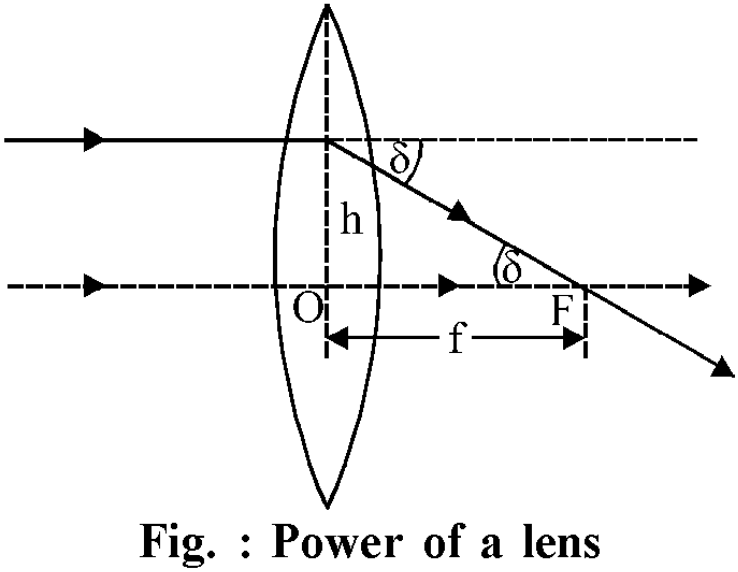
What is meant by power of lens? Explain this.
View full question & answer
Question 55 Marks
Define the following :
(a) Total internal reflection
(b) Diffraction of light
(c) Refraction of light.
Answer
(a) Total internal reflection : When the value of the angle of incidence in a dense medium is increased slightly beyond the critical angle, then the entire incident light gets reflected according to the laws of reflection and returns back to the dense medium as shown in the figure below. This phenomenon is called total internal reflection of light.

Image

Necessary conditions for total internal reflection :
(1) Light must pass from denser medium to rarer medium.
(2) In dense medium the value of angle of incidence should be larger than the critical angle.
(b) Diffraction of light : Diffraction of light is a characteristic property of diffraction wave. When there is any obstacle in the path of waves or the waves pass through a microscopic hole, they 'partially' bend at the edge of the obstacle or hole. This phenomenon is called diffraction.
The phenomenon of diffraction is seen in all types of waves, like light waves, sound waves etc. For diffraction of waves to occur, the size of the obstacle should be of the order of the wavelength of the waves.
(c) Refraction of light : These types of rays move in straight lines in a homogeneous and transparent medium, but when a ray of light passes from one such transparent medium to another transparent medium. So some part of the ray gets reflected on the boundary surface of the mediums and returns to the first medium and the remaining part goes to the second medium. When moving to another medium, the direction of the ray usually changes, i.e., the ray of light deviates from its initial direction.
"The deviation of a light ray from its path when it passes from one transparent medium to another is called refraction."

View full question & answer
Question 65 Marks
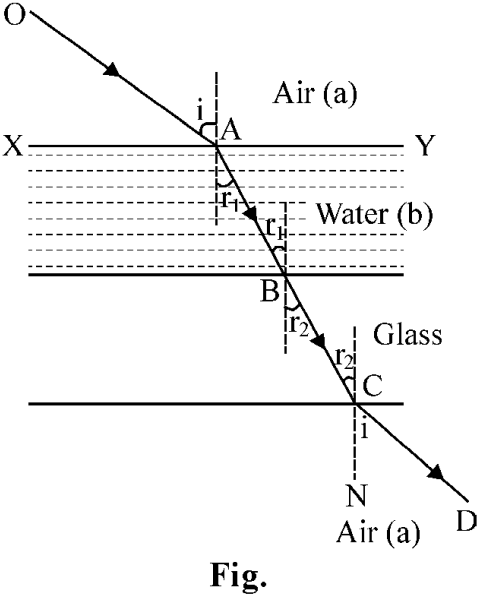
When a light ray passes from the atmosphere (a) through the combination of two mediums water (b) and glass (c), then find the relationship between the refractive indices of the three mediums.
View full question & answer
Question 75 Marks
Prove : $n_{12}=\frac{1}{n_{21}}$
View full question & answer
Question 85 Marks
(a) A point-image (object) is placed on the principal axis of a convex spherical surface of radius of curvature $R$, the refractive index of the medium on one side of this surface is $n _1$ and the refractive index of the medium on the other side is $n_2$, where $n_2>n_1$. For this, draw a ray diagram and derive the relation between object distance $(u)$, image distance $(v)$ and radius of curvature $( R )$ for refraction from rarer medium to denser medium on a convex spherical surface.
(b) Use the above relation in terms of $n_1$ and $n_2$, to obtain the condition for the position of the object and the radius of curvature when a real image is formed.
Answer
(a) For refraction on a convex spherical surface, distance of object $(u)$, distance of image $(v)$, refractive index of the medium $\left(n_1, n_2\right)$ and radius of curvature (R). Derive the relation $\frac{n_2}{v}-\frac{n_1}{u}=\frac{n_2-n_1}{ R }$.
(b) $\frac{n_2}{v}-\frac{n_1}{u}=\frac{n_2-n_1}{ R }$
For real image, $v$ is positive.
Therefore,$\frac{n_2}{v}=0$
$
\begin{array}{ll}
\text { So } \frac{n_1}{|u|}=\frac{n_2-n_1}{R} \\
\Rightarrow \frac{|u|}{n_1}>\frac{R}{n_2-n_1} \Rightarrow|u|>\frac{n_1 R}{n_2-n_1}
\end{array}
$
Which is a necessary condition.
View full question & answer
5 Marks Questions - Physics STD 12 Science Questions - Vidyadip