MCQ
When a parallel plates capacitor is connected to a source of constant potential difference,
  • A
    all the charge drawn from the source is stored in the capacitor.
  • B
    all the energy drawn from the source is stored in the capacitor.
  • C
    the potential difference across the capacitor grows very rapidly initially and this rate decreases to zero eventually.
  • $A$ and $C$ both

Answer

Correct option: D.
$A$ and $C$ both
d
$\mathrm{V}=\mathrm{E} \mathrm{d},$ so $\mathrm{E}=\mathrm{same} .$

same

Need a full question paper?

Generate a complete, print-ready paper with questions like this in minutes — across 16+ boards, with answer keys.

Start Generating Free

Similar questions

A point object is placed at a distance of 30 cm from a convex mirror of focal length 30cm. The image will form at
The frequency order for $\gamma -$ rays $(a)$, $X-$ rays $(b)$ and $UV-$ rays $(c)$ is given as
In a wave, the path difference corresponding to a phase difference of $ \phi$  is
Drift velocity $v_d$ varies with the intensity of electric field as per the relation
When light is refracted, which of the following does not change?
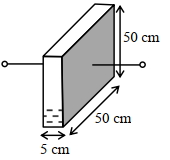
A container has a base of $50 \mathrm{~cm} \times 5 \mathrm{~cm}$ and height $50 \mathrm{~cm}$, as shown in the figure. It has two parallel electrically conducting walls each of area $50 \mathrm{~cm} \times 50 \mathrm{~cm}$. The remaining walls of the container are thin and non-conducting. The container is being filled with a liquid of dielectric constant $3$ at a uniform rate of $250 \mathrm{~cm}^3 \mathrm{~s}^{-1}$. What is the value of the capacitance of the container after $10$ seconds? [Given: Permittivity of free space $\in_0=9 \times 10^{-12} \mathrm{C}^2 \mathrm{~N}^{-1} \mathrm{~m}^{-2}$, the effects of the non-conducting walls on the capacitance are negligible]
In Bohr’s model, if the atomic radius of the first orbit is ${r_0}$, then the radius of the fourth orbit is
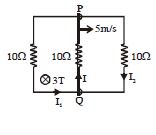
A rectangular loop has a sliding connector $PQ$ of length $2\ m$ and resistance $10\ \Omega  $  and it is moving with a speed $5\ m/s$ as shown. The set-up is placed in a uniform magnetic field $3\ T$ going into the plane of the paper. The three currents $I_1$ , $I_2$ and $I$ are 
The binding energy of the innermost electron in tungsten is $40 keV$. To produce characteristic $X-$ rays using a tungsten target in an $X-$ rays tube the potential difference $V$ between the cathode and the anti-cathode should be
Four modifications are suggested in the lens formula to include the effect of the thickness t of the lens. Which one is likely to be correct?