MCQ
When a particle executes $SHM$ the nature of graphical representation of velocity as a function of displacement is :
  • A
    circular
  • elliptical
  • C
    parabolic
  • D
    straight line

Answer

Correct option: B.
elliptical
b
For a particle executing SHM,

$x = A \sin (\omega t +\phi)$

$v =\omega A \cos (\omega t +\phi)$

$\Rightarrow \frac{ v ^{2}}{\omega^{2} A ^{2}}+\frac{ x ^{2}}{ A ^{2}}=1 \Rightarrow$ equation of ellipse between $v$ and $x.$

Need a full question paper?

Generate a complete, print-ready paper with questions like this in minutes — across 16+ boards, with answer keys.
Start Generating Free

Similar questions

Roads are banked on curves so that
A uniform disc of mass $m_0$ rotates freely about a fixed horizontal axis passing through its centre. A thin cotton pad is fixed to its rim, which can absorb water. The mass of water dripping onto the pad per unit time is $\mu.$ After what time will the angular velocity of the disc get reduced to half its initial value ?
Match List$-I$ with List$-II$.

List$-I$ List$-II$
$(a)$ ${R}_{{H}}$ (Rydberg constant) $(i)$ ${kg} {m}^{-1} {s}^{-1}$
$(b)$ $h$ (Planck's constant) $(ii)$ ${kg} {m}^{2} {s}^{-1}$
$(c)$ $\mu_{{B}}$ (Magnetic field energy density) $(iii)$ ${m}^{-1}$
$(d)$ $\eta$ (coefficient of viscocity) $(iv)$ ${kg} {m}^{-1} {s}^{-2}$

Choose the most appropriate answer from the options given below:

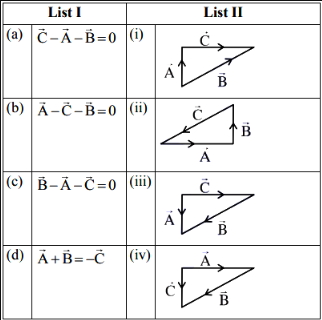
Match List$- I$ with List$- II.$

$[Image]$

Choose the correct answer from the options given below :
A star is modeled as a uniform spherical distribution of matter keeping mass of star constant. How gravitational pressure on surface depends on volume of the star?
A ball of mass $'m'$ moving with a speed $'u'$ under goes a head-on elastic collision with a ball of mass $(nm)$  initially at rest. The fraction of the incident energy transferred to the heaveir ball is
From the top of a tower, two stones whose masses are in the ratio $1 : 2$ are thrown, one straight up with an initial speed $u$ and the second straight down with same speed $u.$ neglecting air resistance,
The radii of two soap bubbles are $r_1$ and $r_2$. In isothermal conditions, two meet together in vaccum. Then the radius of the resultant bubble is given by
Two resistors ${R}_{1}=(4 \pm 0.8) \Omega$ and ${R}_{2}=(4 \pm 0.4)$ $\Omega$ are connected in parallel. The equivalent resistance of their parallel combination will be
The efficiency of a Carnot's engine working between steam point and ice point is: