Question
When a potential difference V is applied across a conductor at a temperature T, the drift velocity of electrons is proportional to:

Answer

  1. $\sqrt{\text{V}}$

Need a full question paper?

Generate a complete, print-ready paper with questions like this in minutes — across 16+ boards, with answer keys.
Start Generating Free

Similar questions

$4\ eV$ is the energy of the incident photon and the work function in $2\ eV.$ What is the stopping potential
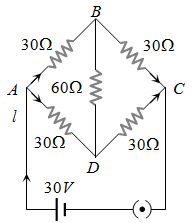
The current between $B$ and $D$ in the given figure is
For a substance the average life for a-emission is 1620 years and for b emission is 405 years. After how much time the 1/4 of the material remains after a and b emission(a) 1500 years(b) 300 years(c) 449 years(d) 810 years
       
Due to the earth's magnetic field, charged cosmic ray particles(a) Require greater kinetic energy to reach the equator than the poles(b) Require less kinetic energy to reach the equator than the poles(c) Can never reach the equator(d) Can never reach the poles


A photon of energy $8\ eV$ is incident on a metal surface of threshold frequency $1.6 \times 10^{15} \mathrm{~Hz}$, then the maximum kinetic energy of photoelectrons emitted is $\left(\mathrm{h}=6.6^{\times 10^{-34} \mathrm{Js}}\right)$
A diminished virtual image can be formed only in(a) Plane mirror(b) A concave mirror(c) A convex mirror(d) Concave-parabolic mirror
   
   
At a certain place, the horizontal component $B _0$ and the vertical component $V _0$ of the earth's magnetic field are equal in magnitude. The total intensity at the place will be
Faraday's laws are consequence of conservation of(a) Energy(b) Energy and magnetic field(c) Charge(d) Magnetic field
   
   
The coefficient of mutual inductance between two coils depends on.
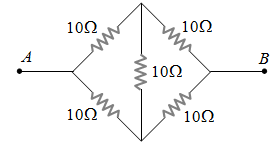
The effective resistance between points $A$ and $B$ is