MCQ
When a potential difference $V$ is applied across a conductor at a temperature $T$, the drift velocity of electrons is proportional to:
  • A
    $\text{V}$
  • $\sqrt{\text{V}}$
  • C
    $\text{T}$
  • D
    $\sqrt{\text{T}}$

Answer

Correct option: B.
$\sqrt{\text{V}}$

Need a full question paper?

Generate a complete, print-ready paper with questions like this in minutes — across 16+ boards, with answer keys.
Start Generating Free

Similar questions

Two thin lenses whose powers are +2D and –4D respectively combine, then the power of combination is
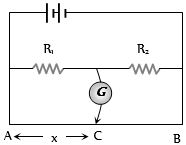
In the shown arrangement of the experiment of the meter bridge if $AC$ corresponding to null deflection of galvanometer is $x$, what would be its value if the radius of the wire $AB$ is doubled
Angular width of central maxima in the Fraunhoffer diffraction pattern of a slit is measured. The slit is illuminated by light of wavelength 6000 Å. When the slit is illuminated by light of another wavelength, the angular width decreases by 30%. The wavelength of this light will be
A scientist is observing a bacteria through a compound microscope. For better analysis and to improve its resolving power he should. (Select the best option)
Let r be the distance of a point on the axis of a magnetic dipole from its centre. The magnetic field at such a point is proportional to:
The coil of dynamo is rotating in a magnetic field. The developed induced $e.m.f.$ changes and the number of magnetic lines of force also changes. Which of the following condition is correct
Two identical pendulum $A$ and $B$ are suspended from the same point. The bobs are given positive charges, with $A$ having more charge than $B$ . They diverge and reach at equilibrium, with $A$ and $B$ making angles $\theta _1$ and $\theta _2$ with the vertical respectively, Then
Assertion : When the speed of an electron increases its specific charge decreases.
Reason : Specific charge is the ratio of the charge to mass.
If a charged particle goes unaccelerated in a region containing electric and magnetic fields
Consider an optical communication system operating at $800\, nm$. Suppose, only $1%$ of the optical source frequency is the available channel bandwidth for optical communication. How many channels can be accommodated for transmitting audio signals requiring a bandwidth of $8 \,kHz$