When a potential difference $V$ is applied across a wire of resistance $R$, it dissipates energy at a rate $W$. If the wire is cut into two halves and these halves are connected mutually parallel across the same supply, the same supply, the energy dissipation rate will become:
JEE MAIN 2024, Diffcult


Download our appand get started for free
Experience the future of education. Simply download our apps or reach out to us for more information. Let's shape the future of learning together!No signup needed.*
Similar Questions
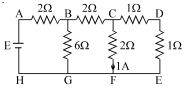
- 1View SolutionIn the circuit shown in figure, which of the statement is incorrect ?
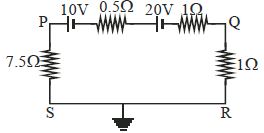
- 2Effective resistance across $A B$ in the network shown in .......... $\Omega$View Solution
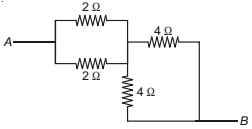
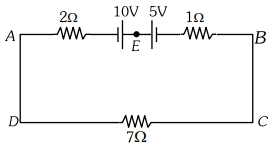
- 3View SolutionThe magnitude and direction of the current in the following circuit is :-
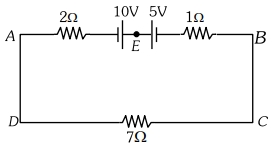
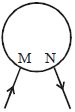
- 4A uniform wire of resistance $20\,ohm$ having resistance $1\Omega /m$ is bent in the adjoining form of a circle as shown in the figure. If the equivalent resistance between $M$ and $N$ is $1.8 \,\Omega $, then the length of the shorter section is ................ $m$View Solution
- 5The resistance of the filament of an electric bulb changes with temperature. If an electric bulb rated $220\, volt$ and $100\, watt$ is connected $(220 \times 0.8)$ $volt$ sources, then the actual power would beView Solution
- 6View SolutionThe maximum current that flows through a fuse wire before it blows out varies with its radius as
- 7The resistance of a coil is $4.2\, \Omega$ at $100\,^o C$ and the temperature coefficient of resistance of its material is $ 0.004\,^o C$. Its resistance at $0\,^o C$ is ............. $\Omega$View Solution
- 8View SolutionThe magnitude and direction of the current in the following circuit is :-
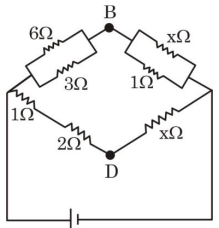
- 9If the potential difference between $B$ and $D$ is zero, the value of $x$ is $\frac{1}{n} \Omega$. The value of $n$ is .......View Solution
- 10The figure shows a network of resistors and $a$ battery. If $1\,A$ current flowsthrough the branch $CF$, then answer the following questions The $\mathrm{emf}$ $E$ of the battery is If a zero resistance wire is connected in parallel to branch $CF$ ............... $V$View Solution