The resistance of a coil is $4.2\, \Omega$ at $100\,^o C$ and the temperature coefficient of resistance of its material is $ 0.004\,^o C$. Its resistance at $0\,^o C$ is ............. $\Omega$
Easy


Download our appand get started for free
Experience the future of education. Simply download our apps or reach out to us for more information. Let's shape the future of learning together!No signup needed.*
Similar Questions
- 1The current in a conductor varies with time t as $I = 2t + 3{t^2}$ where $I$ is in ampere and $t$ in seconds. Electric charge flowing through a section of the conductor during $t = 2\,\sec$ to $t = 3\,\sec$ is ............. $C$View Solution
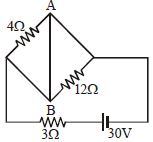
- 2View SolutionConsidering the following circuit, select the correct alternative
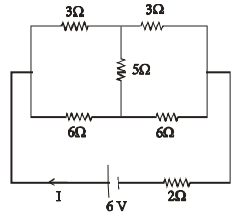
- 3A battery of $6\,V$ is connected to the circuit as shown below. The current I drawn from the battery is:View Solution
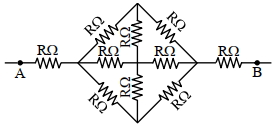
- 4The effective resistance between $A$ and $B$, if resistance of each resistor is $R$, will beView Solution
- 5Water boils in an electric kettle in $20$ minutes after being switched on. Using the same main supply, the length of the heating element should be. . . . . . .to . . . . . .. times of its initial length if the water is to be boiled in $15$ minutes.View Solution
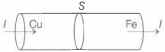
- 6Two rods of copper and iron with the same cross-sectional area are joined at $S$ and a steady current $I$ flows through the rods as shown in the figure. Choose the most appropriate representation of charges accumulated near the junction $S$.View Solution
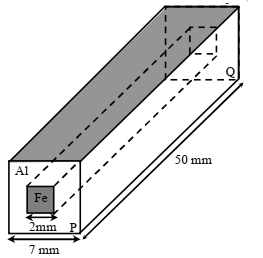
- 7In an aluminium $(A1)$ bar of square cross section, a square hole is drilled and is filled with iron ( $Fe$ ) as shown in the figure. The electrical resistivities of $A 1$ and $Fe$ are $2.7 \times 10^{-8} \ \Omega m$ and $1.0 \times 10^{-7} \ \Omega m$, respectively. The electrical resistance between the two faces $P$ and $Q$ of the composite bar isView Solution
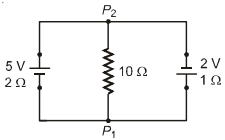
- 8A $5\ V$ battery with internal resistance $2\,\Omega$ and a $2\,V$ battery with internal resistance ln are connected to a $10\,\Omega$ resistor as shown in the figure.View Solution
- 9A potentiometer has uniform potential gradient. The specific resistance of the material of the potentiometer wire is $10^{-7} \, ohm-meter$ and the current passing through it is $0.1\, ampere$; cross-section of the wire is $10^{-6}\, m^2$. The potential gradient along the potentiometer wire isView Solution
- 10A potentiometer wire has length $4\,\, m$ and resistance $8\,\,\Omega $. The resistance that must be connected in series with the wire and an accumulator of e.m.f. $2\,\, V,$ so as to get a potential gradient $1\,\, m \,V$ per $cm$ on the wire is ............. $\Omega$View Solution