MCQ
When a pressure of $100$ atmosphere is applied on a spherical ball, then its volume reduces to $0.01\%$. The bulk modulus of the material of the rubber in $dyne/c{m^2}$ is
  • A
    $10 \times {10^{12}}$
  • B
    $100 \times {10^{12}}$
  • $1 \times {10^{12}}$
  • D
    $20 \times {10^{12}}$

Answer

Correct option: C.
$1 \times {10^{12}}$
c
(c) $K = \frac{{100}}{{0.01/100}} = {10^6}atm = {10^{11}}\;N/{m^2} = {10^{12}}\;dyne/c{m^2}$

Need a full question paper?

Generate a complete, print-ready paper with questions like this in minutes — across 16+ boards, with answer keys.

Start Generating Free

Similar questions

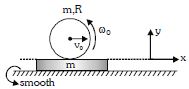
A disc having velocity $v_0$ and angular speed ${\omega _0}$ in anticlockwise direction kept on the rough plank. Initially plank is at rest. (assuming length of plank is very large) Choose $INCORRECT$ option
The pressure $P_{1}$ and density $d_{1}$ of diatomic gas $\left(\gamma=\frac{7}{5}\right)$ changes suddenly to $P _{2}\left(> P _{1}\right)$ and $d _{2}$ respectively during an adiabatic process. The temperature of the gas increases and becomes $......$ times of its initial temperature.$\left(\right.$ given $\left.\frac{ d _{2}}{ d _{1}}=32\right)$
In uniform circular motion
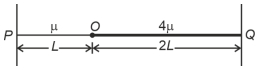
Two uniform strings of mass per unit length $\mu$ and $4 \mu$, and length $L$ and $2 L$, respectively, are joined at point $O$, and tied at two fixed ends $P$ and $Q$, as shown in the figure. The strings are under a uniform tension $T$. If we define the frequency $v_0=\frac{1}{2 L} \sqrt{\frac{T}{\mu}}$, which of the following statement($s$) is(are) correct?

$(A)$ With a node at $O$, the minimum frequency of vibration of the composite string is $v_0$

$(B)$ With an antinode at $O$, the minimum frequency of vibration of the composite string is $2 v_0$

$(C)$ When the composite string vibrates at the minimum frequency with a node at $O$, it has $6$ nodes, including the end nodes

$(D)$ No vibrational mode with an antinode at $O$ is possible for the composite string

When a train stops suddenly, passengers in the running train feel an instant jerk in the forward direction because
Given below are two statement 

Statement $-I$ : What $\mu$ amount of an ideal gas undergoes adiabatic change from state $\left( P _{1}, V _{1}, T _{1}\right)$ to state $\left( P _{2}, V _{2}, T _{2}\right)$, the work done is $W =\frac{1 R \left( T _{2}- T _{1}\right)}{1-\gamma}$, where $\gamma=\frac{ C _{ P }}{ C _{ V }}$ and $R =$ universal gas constant,

Statement $-II$ : In the above case. when work is done on the gas. the temperature of the gas would rise.

Choose the correct answer from the options given below

Calculate the frequency of the second harmonic formed on a string of length $0.5 m$ and mass $2 × 10^{-4}$ kg when stretched with a tension of $20 N$ .... $Hz$
The average momentum of a molecule in a sample of an ideal gas depends on:
The diatomic molecule is treated as:
The second's hand of a watch has length $6\,\, cm$. Speed of end point and magnitude of difference of velocities at two perpendicular positions will be