When a resistor of $11 \,\Omega$ is connected in series with an electric cell, the current flowing in it is $0.5\, A$. Instead, when a resistor of $5 \,\Omega$ is connected to the same electric cell in series, the current increases by $0.4\, A$. The internal resistance of the cell is ................ $\Omega$
Medium


Download our appand get started for free
Experience the future of education. Simply download our apps or reach out to us for more information. Let's shape the future of learning together!No signup needed.*
Similar Questions
- 1A cell of negligible resistance and $e.m.f.$ $2$ $volts$ is connected to series combination of $2$, $3$ and $5\, ohm$. The potential difference in volts between the terminals of $3\, ohm$ resistance will beView Solution
- 2Different combination of $3$ resistors of equal resistance $R$ are shown in the figures.View Solution
The increasing order for power dissipation is: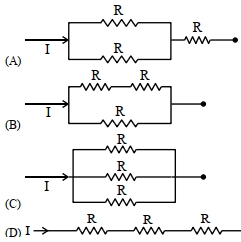
- 3In a potentiometer circuit there is a cell of $e.m.f.$ $2\, volt$, a resistance of $5\, ohm$ and a wire of uniform thickness of length $1000\, cm$ and resistance $15\, ohm$. The potential gradient in the wire isView Solution
- 4A uniform wire of resistance $9\, ohm$ is bent in the form of a circle. The effective resistance across the points $A$ and $B$ is ............... $\Omega$View Solution

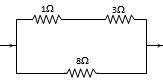
- 5Power dissipated across the $8 \,\,\Omega$ resistor in the circuit shown here is $2\,\, watt.$ The power dissipated in watt units across the $3 \,\,\Omega$ resistor isView Solution
- 6A uniform wire of length $l$ and radius $r$ has a resistance of $100\, \Omega $. It is recast into a wire of radius $\frac{r}{2}$. The resistance of new wire will be ............... $\Omega$View Solution
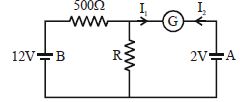
- 7In the adjoining circuit, the galvanometer $G$ shows zero deflection. If the batteries $A$ and $B$ have negligible internal resistance, the value of the resistor $R$ will be .............. $\Omega$View Solution
- 8What is the equivalent resistance of the circuit ............. $\Omega$View Solution
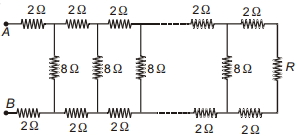
- 9Consider the ladder network shown in figure. What should be the value of resistance $R$, so that effective resistance between $A$ and $B$ becomes independent of number of elements in the combination is ............. $\Omega$View Solution
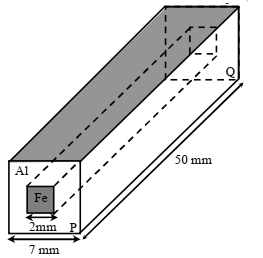
- 10In an aluminium $(A1)$ bar of square cross section, a square hole is drilled and is filled with iron ( $Fe$ ) as shown in the figure. The electrical resistivities of $A 1$ and $Fe$ are $2.7 \times 10^{-8} \ \Omega m$ and $1.0 \times 10^{-7} \ \Omega m$, respectively. The electrical resistance between the two faces $P$ and $Q$ of the composite bar isView Solution