Question
When a spherical mirror is held towards the sun and its sharp image is formed on a piece of a carbon paper for some time, a hole is burnt in the carbon paper.
  1. What is the nature of spherical mirror?
  2. Why is a hole burnt in the carbon paper?
  3. At which point of the spherical mirror the carbon paper is placed?
  4. What name is given to the distance between spherical mirror and carbon paper?
  5. What is the advantage of using a carbon paper rather than a white paper?
Answer

  1. The spherical mirror is concave.
  2. A concave mirror converges light rays, and in this case it will converge the incoming parallel rays of the sun at its focus. Since the carbon paper was kept at the focus of the concave mirror, the hole was burnt into it.
  3. The carbon paper was kept at the focus of the spherical mirror.
  4. The distance between the mirror and the carbon paper is the focal length.
  5. A carbon paper is a good absorber of sunlight; hence, it burnt quickly.​

Need a full question paper?

Generate a complete, print-ready paper with questions like this in minutes — across 16+ boards, with answer keys.

Start Generating Free

Similar questions

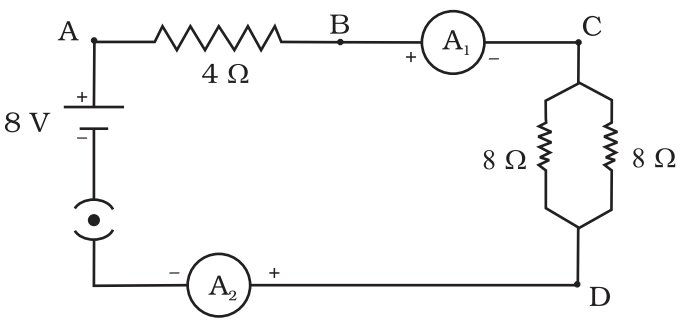
Find out the following in the electric circuit given in Figure.
  1. Effective resistance of two 8Ω resistors in the combination.
  2. Current flowing through 4Ω resistor.
  3. Potential difference across 4Ω resistance.
  4. Power dissipated in 4Ω resistor.
  5. Difference in ammeter readings, if any.
During the reaction of some metals with dilute hydrochloric acid, following observations were made.
  1. Silver metal does not show any change.
  2. The temperature of the reaction mixture rises when aluminium (Al) is added.
  3. The reaction of sodium metal is found to be highly explosive.
  4. Some bubbles of a gas are seen when lead (Pb) is reacted with the acid.
Explain these observations giving suitable reasons.
What is meant by:
  1. Displacement reaction, and
  2. Double displacement reaction? Explain with the help of one example each.
An industry is being established near a town. How can the wastes generated from this industry affect the local environment?
Draw a labelled diagram of the longitudinal section of a flower.
Describe the parts of our tooth with the help of a labelled diagram.
An element E exists in three allotropic forms A, B and C. In allotrope A, the atoms of element E are joined to form spherical molecules. In allotrope B, each atom of element E is surrounded by three other E atoms to form a sheet like structure. In allotrope C, each atom of element E is surrounded by four other E atoms to form a rigid structure.
  1. Name the element E.
  2. What is allotrope A.
  3. What is allotrope B?
  4. What is allotrope C?
  5. Which allotrope is used in making jewellery?
  6. Which allotrope is used in making anode of a dry cell?
Explain why carbon forms compounds mainly by covalent bond. Explain in brief two main reasons for carbon forming a large number of compounds. Why does carbon form strong bonds with most other elements?
What is a solenoid? Draw the pattern of magnetic field lines of:
  1. A current carrying solenoid.
  2. A bar magnet. List two distinguishing features between the two fields.
  1. With the help of a suitable circuit diagram prove that the reciprocal of the equivalent resistance of a group of resistances joined in parallel is equal to the sum of the reciprocals of the individual resistances.
  2. In an electric circuit, two resistors of $12\Omega$ each are joined in parallel to a 6V battery. Find the current drawn from the battery.