MCQ
When an air bubble of radius $‘r’$ rises from the bottom to the surface of a lake, its radius becomes $5r/4$ (the pressure of the atmosphere is equal to the $10 \,m$ height of water column). If the temperature is constant and the surface tension is neglected, the depth of the lake is .... $m$
  • A
    $3.53$
  • B
    $6.53$
  • $9.53$
  • D
    $12.53$

Answer

Correct option: C.
$9.53$
c
In this case, $(4 / 3) \pi r^{3}\left(p_{0}+p_{1}\right)=(4 / 3) \pi r^{3}\left(5^{3} / 4^{3}\right) P _{0}$

where, $P_{0}=$ atm pressure, $P_{1}=$ water pressure

Rearranging, we get, $P_{1}=\left[\left(5^{3} / 4^{3}\right)-1\right] P_{0}$

Or, $\rho gH =(\frac{61}{64}) P _{0}$

Or, $H =\frac{(\frac{61}{64}) P _{0}}{\rho g}$

$P_{0}=10 g$ and $\rho$ of water $=1$

Putting these values we get, $H =9.53 \; m$

Need a full question paper?

Generate a complete, print-ready paper with questions like this in minutes — across 16+ boards, with answer keys.

Start Generating Free

Similar questions

A ball is suspended on a thread from the ceiling of a car. The brakes are applied and the speed of car changes from $5\, m/sec$ to $5/3\, m/sec$ during the time interval of $3\, seconds$. The angle that the thread will deviate from vertical
Young's modulus of elasticity $Y$ is expressed in terms of three derived quantities, namely, the gravitational constant $G$, Planck's constant $h$ and the speed of light $c$, as $Y=c^\alpha h^\beta G^\gamma$. Which of the following is the correct option?
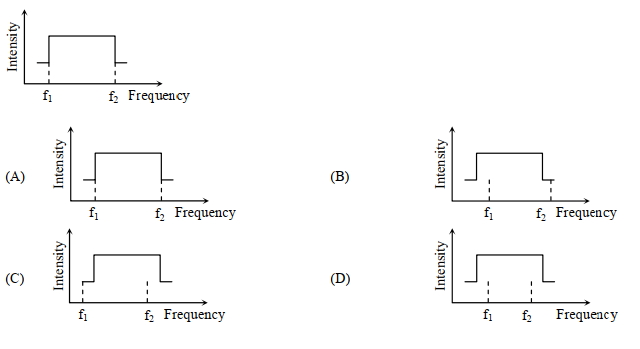
Two trains $A$ and $B$ are moving with speeds $20 \mathrm{~m} / \mathrm{s}$ and $30 \mathrm{~m} / \mathrm{s}$ respectively in the same direction on the same straight track, with $B$ ahead of $A$. The engines are at the front ends. The engine of train  $A$ blows a long whistle.

Assume that the sound of the whistle is composed of components varying in frequency from $f_1=800 \mathrm{~Hz}$ to $f_2=1120 \mathrm{~Hz}$, as shown in the figure. The spread in the frequency (highest frequency - lowest frequency) is thus $320 \mathrm{~Hz}$. The speed of sound in still air is $340 \mathrm{~m} / \mathrm{s}$.

$1.$  The speed of sound of the whistle is

$(A)$ $340 \mathrm{~m} / \mathrm{s}$ for passengers in $A$ and $310 \mathrm{~m} / \mathrm{s}$ for passengers in $B$

$(B)$ $360 \mathrm{~m} / \mathrm{s}$ for passengers in $A$ and $310 \mathrm{~m} / \mathrm{s}$ for passengers in $B$

$(C)$ $310 \mathrm{~m} / \mathrm{s}$ for passengers in $A$ and $360 \mathrm{~m} / \mathrm{s}$ for passengers in $B$

$(D)$ $340 \mathrm{~m} / \mathrm{s}$ for passengers in both the trains

$2.$  The distribution of the sound intensity of the whistle as observed by the passengers in train $\mathrm{A}$ is best represented by

$Image$

$3.$  The spread of frequency as observed by the passengers in train $B$ is

$(A)$ $310 \mathrm{~Hz}$ $(B)$ $330 \mathrm{~Hz}$ $(C)$ $350 \mathrm{~Hz}$ $(D)$ $290 \mathrm{~Hz}$

Give the answer question $1,2$ and $3.$
A particle moves along a straight line such that its displacement at any time $t$ is given by $s = (t^3 -3t^2 + 2)\,m$ The displacement when the acceleration becomes zero is........$m$
The total energy of particle performing $S.H.M.$ depend on
A particle starting from the origin $(0, 0)$ moves in a straight line in the $(x, y)$ plane. Its coordinates at a later time are $(\sqrt 3 , 3) .$ The path of the particle makes with the $x-$axis an angle of ......... $^o$
A mass $M$, attached to a horizontal spring, executes S.H.M. with amplitude $A_1$. When the mass $M$ passes through its mean position then a smaller mass $m$ is placed over it and both of them move together with amplitude $A_2$. The ratio of $\frac{{{A_1}}}{{{A_2}}}$ is
An object moves at a constant speed along a circular path in horizontal $XY$ plane with centre at origin. When the object is at  $x = -2\,m$ , its velocity is $-(4\,m/ s)\hat j$ . What is object's acceleration when it is at $y = 2\,m$ ?
Consider a compound slab consisting of two different materials having equal thickness and thermal conductivities $  K$ and $2K$ respectively. The equivalent thermal conductivity of the slab is
A shell is fired from a cannon with a velocity V at an angle $\theta$ with the horizontal direction. At the highest point in its path, it explodes into two pieces of equal masses. One of the pieces retraces its path to the cannon. The speed of the other piece immediately after the explosion is: